
🇪🇸 Versión en español abajo⬇️
A prior warning: this is a profoundly subjective text. And also a profoundly incomplete one. To speak of “Mexico” is always to run the risk of simplifying a country that, in truth, contains many Mexicos: the Indigenous and the mestizo; the rural and the urban; the north, the south and the south-east; the great cities and the small communities. There is no single way of being Mexican, but rather many forms of Mexicanness that coexist, contradict one another and enrich one another. This text does not claim to speak for all of them. It speaks of a broad, symbolic and deeply personal Mexicanness; of that feeling which, regardless of which corner of the country it comes from, many of us recognise when we say: “that feels very Mexican”.
And yes, I know: Mexico does not stop being Mexico because there is a football World Cup. The violence is still there, as are inequality, impunity, corruption and an open wound that cannot be named without thinking of the searching mothers, of the families digging into the earth in search of those whom the country has failed to find. This text does not seek to render that reality invisible, nor to disguise pain with festivity, colour or folklore. It seeks to do something else: to try to explain something which, I suspect, is impossible to explain fully: Mexicanness.
Or, rather, what is it that makes Mexico produce in so many people such an intense feeling of belonging, strangeness and fascination?
Because, if one looks at the World Cup only in terms of results, stadiums or organisation, one perhaps misses what matters most. What has led so many foreign journalists to repeat the same idea: that Mexico is not merely a host nation. It is the soul of the World Cup. Mexico may lack many things. What it rarely lacks is soul.
And the soul is never the infrastructure. It is the ability to transform an event into an experience. While other countries organise tournaments, Mexico organises stories, creates narratives and offers lived experiences.
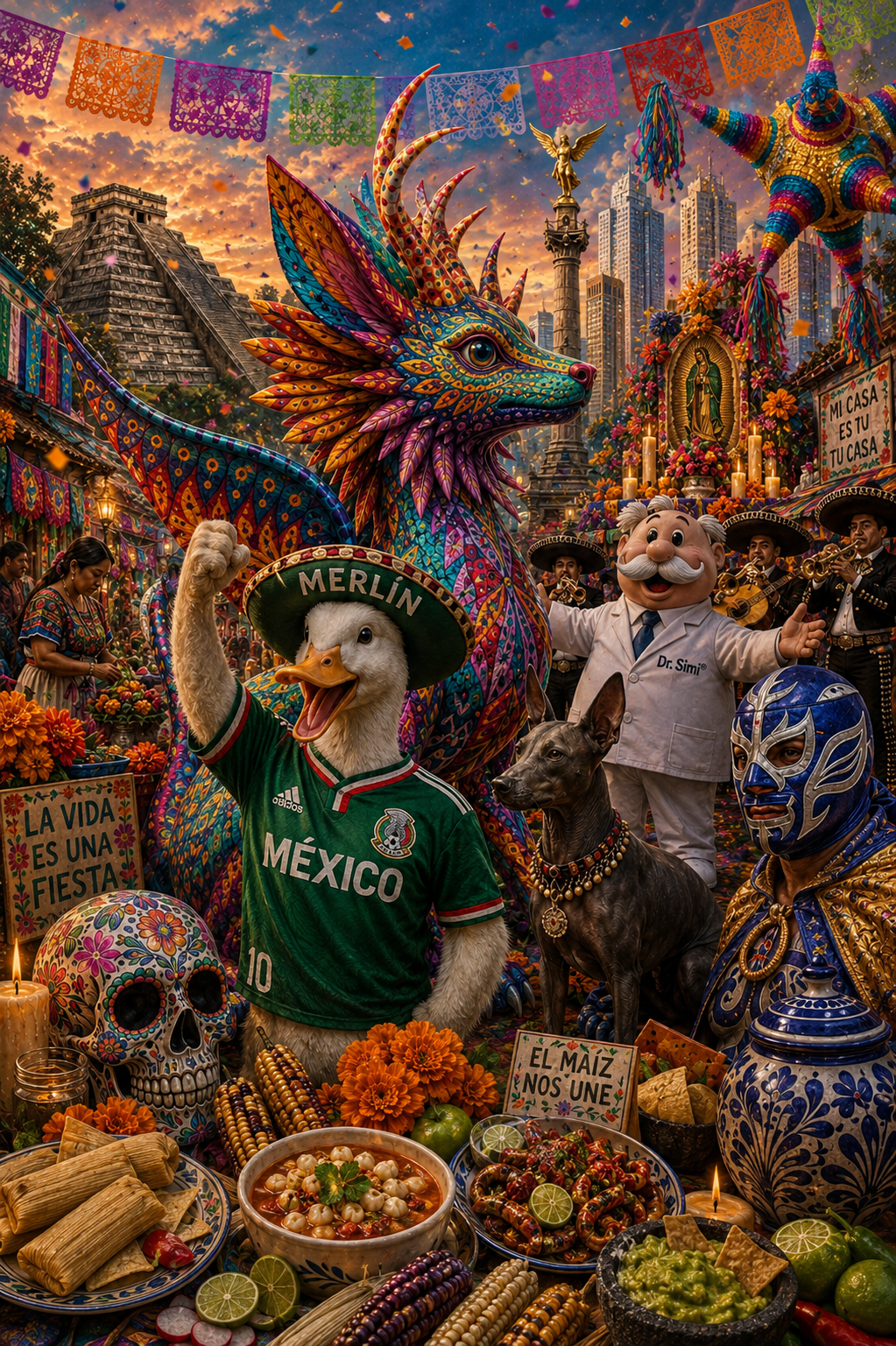
Suddenly, a duck called Merlin stops being a duck and becomes an international celebrity. A pharmacy mascot, Dr Simi, ends up being one of the most photographed mascots of the tournament, without anyone having appointed him as such, far surpassing the official mascot. Because Mexico has a curious habit: even when symbols are proposed to it, it ends up inventing its own. Another thing this sporting and cultural event reminds us of is something we already knew: Mexico does not obey; it reinvents the rules. Thousands of people embrace Colombian, Japanese, Iranian or South Korean fans as though they were long-lost relatives. A mariachi appears where no one expected one. A metro carriage becomes a choir. A public square ends up looking like a scene written by a novelist. And the most disconcerting thing is that no one seems to find any of this particularly strange.
And, come to think of it, why should it surprise us that a duck might become a national hero? We come from a culture in which animals were never simply animals. In the Mesoamerican worldview there were nahuales: human beings capable of transforming into their spiritual animal or of sharing the same fate with it. The coyote, the jaguar, the eagle and the hummingbird were bearers of power, identity and knowledge. Popular tradition inherited another layer of that imaginary world: witches who fly transformed into owls, dogs that announce death, owls as omens, alebrijes that mix impossible species, xoloitzcuintles that accompany souls into the afterlife. Perhaps that is why, when a duck called Merlin appears dressed in Mexico’s shirt, we do not feel that reality has ceased to be logical. We simply feel that Mexican reality is still doing what it has always done: turning an animal into a character.
I suspect that Mexico itself is an alebrije.
A country made of improbable mixtures: Indigenous and European, solemn and mocking, tragic and festive, profoundly spiritual and fiercely irreverent. A country where pyramids and skyscrapers coexist, mariachis and electronic music, religious processions and internet memes, altars for the dead and stadiums full of life. From the outside, all those pieces seem incompatible. There is always a head too many, wings appear where they should not, or a tail defies any taxonomy. From within, however, they form a single creature.
Mexico is not a mosaic, it is an alebrije!
The difference is enormous. A mosaic is made up of pieces that fit together in an orderly way. An alebrije is made up of pieces that should not fit together, but somehow produce an unexpected beauty.
And an alebrije, of course, is never beige. Nor is Mexico. Mexico is not a minimalist country. It is not a clean line on a neutral background. It is excess, accumulation, ornament, texture, noise, sliced fruit, papel picado, pink façades, green markets, oilcloth tablecloths, cempasúchil flowers, talavera, lucha libre, piñatas, Virgins illuminated with neon lights, street stalls, saints, skulls, hand-painted signs and songs coming from several speakers at once. In Mexico, and in much of Latin America, colour is not decoration: it is a form of affirmation. In the face of poverty, violence, loss or chaos, colour insists. Latin American maximalism is not merely an aesthetic; it is vital resistance. Where others seek purity, Mexico seeks presence. Where others empty space in order to find calm, Mexico fills it to remember that it is still alive.
And then there is the food. How can one explain that a single ingredient —maize— can become a tortilla, a tlayuda, a sope, a huarache, a memela, a gordita, a tamal, pozole, atole or a tostada? How can one explain that there are dozens of different moles, that a chilli can be sweet, smoky, fruity or incendiary, or that a fruit can end up covered in chilli, lime and salt? The answer lies in the same logic as an alebrije: taking familiar elements and combining them until they create something that seems impossible. Maize with cacao. Chocolate with chilli. Mango with lime and salt. Squash blossom. Huitlacoche. Grasshoppers. Mole with more than thirty ingredients. A tortilla that changes its name and personality every time it is folded, fried, filled or cooked again. There is no economy in this cuisine; there is imagination. Every table seems to say the same thing as the rest of the country: more colours, more textures, more time, more memory. Mexican cuisine does not accumulate recipes: it accumulates centuries. Each dish carries within it a geography, a season, a patron saint’s festival, a grandmother and a story. The visitor arrives believing they know Mexican food because they once ate a taco; they leave understanding that they had barely seen the cover of the book. If Mexicanness could be eaten, it would taste of maize. But never of the same maize twice.
Almost a century ago, the surrealist André Breton was fascinated by this country because here reality seemed to surpass any attempt at imagination. Since then, a phrase attributed to him has often been repeated: Mexico was supposedly “the most surrealist country in the world”. Beyond the historical precision of the quotation, the intuition remains suggestive. In Mexico, the improbable does not need to justify itself; it simply happens.
But I believe the term “surrealism” falls short. What happens here is closer to magical realism.
Not because miracles happen —although they do too—, but because the boundary between the everyday and the extraordinary is extraordinarily porous. A duck can become a national symbol. A stranger can become a brother after sharing a beer. An advertising object can end up becoming the sentimental heritage of millions of people. No one needs to explain too much why.
That is precisely what writers such as Juan Rulfo, Elena Garro and Gabriel García Márquez understood. For decades, the rest of the world thought they were exaggerating Latin American reality. Perhaps exactly the opposite happened: they simply learnt how to look.
Because in Mexico, reality has always had a vocation for storytelling.
The nation’s history is built upon symbols that coexist without asking permission: ancient civilisations alongside skyscrapers; altars for the dead that celebrate life; an almost ritual solemnity that can turn, five minutes later, into collective laughter. Here, humour does not contradict tragedy; very often, it is the way of surviving it.
Perhaps that is why the visitor stops feeling like a tourist and begins to feel like a guest. Mexican hospitality rarely consists merely of treating someone well. It consists of incorporating the other. The foreigner ceases to be foreign. They become a compadre, a friend, a brother. Perhaps it is difficult to understand until you feel it.
And that, I believe, explains why the World Cup in Mexico produces memories rather than postcards. People do not return speaking only of the matches. Nor of the goals. They return speaking of the man who gave them tacos, of a group of Mexicans tossing others into the air with a blanket, of a Dr Simi dancing among fans, of the food, of a duck called Merlin, or even of a celebration so overflowing that someone decided to build a snake out of beer cups and launch people over it as though a new national sport had just been invented…
From the outside, it all seems absurd.
From within, it simply seems like Tuesday.
Perhaps that is, in the end, Mexicanness: a way of inhabiting the world in which the symbol matters as much as the fact, in which affection modifies reality, in which imagination does not escape everyday life, but accompanies it. A country that turns visitors into family, ordinary objects into myths and sporting tournaments into shared narratives. And perhaps that is why Mexico is so difficult to explain. Because there are countries that can be understood through statistics.
Mexico, by contrast, must first be felt. Only afterwards does it perhaps begin to be understood.
MEXICANIDAD
Advertencia previa: este es un texto profundamente subjetivo. Y también profundamente incompleto. Hablar de «México» siempre implica correr el riesgo de simplificar un país que, en realidad, contiene muchos Méxicos: el indígena y el mestizo; el rural y el urbano; el del norte, el del sur y el del sureste; el de las grandes ciudades y el de las pequeñas comunidades. No existe una única forma de ser mexicano, sino muchas mexicanidades que conviven, se contradicen y se enriquecen entre sí. Este texto no pretende hablar por todas ellas. Habla de una mexicanidad amplia, simbólica y profundamente personal; de esa sensación que, sin importar desde qué rincón del país provenga, muchos reconocemos cuando decimos: «eso se siente muy mexicano».
Y sí, lo sé: México no deja de ser México porque haya un Mundial de futbol. Ahí siguen la violencia, la desigualdad, la impunidad, la corrupción y una herida abierta que no puede nombrarse sin pensar en las madres buscadoras, en las familias que excavan la tierra buscando a quienes el país no ha sabido encontrar. Este texto no pretende invisibilizar esa realidad ni maquillar el dolor con fiesta, color o folclor. Pretende hacer otra cosa: intentar explicar algo que, sospecho, es imposible explicar del todo: la mexicanidad.
O, mejor dicho, ¿qué hace que México produzca en muchos una sensación tan intensa de pertenencia, extrañeza y fascinación?
Porque, si uno observa el Mundial únicamente desde los resultados, los estadios o la organización, se pierde quizá lo más importante. Lo que ha hecho que tantos periodistas extranjeros repitan una misma idea: que México no es solamente una sede. Es el alma del Mundial. A México podrán faltarle muchas cosas. Lo que rara vez le falta es alma.
Y el alma nunca es la infraestructura. Es la capacidad de transformar un acontecimiento en una experiencia. Mientras otros países organizan torneos, México organiza historias, crea relatos y regala vivencias.
De pronto, un pato llamado Merlín deja de ser un pato y se convierte en una celebridad internacional. Una botarga de farmacia, el Dr. Simi, termina siendo una de las mascotas más fotografiadas del torneo, sin que nadie lo haya designado para ello, superando con creces a la mascota oficial. Porque México tiene una costumbre curiosa: incluso cuando le proponen símbolos, termina inventando los suyos. Otra cosa que nos recuerda este evento deportivo y cultural es algo que ya sabíamos: México no obedece; reinventa las reglas. Miles de personas abrazan a aficionados colombianos, japoneses, iraníes o surcoreanos como si fueran familiares perdidos. Un mariachi aparece donde nadie lo esperaba. Un vagón del metro se convierte en coro. Una plaza pública termina pareciendo una escena escrita por un novelista. Y lo más desconcertante es que nadie parece encontrar nada de esto particularmente extraño.
Y, pensándolo bien, ¿por qué habría de sorprendernos que un pato se convierta en héroe nacional? Venimos de una cultura donde los animales nunca fueron simples animales. En la cosmovisión mesoamericana existían los nahuales: seres humanos capaces de transformarse en su animal espiritual o de compartir con él un mismo destino. El coyote, el jaguar, el águila o el colibrí eran portadores de poder, identidad y conocimiento. La tradición popular heredó otra capa de ese imaginario: las brujas que vuelan convertidas en lechuzas, los perros que anuncian la muerte, los búhos como presagios, los alebrijes que mezclan especies imposibles, los xoloitzcuintles que acompañan a las almas hacia el más allá. Quizá por eso, cuando un pato llamado Merlín aparece vestido con la camiseta de México, no sentimos que la realidad haya dejado de ser lógica. Sentimos, simplemente, que la realidad mexicana sigue haciendo lo que siempre ha hecho: convertir un animal en personaje.
Sospecho que México mismo es un alebrije.
Un país hecho de mezclas improbables: indígena y europeo, solemne y burlón, trágico y festivo, profundamente espiritual y ferozmente irreverente. Un país donde conviven pirámides y rascacielos, mariachis y música electrónica, procesiones religiosas y memes de internet, altares para los muertos y estadios llenos de vida. Desde fuera, todas esas piezas parecen incompatibles. Siempre sobra una cabeza, aparecen alas donde no deberían existir o una cola que desafía cualquier taxonomía. Desde dentro, en cambio, forman una sola criatura.
México no es un mosaico, ¡es un alebrije!
La diferencia es enorme. Un mosaico está compuesto por piezas que encajan de forma ordenada. Un alebrije está compuesto por piezas que no deberían encajar, pero de alguna manera producen una belleza inesperada.
Y un alebrije, por supuesto, nunca es beige. México tampoco. México no es un país minimalista. No es una línea limpia sobre fondo neutro. Es exceso, acumulación, ornamento, textura, ruido, fruta partida, papel picado, fachadas rosas, mercados verdes, manteles de hule, flores de cempasúchil, talavera, lucha libre, piñatas, vírgenes iluminadas con luces de neón, puestos callejeros, santos, calaveras, letreros pintados a mano y canciones que salen de varias bocinas al mismo tiempo. En México y en buena parte de América Latina, el color no es decoración: es una forma de afirmación. Frente a la pobreza, la violencia, la pérdida o el caos, el color insiste. El maximalismo latinoamericano no es solamente estética; es resistencia vital. Donde otros buscan pureza, México busca presencia. Donde otros vacían el espacio para encontrar calma, México lo llena para recordar que sigue vivo.
Y luego está la comida. ¿Cómo explicar que un mismo ingrediente —el maíz— pueda convertirse en tortilla, tlayuda, sope, huarache, memela, gordita, tamal, pozole, atole o tostada? ¿Cómo explicar que existan decenas de moles distintos, que un chile pueda ser dulce, ahumado, frutal o incendiario, o que una fruta termine cubierta de chile, limón y sal? La respuesta está en la misma lógica de un alebrije: tomar elementos conocidos y combinarlos hasta crear algo que parece imposible. Maíz con cacao. Chocolate con chile. Mango con limón y sal. Flor de calabaza. Huitlacoche. Chapulines. Mole con más de treinta ingredientes. Una tortilla que cambia de nombre y de personalidad cada vez que se pliega, se fríe, se rellena o se vuelve a cocer. No hay economía en esta cocina; hay imaginación. Cada mesa parece decir lo mismo que el resto del país: más colores, más texturas, más tiempo, más memoria. La cocina mexicana no acumula recetas: acumula siglos. Cada platillo lleva dentro una geografía, una temporada, una fiesta patronal, una abuela y una historia. El visitante llega creyendo que conoce la comida mexicana porque alguna vez comió un taco; se marcha entendiendo que apenas había visto la portada del libro. Si la mexicanidad pudiera comerse, sabría a maíz. Pero no al mismo maíz dos veces.
Hace casi un siglo, el surrealista André Breton quedó fascinado por este país porque aquí la realidad parecía superar cualquier intento de imaginación. Desde entonces se repite una frase atribuida a él: México sería «el país más surrealista del mundo». Más allá de la precisión histórica de la cita, la intuición sigue siendo sugerente. En México lo improbable no necesita justificarse; simplemente ocurre.
Pero creo que el término «surrealismo» se queda corto. Lo que ocurre aquí se parece más al realismo mágico.
No porque sucedan milagros —que también—, sino porque la frontera entre lo cotidiano y lo extraordinario es extraordinariamente porosa. Un pato puede convertirse en símbolo nacional. Un desconocido puede transformarse en hermano después de compartir una cerveza. Un objeto de publicidad puede terminar siendo patrimonio sentimental de millones de personas. Nadie necesita explicar demasiado por qué.
Eso es precisamente lo que comprendieron escritores como Juan Rulfo, Elena Garro o Gabriel García Márquez. Durante décadas el resto del mundo creyó que ellos exageraban la realidad latinoamericana. Quizá ocurrió exactamente lo contrario: simplemente aprendieron a mirar.
Porque en México la realidad siempre ha tenido vocación de relato.
La historia nacional está construida sobre símbolos que conviven sin pedir permiso: civilizaciones milenarias junto a rascacielos; altares para los muertos que celebran la vida; una solemnidad casi ritual que puede convertirse, cinco minutos después, en una carcajada colectiva. Aquí el humor no contradice la tragedia; muchas veces es la forma de sobrevivirla.
Tal vez por eso el visitante deja de sentirse turista y empieza a sentirse invitado. La hospitalidad mexicana rara vez consiste únicamente en atender bien. Consiste en incorporar al otro. El extranjero deja de ser extranjero. Se vuelve compadre, amigo, hermano. Quizás sea difícil comprenderlo, hasta que lo sientes.
Y eso, creo, explica por qué el Mundial en México produce recuerdos más que postales. La gente no vuelve hablando únicamente de los partidos. Ni de los goles. Vuelve hablando del señor que le regaló tacos, de un grupo de mexicanos lanzando a otros por el aire con una cobija, de un Dr. Simi bailando entre aficionados, de la comida, de un pato llamado Merlín, o incluso de una celebración tan desbordada que alguien decidió construir una víbora con vasos de cerveza y lanzar personas sobre ella como si acabara de inventarse un nuevo deporte nacional…
Desde fuera todo parece absurdo.
Desde dentro simplemente parece martes.
Quizá eso sea, al final, la mexicanidad: una manera de habitar el mundo donde el símbolo importa tanto como el hecho, donde el afecto modifica la realidad, donde la imaginación no escapa de la vida cotidiana, sino que la acompaña. Un país que convierte visitantes en familia, objetos comunes en mitos y torneos deportivos en relatos compartidos. Y tal vez por eso resulta tan difícil explicar México. Porque hay países que pueden entenderse con estadísticas.
México, en cambio, primero hay que sentirlo. Solo después empieza, quizá, a entenderse.


Deja una respuesta