
🇬🇧 English version below ⬇️
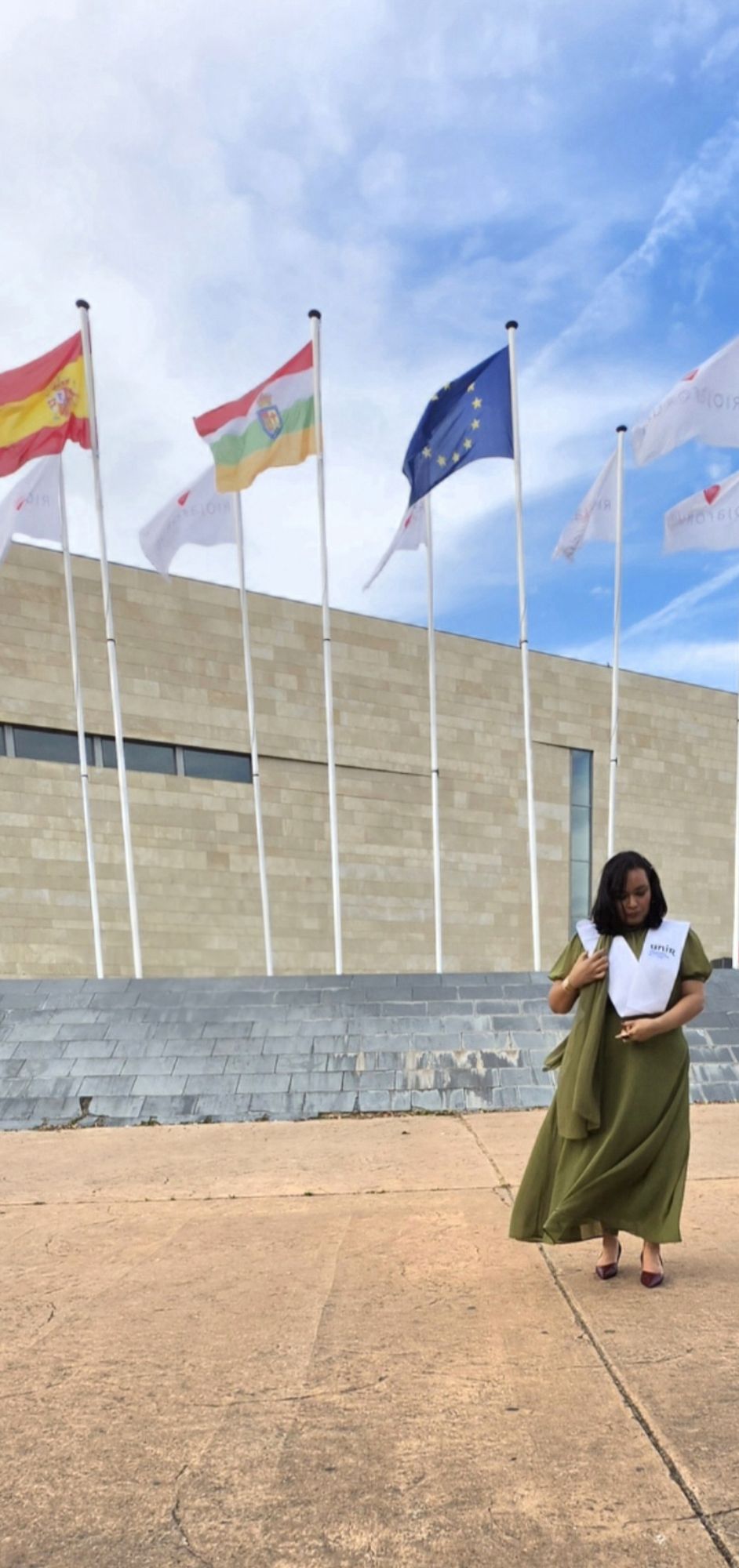
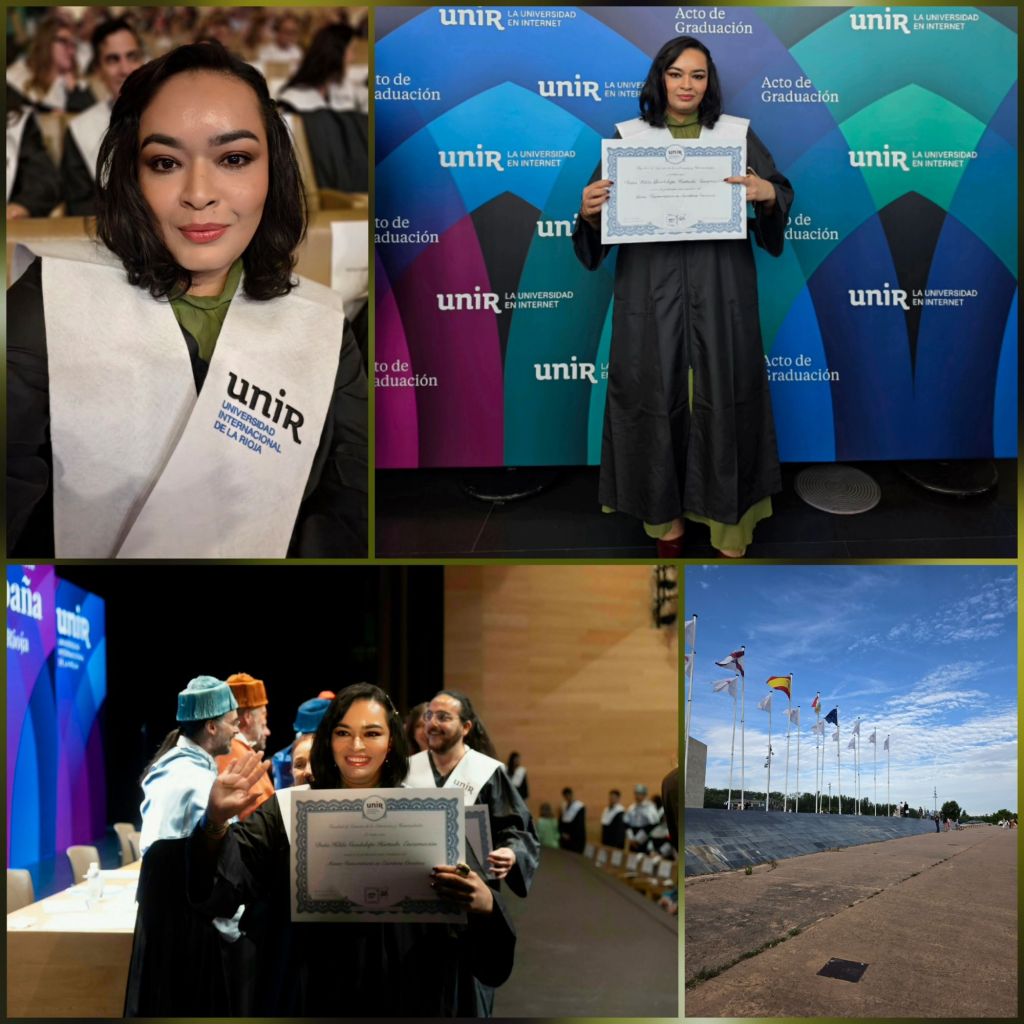
Hace unos días viajé a La Rioja, a Logroño para ser precisa, para asistir a la ceremonia de graduación de mi Máster en Escritura Creativa. La asistencia no era obligatoria. Podría haber recibido el título sin hacer el viaje ni participar en el acto. Desde un punto de vista académico, el resultado habría sido exactamente el mismo.
Sin embargo, para mí era importante estar allí.
Con el paso de los días he comprendido que no viajé únicamente para recibir un diploma. Viajé porque necesitaba cerrar una historia que había permanecido abierta durante veintiún años.
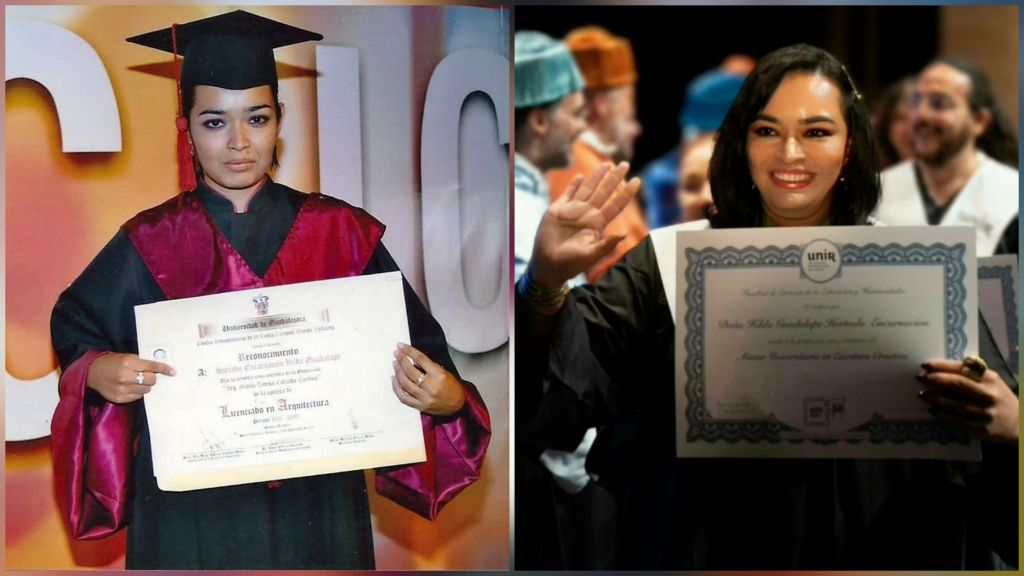
Mi primera graduación fue cuando terminé Arquitectura. Tenía veintiún años y la ceremonia tuvo lugar apenas un mes después del fallecimiento de mi padre.
Para él era un sueño ver a su hija graduarse. Nadie en la familia lo había hecho antes. A mí me criaron para estudiar, para bien o para mal. Mis padres hicieron un enorme esfuerzo para pagar una carrera que estaba muy lejos de nuestras posibilidades económicas. Mi padre siguió de cerca mis desvelos, mis exámenes y mis metas. Alcancé a entregarle la invitación oficial a la graduación en su cama de hospital. Es decir, supo que lo habíamos logrado.
Pero no llegó a verlo.
Recuerdo aquella ceremonia como una sucesión de imágenes dispersas. Mi cuerpo estaba sentado entre mis compañeros, pero mi alma permanecía en otro lugar. Aquella ceremonia tuvo lugar en Puerto Vallarta, una ciudad donde el Pacífico parece recordarle constantemente a uno que todo está en movimiento. El calor, la humedad y la luz intensa formaban parte del paisaje de aquellos días. Sin embargo, yo era incapaz de ver nada de eso. El duelo ocupaba todo el espacio posible. El mar seguía allí, inmenso, mientras mi mundo acababa de romperse. Fui incapaz de disfrutar un logro por el que había trabajado durante años porque la ausencia pesaba infinitamente más que la celebración.
Durante mucho tiempo pensé que aquella graduación me había sido arrebatada.
Después pasó toda una vida.
Trabajé, emigré, cambié, perdí personas importantes, encontré otras y seguí adelante. También conservé un sueño que me acompañaba desde entonces: estudiar un máster. Durante años pensé que no había podido hacerlo. Hoy entiendo que no era una cuestión de imposibilidad, sino de tiempo.
Los antiguos griegos distinguían entre chronos, el tiempo que transcurre y puede medirse, y kairós, el tiempo oportuno, ese instante en el que algo encuentra, por fin, las condiciones para suceder. Durante mucho tiempo interpreté aquel sueño desde chronos: los años pasaban y el máster seguía sin llegar. Hoy lo leo desde kairós. No llegó tarde. Llegó cuando era capaz de comprender lo que tenía para ofrecerme.
Cuando me matriculé atravesaba uno de los momentos más difíciles de mi vida. Por razones que no vienen al caso, me encontraba profundamente desgastada y emocionalmente rota. Llegué buscando una formación académica y encontré algo mucho más difícil de definir.
La escritura se convirtió en una forma de reconstrucción.
Aprendí técnica narrativa y teoría literaria, por supuesto. Pero también aprendí algo que ningún plan de estudios promete enseñar. Descubrí que escribir no consiste únicamente en encontrar palabras; consiste en encontrar sentido. En ordenar la experiencia, dialogar con la memoria y descubrir relaciones que antes permanecían invisibles.
Lo disfruté con una intensidad que difícilmente habría podido experimentar a los veintiún años. Disfruté las lecturas, las clases, los debates, los ejercicios y las conversaciones. A veces pienso que nadie disfrutó ese máster tanto como yo. No porque aprendiera más que los demás, sino porque llegó exactamente cuando estaba preparada para vivirlo.
Fue allí donde ocurrió algo inesperado.
Durante muchos años viví convencida de que ciertas partes de mí debían corregirse. Mi tendencia a establecer conexiones poco habituales, mi fascinación por los símbolos, mi manera de mirar el mundo o mi intensidad parecían rasgos que convenía moderar para resultar más comprensible.
La escritura me enseñó exactamente lo contrario.
Comprendí que una voz no nace de aquello que compartimos con los demás, sino precisamente de aquello que nos vuelve irrepetibles.
Virginia Woolf escribió toda su vida sobre la identidad como una realidad múltiple, imposible de reducir a una única versión de nosotros mismos. Esa idea me ha acompañado desde que terminé el máster. Durante mucho tiempo pensé que había sido varias personas: la niña que se escondía en un jardín imaginario, la estudiante de Arquitectura, la inmigrante, la mujer enamorada, la escritora. Ninguna desapareció. Todas siguen aquí.
La niña continúa observando el mundo con la misma curiosidad. La arquitecta sigue buscando estructuras para comprender la realidad. La escritora intenta darles un lenguaje.
No son personas distintas.
Son distintas maneras de habitar una misma vida.
Por eso la ceremonia en Logroño tuvo para mí un significado que iba mucho más allá de un acto académico. No solo celebraba el final de unos estudios. Estaba regresando, veintiún años después, a una ceremonia que había quedado inconclusa. El escenario no podía ser más distinto. La Rioja ofrecía un paisaje hecho de viñedos, piedra y colinas suaves, un territorio donde el tiempo parece medirse de otra manera. Allí comprendí que algunas cosas necesitan años para madurar, igual que el vino que ha dado fama a esa tierra.
El mar me enseñó que existen pérdidas que no pueden detenerse. La tierra me recordó que también existen frutos que solo llegan después de muchos años de espera.
Si observo mi vida con cierta distancia, encuentro una simetría que me resulta imposible ignorar.
A los veintiún años terminó un primer gran ciclo.
A los cuarenta y dos concluyó otro.
No sé si la vida realmente se organiza en capítulos de veintiún años o si somos nosotros quienes necesitamos encontrar una geometría para comprender el tiempo. Lo cierto es que esa lectura ha dado sentido a muchas cosas que durante años parecían inconexas.
El primer ciclo estuvo marcado por mis padres.
El segundo estuvo marcado por quienes caminaron a mi lado durante muchos años y me acompañaron en el lento tránsito de niña a mujer. Fueron ellos quienes me ayudaron a encontrar el lugar exacto donde necesitaba estar para desarrollarme y a convertirme, poco a poco, en quien realmente era. También estuvo marcado por quienes, sin proponérselo, cambiaron el rumbo de mi historia. Unos me sostuvieron. Otros me obligaron a reconstruirme. Todos dejaron una huella.
Porque nadie llega solo hasta un lugar importante.
Y, sin embargo, hay una parte de este camino que pertenece únicamente a mí. Porque el trabajo realizado durante este máster es profundamente mío. La escritura que desarrollé nace de mi experiencia, de mis preguntas, de mis heridas y de mi manera particular de mirar el mundo. Nadie pudo escribir esas páginas por mí.
Se la dedico a la niña que todavía vive en algún rincón de mi interior y en aquel jardín imaginario donde se ocultaba del resto. A esa niña curiosa, sensible y diferente que durante mucho tiempo creyó que debía esconderse para ser aceptada y hacer todo perfecto para que la quisieran. Creía que había algo equivocado en ella. Esta graduación también le pertenece, porque finalmente comprendió que aquello que durante tantos años intentó ocultar era, precisamente, el lugar desde donde podía crear.
No dejó de ser rara.
Descubrió que esa rareza era su voz.
Borges escribió que «el tiempo es la sustancia de la que estoy hecho». Durante mucho tiempo entendí esa frase como una reflexión sobre el paso de los años. Hoy la leo de otra manera. También somos las preguntas que tardan décadas en encontrar respuesta. Los sueños que tuvieron que esperar. Las pérdidas que nos transformaron. Y las historias que solo comprendemos cuando el tiempo nos permite volver sobre ellas.
A los veintiún años despedí a mi padre y aprendí que el amor permanece incluso cuando las personas se marchan.
A los cuarenta y dos cumplí un sueño largamente postergado y comprendí que algunas cosas no llegan tarde. Simplemente llegan cuando encuentran a la persona capaz de recibirlas.
Ahora comienza un tercer capítulo. No sé qué traerán los próximos veintiún años.
Ya no intento averiguarlo.
Si algo he aprendido es que la vida posee una inteligencia narrativa muy superior a la nuestra. Los capítulos que más nos transforman suelen ser aquellos que nunca habríamos sabido escribir de antemano.
Después de todo, todavía quedan muchas páginas por escribir.
Y, por fortuna, todavía no conozco el final de la historia.
CYCLES ⌛
A few days ago, I travelled to La Rioja, to Logroño to be precise, to attend the graduation ceremony for my Master’s in Creative Writing. Attendance was not compulsory. I could have received my degree without making the journey or taking part in the ceremony. From an academic point of view, the outcome would have been exactly the same.
And yet, it was important to me to be there.
As the days have passed, I have come to understand that I did not travel merely to receive a diploma. I travelled because I needed to close a story that had remained open for twenty-one years.
My first graduation was when I finished Architecture. I was twenty-one, and the ceremony took place barely a month after my father’s death.
For him, seeing his daughter graduate was a dream. No one in the family had done so before. I was raised to study, for better or worse. My parents made an enormous effort to pay for a degree that was far beyond our financial means. My father followed my sleepless nights, my exams and my goals closely. I managed to give him the official invitation to the graduation while he lay in his hospital bed. In other words, he knew that we had made it.
But he did not live to see it.
I remember that ceremony as a succession of scattered images. My body was sitting among my classmates, but my soul remained elsewhere. That ceremony took place in Puerto Vallarta, a city where the Pacific seems constantly to remind you that everything is in motion. The heat, the humidity and the intense light were part of the landscape of those days. And yet I was incapable of seeing any of it. Grief occupied every possible space. The sea was still there, immense, while my world had just broken apart. I was unable to enjoy an achievement for which I had worked for years because absence weighed infinitely more than celebration.
For a long time, I thought that graduation had been taken from me.
Then an entire life happened.
I worked, emigrated, changed, lost important people, found others and carried on. I also kept a dream that had accompanied me ever since: to study for a master’s degree. For years, I thought I had not been able to do it. Today, I understand that it was not a question of impossibility, but of time.
The ancient Greeks distinguished between chronos, the time that passes and can be measured, and kairos, the opportune time, that instant in which something finally finds the conditions it needs in order to happen. For a long time, I interpreted that dream through chronos: the years went by and the master’s degree still did not come. Today, I read it through kairos. It did not arrive late. It arrived when I was capable of understanding what it had to offer me.
When I enrolled, I was going through one of the most difficult moments of my life. For reasons that are not relevant here, I was profoundly worn down and emotionally broken. I arrived in search of academic training and found something much harder to define.
Writing became a form of reconstruction.
I learnt narrative technique and literary theory, of course. But I also learnt something that no syllabus promises to teach. I discovered that writing is not only about finding words; it is about finding meaning. About ordering experience, entering into dialogue with memory and discovering relationships that had previously remained invisible.
I enjoyed it with an intensity I could hardly have experienced at twenty-one. I enjoyed the readings, the classes, the debates, the exercises and the conversations. Sometimes I think that no one enjoyed that master’s as much as I did. Not because I learnt more than anyone else, but because it arrived exactly when I was ready to live it.
It was there that something unexpected happened.
For many years, I lived convinced that certain parts of me needed to be corrected. My tendency to make unusual connections, my fascination with symbols, my way of looking at the world, my intensity — all seemed like traits that ought to be moderated in order for me to be more easily understood.
Writing taught me exactly the opposite.
I understood that a voice is not born from what we share with others, but precisely from what makes us unrepeatable.
Virginia Woolf wrote throughout her life about identity as a multiple reality, impossible to reduce to a single version of ourselves. That idea has stayed with me since I finished the master’s. For a long time, I thought I had been several people: the girl who hid in an imaginary garden, the Architecture student, the immigrant, the woman in love, the writer. None of them disappeared. They are all still here.
The girl continues to observe the world with the same curiosity. The architect still looks for structures with which to understand reality. The writer tries to give them language.
They are not different people.
They are different ways of inhabiting the same life.
That is why the ceremony in Logroño had, for me, a meaning that went far beyond an academic event. I was not only celebrating the end of a course of study. I was returning, twenty-one years later, to a ceremony that had remained unfinished. The setting could not have been more different. La Rioja offered a landscape made of vineyards, stone and gentle hills, a land where time seems to be measured in another way. There I understood that some things need years to mature, just like the wine that has made that land famous.
The sea taught me that there are losses that cannot be stopped. The land reminded me that there are also fruits that only arrive after many years of waiting.
When I look at my life from a certain distance, I find a symmetry that I cannot ignore.
At twenty-one, a first great cycle came to an end.
At forty-two, another one concluded.
I do not know whether life truly organises itself into chapters of twenty-one years, or whether it is we who need to find a geometry with which to understand time. What is certain is that this reading has given meaning to many things that, for years, had seemed disconnected.
The first cycle was marked by my parents.
The second was marked by those who walked beside me for many years and accompanied me through the slow passage from girlhood to womanhood. They were the ones who helped me find the exact place where I needed to be in order to grow, and to become, little by little, who I truly was. It was also marked by those who, without intending to, changed the course of my story. Some held me up. Others forced me to rebuild myself. All of them left a mark.
Because no one reaches an important place alone.
And yet, there is a part of this journey that belongs only to me. Because the work I carried out during this master’s is profoundly mine. The writing I developed was born from my experience, from my questions, from my wounds and from my particular way of looking at the world. No one could have written those pages for me.
I dedicate it to the girl who still lives somewhere inside me, and in that imaginary garden where she used to hide from everyone else. To that curious, sensitive and different girl who, for a long time, believed she had to hide in order to be accepted, and do everything perfectly in order to be loved. She believed there was something wrong with her. This graduation belongs to her too, because she finally understood that what she had spent so many years trying to hide was precisely the place from which she could create.
She did not stop being strange.
She discovered that her strangeness was her voice.
Borges wrote that “time is the substance I am made of”. For a long time, I understood that sentence as a reflection on the passing of the years. Today, I read it differently. We are also the questions that take decades to find an answer. The dreams that had to wait. The losses that transformed us. And the stories we only understand when time allows us to return to them.
At twenty-one, I said goodbye to my father and learnt that love remains even when people leave.
At forty-two, I fulfilled a long-postponed dream and understood that some things do not arrive late. They simply arrive when they find the person capable of receiving them.
Now a third chapter begins. I do not know what the next twenty-one years will bring.
I no longer try to find out.
If I have learnt anything, it is that life possesses a narrative intelligence far greater than our own. The chapters that transform us most are often those we would never have known how to write in advance.
After all, there are still many pages left to write.
And, fortunately, I still do not know the end of the story.
 Trilingual Blog
Deja un comentario