
🇪🇸 ⬇️Versión en español abajo
Today I want to interpret the suit of Wands in tarot as though it were a story. Not merely as separate meanings, but as a complete path. This tale is both particular and universal: the story of someone who has already faced the truth of the Swords, the reality of the Pentacles, and the depth of the Cups. But now he still has to go through the fire.
The Swords spoke of the mind.
The Pentacles spoke of facts.
The Cups spoke of the heart.
But the Wands speak of will.
They speak of desire, impulse, courage, action, of the energy that cannot simply be felt, thought about, or promised. They speak of what burns inside someone and of what that person dares — or does not dare — to do with that fire.
The Swords asked:
“What is your truth?”
The Pentacles asked:
“What are you going to do with it?”
The Cups asked:
“What do you truly feel?”
And the Wands came to ask:
“Do you have the courage to act?”
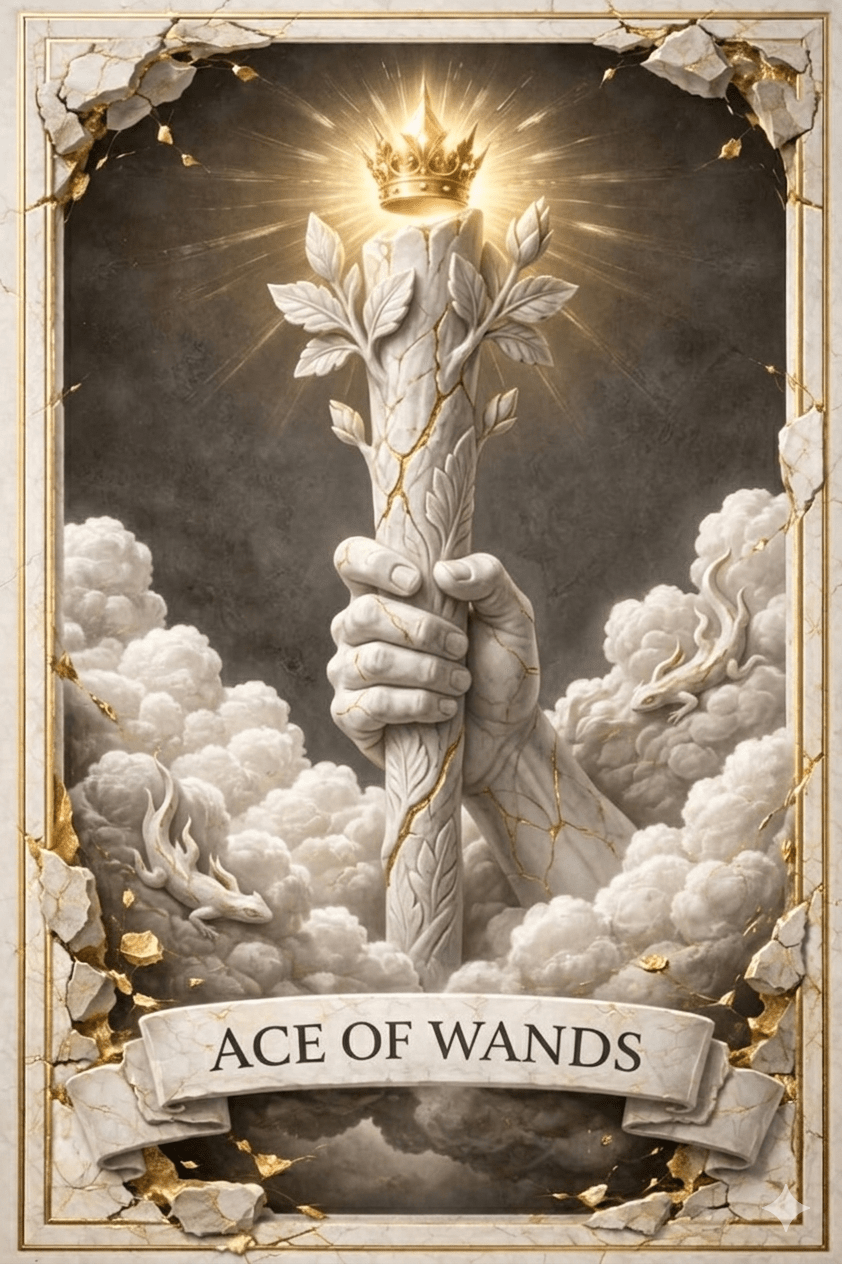
First appeared the Ace of Wands.
It was not a sword piercing the sky, nor a seed in the palm of the hand, nor an overflowing cup.
It was fire. A spark. A desire. A living impulse. Something inside him lit up again.
After so much thinking, holding, remembering, and feeling, a simpler and more dangerous force appeared: the urge. The urge to move. The urge to break the stillness. The urge to go towards that which was still calling him.
The Ace of Wands did not ask whether he was afraid. It asked whether he had fire. Because there are truths that are known. There are loves that are felt. There are paths that are built.
But nothing happens if no one dares to light them.
Then came the Two of Wands.
And with it, vision.
He looked from afar. He looked at what he had. He looked at what he could lose. He looked at the world he knew and the world he longed to reach. One part of him wanted to stay where everything was safe. Another part knew that life does not open itself to those who only look from the window.
The Two of Wands showed him the map, but did not walk it for him.
There was the Queen. There was the possibility. There was the fire. But there was also the distance between imagining a life and having the courage to go towards it.
Then came the Three of Wands.
And there he understood that every true decision begins to call the future.
Something had already been sent out. An intention. A gesture. A sign. An energy that could no longer return in the same form. He looked at the horizon and understood that love is not only thought of backwards; it is also chosen forwards.
After the Swords, he could no longer pretend he did not know. After the Pentacles, he could no longer pretend that facts did not matter. After the Cups, he could no longer pretend that he did not feel.
The Three of Wands said to him:
“Then look ahead. But look with intention. Not with fantasy.”
Waiting is not the same as acting. And desiring is not the same as moving forward.
With the Four of Wands, the image of a celebration appeared.
A possible home. An arrival. A place where the fire did not burn, but gave light. Where the King and the Queen could lay down their weapons, lower their defences, and rest without fear that love would turn back into a test.
The Four of Wands showed what could exist if both of them stopped merely surviving the bond and began to inhabit it.
But it also reminded the King of something: what is not honoured cannot be celebrated. A home is not built with intermittent presence. A house is not lit by the fire of a single day.
Joy also needs commitment.
Then came the Five of Wands.
And with it, friction.
The clash. Pride. Energy badly directed.
It was not the cold pain of the Three of Swords, nor the misery of the Five of Pentacles. It was not the grief of the Five of Cups. It was fire against fire.
When two strong temperaments meet, love can become a spark or a blaze. He was not an easy man to move. She was not an easy woman to extinguish. He could become dominant when he felt he was losing control. She could become defiant when she felt someone was trying to diminish her. And so, instead of meeting through desire, they faced each other through pride. Two fires measuring their strength. Two wills wanting to be seen. Two bodies remembering the attraction, but two egos refusing to yield.
Two wills trying to defend themselves. Two wounds raising their voices. Two egos competing not to feel vulnerable. Perhaps neither of them wanted to destroy the other, but both could end up striking where it hurt most.
The Five of Wands showed that passion, when it lacks awareness, turns into conflict. And the King had to recognise something uncomfortable: sometimes it was not a lack of love. It was a lack of mastery over his own fire.
Then appeared the Six of Wands.
And there came the question of pride.
Did he want to win?
Or did he want to love?
Because the Six of Wands can speak of recognition, victory, of being seen. But in this story it also brought a shadow: the need to look good, to be right, to come out intact in the eyes of others, even though everything inside was burning.
Perhaps the King wanted to seem strong.
Perhaps he wanted to act as though nothing touched him.
Perhaps he wanted to win a battle that, in truth, left him alone.
But love is not a parade. The Queen was not a trophy. And the truth did not need applause.
The Six of Wands taught him that some victories serve only to feed the ego. And that, if in order to win he had to lose his heart, then he had won nothing.
With the Seven of Wands, defence arrived.
The King went on guard.
It was not a lack of feelings, but an excess of everything. He defended his position, his reasons, his distance, his way of seeing things. He raised the wand like someone saying: “Do not move me from here.”
And perhaps the Queen defended herself too.
Because she was not still water either. Nor was she obedient earth. There was a flame in her that would not accept being taken halfway. If she felt underestimated, she burned. If she felt ignored, she rose up. If she felt the King wanted to control the rhythm, she defended her own fire.
After so many wounds, she could no longer open the door without looking at who was coming. She could no longer give her fire to someone who confused it with availability. She could no longer lower her boundaries simply because he appeared all aflame.
The Seven of Wands showed that defending oneself can be necessary. But always living in defence is also exhausting. Because whoever is constantly protecting their position may end up losing the encounter.
Then came the Eight of Wands.
And everything wanted to move all at once.
Messages. Impulses. Signs. The desire to speak. The desire to run. The desire to cross, in an instant, all the distance that fear had built over so long.
The Eight of Wands brought speed.
But it also brought a warning: what is fast is not always clear. And what is intense is not always deep.
After so much silence, he may have wanted to say everything. After so much waiting, she may have felt that something was arriving late. After so much restraint, the fire wanted to pierce through it all. But moving is not enough. One must know where one is going. Writing is not enough. One must know from where one is writing. Arriving is not enough. One must know how to stay.
Then came the Nine of Wands.
And there appeared the exhaustion of having resisted too much.
The King was standing, but wounded. The Queen too. Both had survived too many trials, too many defences, too many comings and goings. No one emerges untouched from a story like that.
The Nine of Wands did not speak of giving up. It spoke of vigilance.
Of that moment when the heart wants to believe, but the body remembers that it must stay alert. Of that instant when one part wants to open, but another asks: “What if it hurts again?”
He still had fire. But he also had fear.
She could still feel. But she could no longer ignore her scars.
The Nine of Wands taught them that resistance is not the same as hardness. And that, sometimes, true courage lies not in continuing to fight, but in lowering the wand without forgetting what has been learnt.
And finally came the Ten of Wands.
The weight of fire carried badly.
Everything he did not say. Everything he postponed. Everything he wanted to control. Everything he left burning inside without giving it a way out.
The Ten of Wands showed a King exhausted from carrying alone a story he did not know how to share in time. It was not a lack of desire. It was an excess of weight. An excess of pride. An excess of misunderstood responsibility. An excess of impulse contained until it became a burden.
The Queen also carried her own.
She carried expectations. She carried anguish. She carried love. She carried waiting. She carried crossed boundaries.
She carried the exhaustion of having held a fire that, many times, she did not know whether it warmed her or burned her.
The Ten of Wands said:
“This is heavy because it can no longer continue to be carried like this.”
And there, the King understood something: fire that is not shared ends up consuming.
Then appeared the Page of Wands.
A new part of him awoke.
Not the curiosity of the Page of Swords, nor the practical humility of the Page of Pentacles. Not the tenderness of the Page of Cups.
This time it was a spark.
A young, direct, restless energy. The part of him that still wanted to live, to try, to discover, to move. The part that looked at fire not as a threat, but as a possibility.
The Page of Wands did not have all the answers. But he had something the King had lost: enthusiasm.
And perhaps that was needed too. Not only guilt. Not only analysis. Not only repair. Life too. Clean desire too. A way of approaching that was not born from fear, but from an awakened will.
The Page asked:
“What would you do if you did not let fear decide for you?”
Then came the Knight of Wands.
And with him, risk.
Because this Knight does act. He does move forward. He does throw himself in. He does want to conquer the distance with fire in his hands. But he can also be reckless.
He can arrive intensely and leave just as quickly. He can confuse passion with presence. He can believe that an outburst is worth the same as a choice. He can appear when desire pushes him, but not always stay when responsibility calls him.
The Knight of Wands was a warning for the King:
Do not arrive only because you are burning. Do not promise from the blaze. Do not confuse movement with commitment.
The Queen did not need an inferno. She needed a fire that knew how to stay lit without destroying everything.
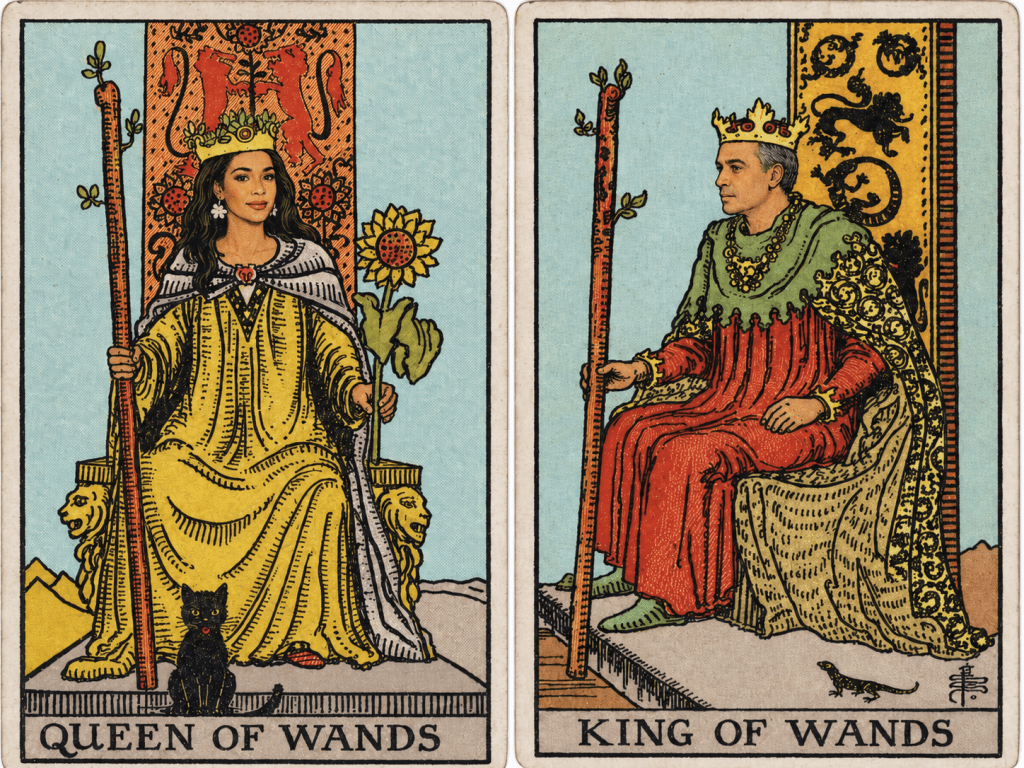
Then appeared the Queen of Wands.
And she was there: magnetic, alive, proud, luminous.
Not only the Queen of Swords, who asked for truth. Not only the Queen of Pentacles, who asked for presence. Not only the Queen of Cups, who asked for honesty of the soul.
She was also the Queen of Wands: a woman with fire of her own.
The witch of the tarot. The one who enters a room and changes the temperature. The one who does not need to explain her power because her presence already announces it.
The Queen of Wands is desire, intuition, magnetism, creativity, eroticism, will. She is the woman who knows her body, her energy, her shadow, and her light. The one who can be both home and bonfire. The one who can caress, create, ignite, but also burn a bridge if she understands that there is no longer life there.
Her black cat is not there as an ornament. It is a symbol of mystery, instinct, magic, autonomy. The Queen of Wands does not ask permission to exist. She does not apologise for shining. She does not lower her voice so others may feel comfortable with her fire.
For the King, that energy could be both fascinating and threatening.
She attracted him because she was alive. She unsettled him because he could not control her. She ignited him because she was not lukewarm. She confronted him because her fire demanded presence, not promises. Perhaps that is why, in his shadow, he may have seen her as too intense, too proud, too free, too dangerous. But perhaps what he called danger was simply a woman who was no longer willing to put herself out in order to be chosen.
A woman who does not merely feel. She burns.
A woman who can love with intensity, but also rise with dignity. Who can be warm, generous, desiring, powerful, but not available to someone who does not know how to honour her energy. Because for her, it was not only fire. It was the first time she allowed someone into a room within herself that she had never opened before. And the King knew it: for her, that fire had been a door one crosses only once.
In her shadow, she could be seen as too intense. Too proud. Too demanding. Too aflame. A woman who does not beg for fire because she carries it within. A woman who, when she grows tired, does not go out: she withdraws.
And that also confronted the King.
Because a Queen of Wands is not won with lukewarmness. She is not kept with doubts. She is not deserved with excuses. She was not asking him to burn in the same way she did. She was asking him not to be afraid of the fire.
And at the end appeared the King of Wands.
But before becoming that King, he had to recognise his shadow.
His temperament could be strong. Quick. Proud.
When he wanted something, he wanted it with everything. But when something confronted him, he could also close himself off with the same intensity. He could want to direct the fire, set the rhythm, decide when to come close and when to move away. He could confuse leadership with control, desire with entitlement, silence with power. He could feel he had the right to punish, just as he punished himself.
And in front of a Queen of Wands, that did not go unnoticed.
Impulsive.
Proud.
Dominant.
Capable of desiring greatly, but not always of acting with awareness.
A man who could ignite a story and then not know how to sustain the blaze he had caused. Who could inspire, attract, promise through presence, but also impose his rhythm, disappear when the fire demanded maturity, or expect everything to revolve around his will.
In his shadow, the King of Wands could seem selfish, because his desire could take up too much space. He could want without asking whether the other person was also ready. He could move forward from impulse and call fate what was still anxiety.
But in his light, the King of Wands is something else.
He is the man who acts. The man who has courage. The man who does not hide behind the mind, matter, or emotion. The man who does not ghost.
When the King of Wands and the Queen of Wands meet in their shadow, they provoke each other, challenge each other, wound each other with the same fire that attracts them. Neither wants to seem weak. Neither wants to yield first. Neither wants to admit how much they are burning inside.
But when they meet in their light, they do not compete. They recognise each other.
He does not try to extinguish her. She does not try to defeat him. He holds the fire with direction. She keeps it alive with presence. And then passion stops being war. It becomes creation.
The King of Wands does not merely know what he wants. He goes towards it.
But not like the Knight, from haste. Not from ego. Not from conquest. He goes from mature will. He knows that fire is not there to devastate, but to illuminate.
He knows that desire is not there to possess, but to give life. He knows that passion without direction becomes harm. And that passion with awareness can become destiny.
And so, after going through the whole suit of Wands, he understood something:
It was not enough to know the truth.
It was not enough to build something real.
It was not enough to feel deeply.
One also had to have courage.
Courage to act.
Courage to sustain the fire.
Courage not to flee when desire demands presence.
Courage to come close without burning.
Courage to love without hiding.
Courage to show one’s face.
Courage to be vulnerable.
Between the King and the Queen there had been too many swords. The Pentacles asked whether something could be built upon that earth. The Cups asked whether love could flow again without drowning them.
But the Wands asked the final question:
“Are you going to light it, or are you going to keep looking at the ashes?”
Because the Wands do not only burn. They also awaken.
And there is the Ace of Wands, King.
The flame in front of you.
Do not let it die. 🔥
Lo que cuentan los Bastos
Hoy quiero interpretar el palo de Bastos del tarot como si fuera una historia. No solo como significados separados, sino como un camino completo. Este relato es una historia particular y, al mismo tiempo, universal: la historia de alguien que ya enfrentó la verdad de las Espadas, la realidad de los Oros y la profundidad de las Copas. Pero ahora le falta atravesar el fuego.
Las Espadas hablaron de la mente.
Los Oros hablaron de los hechos.
Las Copas hablaron del corazón.
Pero los Bastos hablan de la voluntad.
Hablan del deseo, del impulso, del valor, de la acción, de la energía que no basta con sentir ni con pensar ni con prometer. Hablan de lo que arde dentro de alguien y de lo que esa persona se atreve —o no— a hacer con ese fuego.
Las Espadas preguntaron:
“¿Cuál es tu verdad?”
Los Oros preguntaron:
“¿Qué vas a hacer con ella?”
Las Copas preguntaron:
“¿Qué sientes realmente?”
Y los Bastos vinieron a preguntar:
“¿Tienes el valor de actuar?”
Primero apareció el As de Bastos.
No fue una espada atravesando el cielo, no fue una semilla en la palma de la mano,
ni una copa desbordándose.
Fue fuego. Una chispa. Un deseo. Un impulso vivo. Algo dentro de él volvió a encenderse.
Después de tanto pensar, sostener, recordar y sentir, apareció una fuerza más simple y más peligrosa: las ganas. Ganas de moverse. Ganas de romper la quietud. Ganas de ir hacia aquello que todavía lo llamaba.
El As de Bastos no preguntó si tenía miedo. Preguntó si tenía fuego. Porque hay verdades que se saben. Hay amores que se sienten. Hay caminos que se construyen.
Pero nada sucede si nadie se atreve a encenderlos.
Después llegó el Dos de Bastos.
Y con él, la visión.
Él miró desde lejos. Miró lo que tenía. Miró lo que podía perder. Miró el mundo que conocía y el mundo que deseaba alcanzar. Una parte de él quería quedarse donde todo era seguro. Otra parte sabía que la vida no se abre para quien solo mira desde la ventana.
El Dos de Bastos le mostró el mapa, pero no caminó por él.
Ahí estaba la Reina. Ahí estaba la posibilidad. Ahí estaba el fuego. Pero también estaba la distancia entre imaginar una vida y tener el valor de ir hacia ella.
Entonces vino el Tres de Bastos.
Y ahí entendió que toda decisión verdadera empieza a llamar al futuro.
Algo ya había sido enviado. Una intención. Un gesto. Una señal. Una energía que no podía volver igual. Él miró el horizonte y comprendió que el amor no solo se piensa hacia atrás; también se elige hacia adelante.
Después de las Espadas, ya no podía fingir que no sabía. Después de los Oros, ya no podía fingir que los hechos no importaban. Después de las Copas, ya no podía fingir que no sentía.
El Tres de Bastos le dijo:
“Entonces mira adelante. Pero mira con intención. No con fantasía.”
Esperar no es lo mismo que actuar. Y desear no es lo mismo que avanzar.
Con el Cuatro de Bastos, apareció la imagen de una celebración.
Un hogar posible. Una llegada. Un lugar donde el fuego no quemara, sino alumbrara. Donde el Rey y la Reina pudieran dejar las armas, bajar las defensas, descansar sin miedo a que el amor volviera a convertirse en prueba.
El Cuatro de Bastos mostró lo que podía existir si ambos dejaban de sobrevivir al vínculo y empezaban a habitarlo.
Pero también le recordó algo al Rey: no se celebra lo que no se honra. No se construye hogar con presencia intermitente. No se enciende una casa con el fuego de un solo día.
La alegría también necesita compromiso.
Entonces llegó el Cinco de Bastos.
Y con él, la fricción.
El choque. El orgullo. La energía mal dirigida.
No era el dolor frío del Tres de Espadas ni la miseria del Cinco de Oros. No era el duelo del Cinco de Copas. Era fuego contra fuego.
Cuando dos temperamentos fuertes se encuentran, el amor puede volverse chispa o incendio. Él no era un hombre fácil de mover. Ella no era una mujer fácil de apagar. Él podía volverse dominante cuando sentía que perdía el control. Ella podía volverse desafiante cuando sentía que la querían reducir. Y entonces, en lugar de encontrarse desde el deseo, se enfrentaban desde el orgullo. Dos fuegos midiendo fuerza. Dos voluntades queriendo ser vistas. Dos cuerpos recordando la atracción, pero dos egos negándose a ceder.
Dos voluntades intentando defenderse. Dos heridas levantando la voz. Dos egos compitiendo por no sentirse vulnerables. Tal vez ninguno quería destruir al otro, pero ambos pudieron terminar golpeando donde más dolía.
El Cinco de Bastos mostró que la pasión, cuando no tiene conciencia, se convierte en pelea. Y el Rey tuvo que reconocer algo incómodo: a veces no era falta de amor. Era falta de dominio sobre su propio fuego.
Luego apareció el Seis de Bastos.
Y ahí vino la pregunta por el orgullo.
¿Quería vencer?
¿O quería amar?
Porque el Seis de Bastos puede hablar de reconocimiento, de victoria, de ser visto. Pero en esta historia también trajo una sombra: la necesidad de quedar bien, de tener razón, de salir entero ante los ojos de los demás, aunque por dentro todo estuviera ardiendo.
Tal vez el Rey quiso parecer fuerte.
Tal vez quiso actuar como si nada lo tocara.
Tal vez quiso ganar una batalla que, en realidad, lo dejaba solo.
Pero el amor no es un desfile. La Reina no era un trofeo. Y la verdad no necesitaba aplausos.
El Seis de Bastos le enseñó que algunas victorias solo sirven para alimentar el ego. Y que, si para ganar tenía que perder el corazón, entonces no había ganado nada.
Con el Siete de Bastos, llegó la defensa.
El Rey se puso en guardia.
No era falta de sentimientos, sino exceso de todo. Defendió su postura, sus razones, su distancia, su manera de ver las cosas. Levantó el basto como quien dice: “No me muevas de aquí.”
Y tal vez la Reina también se defendió.
Porque ella tampoco era agua quieta. Tampoco era tierra obediente. Había en ella una llama que no aceptaba ser tomada a medias. Si se sentía subestimada, ardía. Si se sentía ignorada, se levantaba. Si sentía que el Rey quería dominar el ritmo, ella defendía su propio fuego.
Después de tantas heridas, ella ya no podía abrir la puerta sin mirar quién venía. Ya no podía entregar su fuego a quien lo confundiera con disponibilidad. Ya no podía bajar sus límites solo porque él apareciera encendido.
El Siete de Bastos mostró que defenderse puede ser necesario. Pero vivir siempre en defensa también cansa. Porque quien todo el tiempo protege su posición puede terminar perdiendo el encuentro.
Entonces llegó el Ocho de Bastos.
Y todo quiso moverse de golpe.
Mensajes. Impulsos. Señales. Ganas de hablar. Ganas de correr. Ganas de cruzar en un instante toda la distancia que el miedo había construido durante tanto tiempo.
El Ocho de Bastos trajo velocidad.
Pero también trajo una advertencia: lo rápido no siempre es claro. Y lo intenso no siempre es profundo.
Después de tanto silencio, él pudo querer decirlo todo. Después de tanta espera, ella pudo sentir que algo llegaba tarde. Después de tanta contención, el fuego quiso atravesarlo todo. Pero no basta con moverse. Hay que saber hacia dónde. No basta con escribir. Hay que saber desde dónde. No basta con llegar. Hay que saber quedarse.
Después vino el Nueve de Bastos.
Y ahí apareció el cansancio de haber resistido demasiado.
El Rey estaba de pie, pero herido. La Reina también. Ambos habían sobrevivido a demasiadas pruebas, demasiadas defensas, demasiadas idas y vueltas. Nadie salía intacto de una historia así.
El Nueve de Bastos no habló de rendirse. Habló de vigilancia.
De ese momento en que el corazón quiere creer, pero el cuerpo recuerda que debe estar en alerta. De ese instante en que una parte quiere abrirse, pero otra pregunta: “¿Y si vuelve a doler?”
Él aún tenía fuego. Pero también tenía miedo.
Ella aún podía sentir. Pero ya no podía ignorar sus cicatrices.
El Nueve de Bastos les enseñó que la resistencia no es lo mismo que la dureza. Y que, a veces, el verdadero valor no está en seguir peleando, sino en bajar el basto sin olvidar lo aprendido.
Y finalmente llegó el Diez de Bastos.
El peso del fuego mal cargado.
Todo lo que no dijo. Todo lo que postergó. Todo lo que quiso controlar. Todo lo que dejó arder por dentro sin darle salida.
El Diez de Bastos mostró a un Rey agotado por cargar solo con una historia que no supo compartir a tiempo. No era falta de deseo. Era exceso de peso. Exceso de orgullo. Exceso de responsabilidad mal entendida. Exceso de impulso contenido hasta volverse carga.
También la Reina cargó lo suyo.
Cargó expectativas. Cargó angustia. Cargó amor. Cargo espera. Cargó límites cruzados.
Cargó el cansancio de haber sostenido un fuego que muchas veces no sabía si la calentaba o la quemaba.
El Diez de Bastos dijo:
“Esto pesa porque ya no puede seguir cargándose así.”
Y ahí, el Rey entendió algo: el fuego que no se comparte termina consumiendo.
Entonces apareció la Sota de Bastos.
Una parte nueva de él despertó.
No la curiosidad de la Sota de Espadas, ni la humildad práctica de la Sota de Oros. No la ternura de la Sota de Copas.
Esta vez fue una chispa.
Una energía joven, directa, inquieta. La parte de él que todavía quería vivir, intentar, descubrir, moverse. La parte que miraba el fuego no como amenaza, sino como posibilidad.
La Sota de Bastos no tenía todas las respuestas. Pero tenía algo que él había perdido: entusiasmo.
Y tal vez eso también hacía falta. No solo culpa. No solo análisis. No solo reparación. También vida. También deseo limpio. También una manera de acercarse que no naciera del miedo, sino de una voluntad despierta.
La Sota preguntó:
“¿Qué harías si no dejaras que el miedo decidiera por ti?”
Luego llegó el Caballero de Bastos.
Y con él, el riesgo.
Porque este Caballero sí actúa. Sí avanza. Sí se lanza. Sí quiere conquistar la distancia con fuego en las manos. Pero también puede ser imprudente.
Puede llegar intenso y marcharse igual de rápido. Puede confundir pasión con presencia. Puede creer que un arrebato vale lo mismo que una elección. Puede aparecer cuando el deseo lo empuja, pero no siempre quedarse cuando la responsabilidad lo llama.
El Caballero de Bastos era una advertencia para el Rey:
No llegues solo porque ardes. No prometas desde la llamarada. No confundas movimiento con compromiso.
La Reina no necesitaba un incendio. Necesitaba un fuego que supiera quedarse encendido sin destruirlo todo.
Después apareció la Reina de Bastos.
Y ella estaba ahí: magnética, viva, orgullosa, luminosa.
No solo la Reina de Espadas, que pedía verdad. No solo la Reina de Oros, que pedía presencia. No solo la Reina de Copas, que pedía honestidad del alma.
También era la Reina de Bastos: una mujer con fuego propio.
La bruja del tarot. La que entra en una habitación y cambia la temperatura. La que no necesita explicar su poder porque su presencia ya lo anuncia.
La Reina de Bastos es deseo, intuición, magnetismo, creatividad, erotismo, voluntad. Es la mujer que conoce su cuerpo, su energía, su sombra y su luz. La que puede ser hogar y hoguera. La que puede acariciar, crear, encender, pero también quemar un puente si comprende que allí ya no hay vida.
Su gato negro no está ahí por adorno. Es símbolo de misterio, instinto, magia, autonomía. La Reina de Bastos no pide permiso para existir. No se disculpa por brillar. No baja la voz para que otros se sientan cómodos con su fuego.
Para el Rey, esa energía podía ser fascinante y amenazante a la vez.
Ella lo atraía porque estaba viva. Lo inquietaba porque no podía controlarla. Lo encendía porque no era tibia. Lo confrontaba porque su fuego le exigía presencia, no promesas.Tal vez por eso, en su sombra, él pudo verla como demasiado intensa, demasiado orgullosa, demasiado libre, demasiado peligrosa. Pero quizá lo que él llamaba peligro era simplemente una mujer que ya no estaba dispuesta a apagarse para ser elegida.
Una mujer que no solo siente. Arde.
Una mujer que puede amar con intensidad, pero también levantarse con dignidad. Que puede ser cálida, generosa, deseante, poderosa, pero no disponible para quien no sepa honrar su energía. Porque para ella no fue solo fuego. Fue la primera vez que dejó que alguien entrara en una habitación de sí misma que nunca había abierto. Y el Rey lo sabía: para ella, ese fuego había sido una puerta que solo se cruza una vez.
En su sombra, podía ser vista como demasiado intensa. Demasiado orgullosa. Demasiado exigente. Demasiado encendida. Una mujer que no suplica fuego porque lo lleva dentro. Una mujer que, cuando se cansa, no se apaga: se retira.
Y eso al Rey también lo enfrentó.
Porque una Reina de Bastos no se conquista con tibieza. No se retiene con dudas. No se merece con excusas. Ella no pedía que él ardiera igual que ella. Pedía que no le tuviera miedo al fuego.
Y al final apareció el Rey de Bastos.
Pero antes de convertirse en ese Rey, él tuvo que reconocer su sombra.
Su temperamento podía ser fuerte. Rápido. Orgulloso.
Cuando quería algo, lo quería con todo. Pero cuando algo lo confrontaba, también podía cerrarse con la misma intensidad. Podía querer dirigir el fuego, marcar el ritmo, decidir cuándo acercarse y cuándo alejarse. Podía confundir liderazgo con control, deseo con derecho, silencio con poder. Podía sentir que tiene el derecho de castigar, como se castiga él mismo.
Y frente a una Reina de Bastos, eso no pasaba desapercibido.
Impulsivo.
Orgulloso.
Dominante.
Capaz de desear mucho, pero no siempre de actuar con conciencia.
Un hombre que podía encender una historia y luego no saber sostener el incendio que había provocado. Que podía inspirar, atraer, prometer con presencia, pero también imponer su ritmo, desaparecer cuando el fuego exigía madurez o esperar que todo girara alrededor de su voluntad.
En su sombra, el Rey de Bastos podía parecer egoísta, porque su deseo podía ocupar demasiado espacio. Podía querer sin preguntar si el otro también estaba listo. Podía avanzar desde el impulso y llamar destino a lo que todavía era ansiedad.
Pero en su luz, el Rey de Bastos es otra cosa.
Es el hombre que actúa. El hombre que tiene valor. El hombre que no se esconde detrás de la mente, de la materia ni de la emoción. El hombre que no ghostea.
Cuando el Rey de Bastos y la Reina de Bastos se encuentran en su sombra, se provocan, se desafían, se hieren con el mismo fuego que los atrae. Ninguno quiere parecer débil. Ninguno quiere ceder primero. Ninguno quiere admitir cuánto arde por dentro.
Pero cuando se encuentran en su luz, no compiten. Se reconocen.
Él no intenta apagarla. Ella no intenta vencerlo. Él sostiene el fuego con dirección. Ella lo mantiene vivo con presencia. Y entonces la pasión deja de ser guerra. Se vuelve creación.
El Rey de Bastos no solo sabe lo que quiere. Va hacia ello.
Pero no como el Caballero, desde la prisa. No desde el ego. No desde la conquista. Va desde la voluntad madura. Sabe que el fuego no está para arrasar, sino para alumbrar.
Sabe que el deseo no está para poseer, sino para dar vida. Sabe que una pasión sin dirección se vuelve daño. Y que una pasión con conciencia puede volverse destino.
Y así, después de atravesar todo el palo de Bastos, él comprendió algo:
No bastaba con saber la verdad.
No bastaba con construir algo real.
No bastaba con sentir profundamente.
También había que tener valor.
Valor para actuar.
Valor para sostener el fuego.
Valor para no huir cuando el deseo exige presencia.
Valor para acercarse sin quemar.
Valor para amar sin esconderse.
Valor para dar la cara.
Valor para ser vulnerable.
Entre el Rey y la Reina hubo demasiadas espadas. Los Oros preguntaron si podía construirse algo sobre esa tierra. Las Copas preguntaron si el amor podía volver a fluir sin ahogarlos.
Pero los Bastos hicieron la pregunta final:
“¿Vas a encenderlo o vas a seguir mirando las cenizas?”
Porque los Bastos no solo arden. También despiertan.
Y ahí está el As de Bastos, Rey.
La llama frente a ti.
No la dejes morir.


Deja una respuesta