
🇪🇸 Versión en español abajo ⬇️
Today I want to interpret the suit of Cups in tarot as though it were a story. Not as a series of separate meanings, but as a complete path.
This tale is particular and, at the same time, universal: the story of someone who has already had to face the truth of the Swords and the reality of the Pentacles, but who must now move through something deeper: the world of the heart.
The Swords spoke of the mind, of words, of decisions and wounds. The Pentacles spoke of actions, of time, of value, of what is built and what is sustained.
But the Cups speak of the soul. I confess they are my favourite suit.
They speak of what is felt, of what is desired, of what is remembered, of what is idealised, of what is given, and of what is lost when love is left without a channel.
The Swords asked:
“What is your truth?”
The Pentacles asked:
“What are you going to do with it?”
And the Cups came to ask:
“What do you truly feel when you can no longer hide behind reason or facts?”
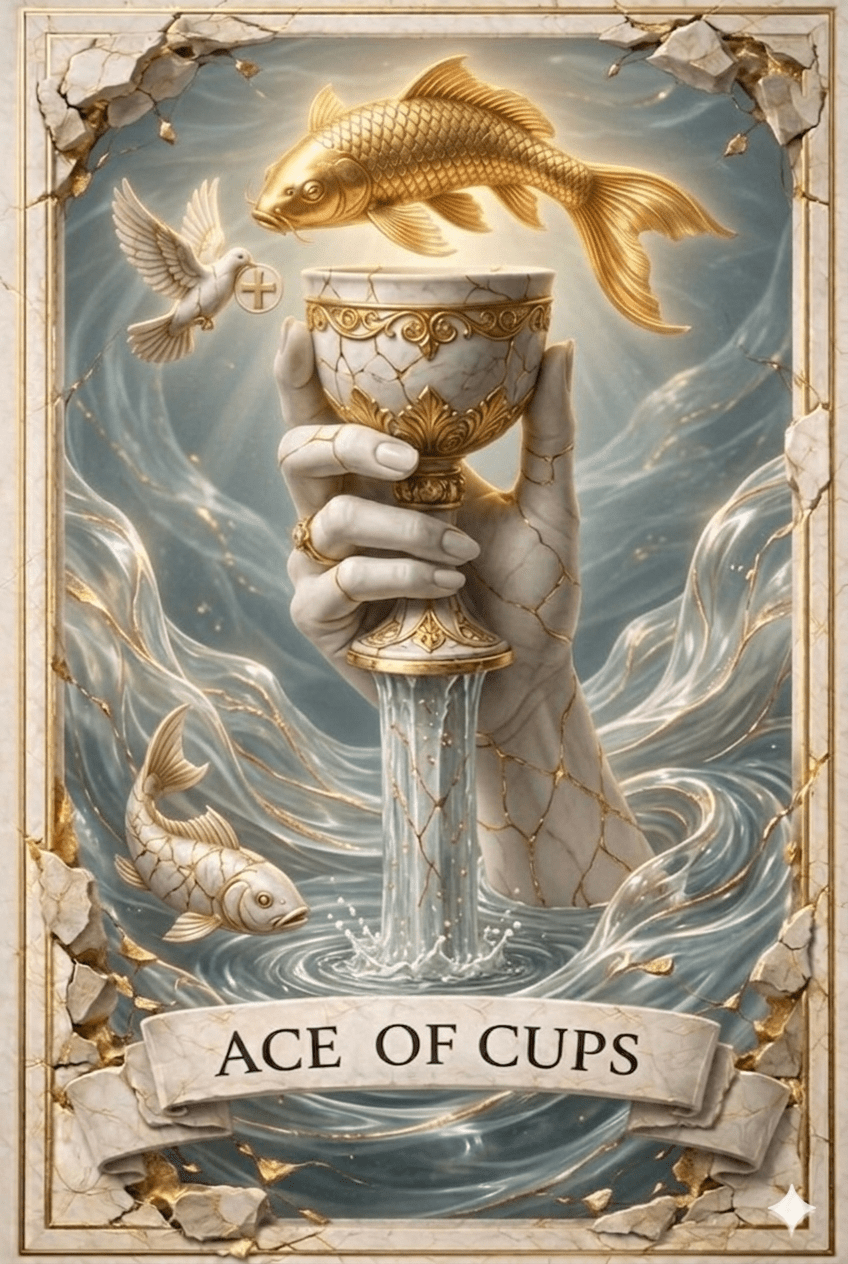
First appeared the Ace of Cups.
It was no longer a sword cutting through the sky, nor a seed in the palm of the hand.
It was a cup overflowing. A feeling that could no longer be contained within him. Something pure, ancient and new at the same time. An emotion that did not need to be explained in order to exist. After so much mind, so much defence and so many attempts to control what hurt, the water appeared: alive, clear, inevitable.
He felt it in his chest before he could name it.
The Ace of Cups did not come to demand an immediate decision from him. It came to show him that there was still love. That beneath the wounds, the pride, the silence, the time, the distance and the caution, something was still flowing.
And that frightened him.
Because one thing was to know a truth with the mind. Another, to prove it through actions. But to feel it without armour was a form of surrender to which the King was not accustomed.
Then came the Two of Cups.
And with it, the mirror.
There, he was not alone. She was there.
The Queen before him, like someone with whom, once, on some plane, there had been a real union. Two cups raised. Two gazes. Two souls recognising one another beyond everything that later broke.
The Two of Cups reminded him that between the King and the Queen there had not only been swords. There had also been meeting. There had also been tenderness. Laughter. A way of looking at one another that did not need to defend itself. Before pride, there was connection. Before distance, closeness. Before fear, surrender. Perhaps that was why it hurt so much. It hurt them both. Because something that was never deep does not break in the same way, whatever label it may have had.
Then came the Three of Cups.
And there appeared the joy that had once existed.
The laughter. The complicity. The simple celebration of being close. The moments when love did not feel heavy and the presence of the other was not a difficult question, but a luminous answer.
The Three of Cups spoke of sharing. Of raising a glass. Of recognising that the bond had not been made only of conflict, but also of life. There were good days. There was beauty. There were moments when both of them were refuge and celebration.
But after the Swords, that joy could no longer be seen in the same way. When a cup cracks, even the memory of the wine can hurt.
Perhaps the King tried to distract himself in order to forget the Queen. He sought noise, company, toasts, conversations that did not weigh heavily. But even among laughter, something in him kept returning to her. There are absences that cannot be filled with people around. Sometimes they become even more evident when the heart is not truly celebrating.
He understood that he did not only miss the Queen. He also missed who he was when he was with her. He missed the version of them both before the defences, before the silences, before the tests neither of them knew how to pass through without causing hurt.
With the Four of Cups, he closed himself off.
Not as in the Four of Pentacles, where he clung on out of fear of losing. Nor as in the Four of Swords, where he withdrew out of exhaustion. Here, the closing came from another place: the heart, saturated, no longer knew how to receive.
There was a cup in front of him, but he did not look at it. He was indifferent to it. Perhaps life was offering him an opportunity. Perhaps she was still present in some way. Perhaps love was still trying to knock at the door, but he was too sunk in everything that had gone wrong. He looked at the three cups of the past: what had been, what had hurt, what could no longer be repeated. And, from looking so much at what had been lost, he could not see what might still appear.
The Four of Cups showed him a silent sadness: that of someone who is not empty, but closed. That of someone who wants to feel, but fears that feeling will drag him under again.
Then came the Five of Cups.
And there, grief became visible.
Three cups spilled. What was lost. What was not said. What was broken. What could have been and was not. He looked at the ground of the soul and saw the water spread out like a loss impossible to gather back up. He regretted the words, the silences, the moments when pride spoke louder than love. He also regretted the harm done to those involved.
As in the Five of Swords, he understood that some victories leave a bitter taste. But here it was no longer about the battlefield after the battle, but about the heart after the loss.
As in the Five of Pentacles, there appeared the feeling of being outside, far from warmth. Only this time the poverty was not of earth or presence, but of water: the impression that something had been emptied inside.
The Five of Cups said to him:
“Yes, something was spilled. Yes, something hurt. Yes, something will not return in exactly the same way.”
But there were also two cups behind him. Not everything was lost. Not everything had been emptied. Not all wounded love is necessarily dead.
The problem was that, in order to see what remained, he first had to stop looking only at what had fallen.
Then appeared the Six of Cups.
And with it, memory.
Not a cruel memory, but a sweet and dangerous one. The small gestures returned, the words, the places, the symbols, the smells. The way she looked at him before hardening. Her smile. The way he came closer before hiding. The innocence that existed before they both learnt to defend themselves so much.
The Six of Cups brought nostalgia. And nostalgia has a delicate beauty, but also a trap: it can turn the past into a perfect garden, forgetting that even there, there were shadows. He remembered the good, and that opened his heart. But he also had to remember what was true. What was, and what never came to be. That required maturity.
It was not about returning to the past as though nothing had happened. It was about rescuing what was pure without denying what hurt.
The Cups whispered to him:
“Remember, but do not idealise. Love, but do not return asleep.”
With the Seven of Cups, fantasies appeared. And emotional confusion too.
After so much memory, his heart began to imagine paths: a perfect conversation, a possible reunion, an apology that healed everything, a future without wounds, a Queen who understood him without him having to explain himself, a love that fixed itself simply because it still hurt.
But the Seven of Cups showed him that not every image of the heart is truth. Some images are desire. Others, fear. Others, evasion. Sometimes the soul imagines so that it does not have to fully touch reality.
The Swords had already given him clarity. The Pentacles had already asked him for actions. The Cups now showed him his illusions.
And he had to ask himself:
“Am I loving the real Queen, or the image I built so as not to lose her completely?
Do I want to return, or do I want to erase the pain?
Am I choosing from love, or from nostalgia?”
Then came the Eight of Cups.
And with it, the emotional departure.
It is not always the one who has stopped loving who leaves. Sometimes the one who leaves is the one who can no longer keep inhabiting a place where the soul does not rest.
The Eight of Cups was not an escape like the evasions of the Seven of Swords, nor a simple crossing towards a less painful shore as in the Six of Swords. It was something more intimate: recognising that some cups, even if they remain standing, no longer fill.
He had to move away from a way of feeling that kept him trapped. Away from guilt, from fantasy, from the role of victim, from the desire for love to save him without him having to transform. And he also had to look, again and again, at the cruel way in which he left: feeling, caring, and still without the courage to stay and say everything.
He left with the cups still full inside him, but without knowing how to hold them before her. He walked away carrying love, fear, rage, guilt, silence and desire, like someone abandoning a table before daring to look at what still remained upon it.
That was one of the hardest truths: it is not always the one who has stopped loving who leaves. Sometimes the one who leaves is the one who does not know how to love without hiding. Or the one who decides to prioritise his pentacles.
Perhaps she too had to walk away. And it cost her enormously.
She used every resource she had to express herself, to ask for forgiveness, to understand. But the King rejected her again and again. So she had to leave. Not because she no longer loved the King, but out of self-love.
Then came the Nine of Cups.
And there appeared desire, together with an intimate question:
“What would truly make me happy?”
He had thought about what he wanted. He had measured what he could build. Now he had to feel whether his desire came from the soul or from the ego. The Nine of Cups spoke of satisfaction, of fulfilment, of what the heart asks for when no one is watching. It also brought a warning: not to confuse a fulfilled desire with mature love.
He had treated the Queen as a fulfilled desire. Satisfying for him, insufficient for her, whose heart overflowed with love and dreams. Because wanting something does not mean being ready to receive it. Desiring someone does not mean knowing how to care for them. Feeling a great deal does not mean loving well.
He could imagine himself happy with the Queen. But the real question was another:
“Do I want her to return in order to fill my cup, or do I want to arrive with my cup full in order to share?”
He also had to look at her differently. Not as a cup destined to quench his thirst. Not as the answer to his emptiness. Not as a promise of happiness placed outside himself. But as a woman with her own water, her own desire, her own depth. Someone capable of mingling her current with another river, but not of losing herself in it.
And finally came the Ten of Cups.
The vision of love in harmony.
It was no longer only the stability of the Ten of Pentacles, nor the end of pain of the Ten of Swords. The Ten of Cups showed an image of the reconciled heart: peace, union, blessing, belonging.
A perfect fantasy, yes. But also the possibility of a love in which there was no longer any need to fight in order to be seen, to keep silent in order not to lose, or to harden in order to survive. He saw what love could be if it stopped being used as a battlefield. If the Swords became truth. If the Pentacles became care. If the Cups could flow again without fear.
But the Ten of Cups is not reached simply because two people love one another. It is reached when both can inhabit the bond without spilling themselves over one another. Because a cup must not drown. It must contain.
Then appeared the Page of Cups.
A tender part of him awakened.
It was no longer the mental curiosity of the Page of Swords, nor the willingness to learn how to care of the Page of Pentacles. This time something more vulnerable emerged: the ability to feel without hiding. The Page of Cups brought a small cup in his hands, and inside it, something unexpected. A sincere emotion. A humble apology. A message born not from strategy, but from the heart.
He began to ask himself:
“Can I speak without defending myself?
Can I ask for forgiveness without expecting a reward?
Can I show tenderness without feeling weak?
Can I come closer without demanding that she heal my fear?”
The Page of Cups did not know how to do everything.
But he wanted to try from a cleaner place.
Then came the Knight of Cups.
And with him, the romantic gesture.
The desire to approach with an outstretched cup. To say what he feels. To offer beauty, emotion, sensitivity.
He does not arrive like the Knight of Swords, with truth in his mouth and urgency in his body. Nor like the Knight of Pentacles, slow, constant, sustained by deeds. This Knight arrives with his heart visible.
But here too there was a risk.
The Knight of Cups can fall in love with his own emotion. He can believe that a beautiful phrase repairs a deep wound. He can think that the intensity of what he feels is enough to open a door that closed because of a lack of safety. The Knight of Cups likes to enchant. That can be his reward. He is flattered by awakening deep emotions, even though afterwards he does not always want to deal with them.
He had to learn that romance does not replace responsibility, and that tenderness does not erase harm unless it comes accompanied by awareness. A cup offered late must be held with steady hands.
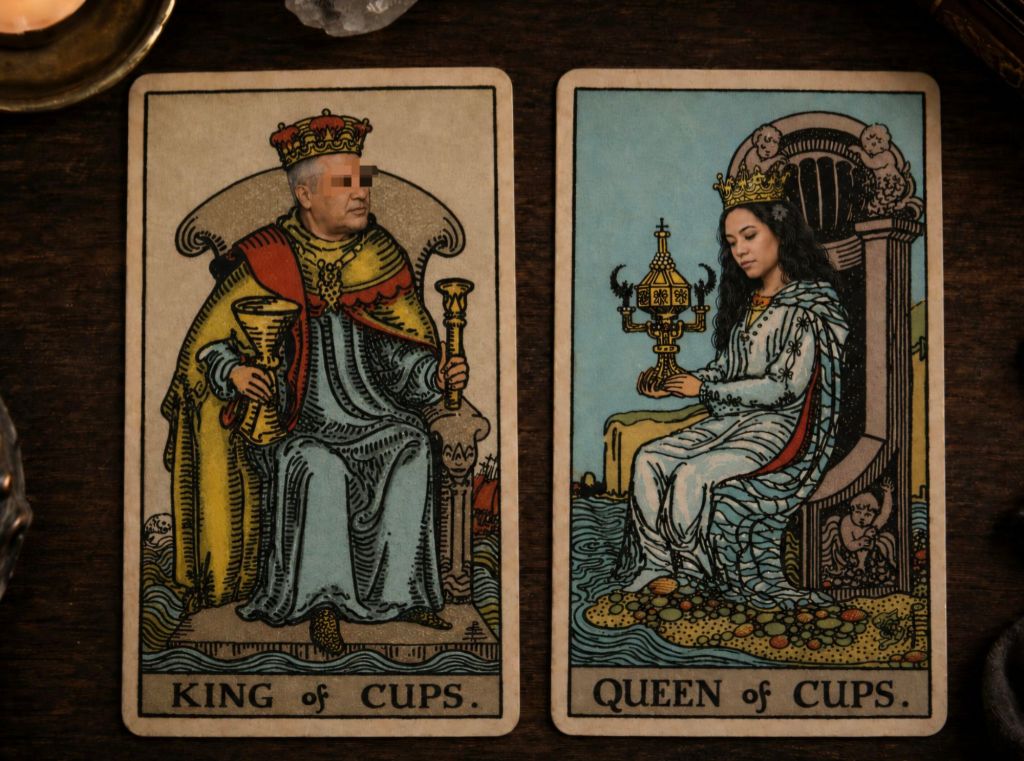
Then appeared the Queen of Cups.
She was there: deep, intuitive, sensitive, mysterious. Intense. Too intense for some.
But before seeing her in her light, he also had to look at the shadow of those waters.
Because the Cups, when they overflow, can become confusion. They can become emotional silence, waiting, melancholy, sensitivity. They can make someone love deeply, but not always know how to say it. Feel too much and retreat into their depths when they do not feel safe.
Perhaps, at some point, the King saw her as too emotional. Too vulnerable. Too much water for a man who still did not know how to swim in the depths.
Perhaps he silently called her exaggerated. Perhaps he confused her sensitivity with disorder, her intuition with threat, her pain with excess. Perhaps, from his fear, he came to see her as “mad”, when in truth she was feeling what he did not dare to look at.
Perhaps he exposed her. Perhaps he blamed her in order to save himself. He knows it. She understands it. She does not hold a grudge against him. Both of them allowed the water to slip through their hands.
Perhaps the King expected from the Queen an admirable emotional management. He expected calm, measure, understanding, temperance. He expected her to know how to contain her waters even when the bond did not offer her safe ground on which to rest.
But for her there was never true safety. There were silences that opened anguish in her, distances that awakened insecurity, ambiguous gestures that left her trying to hold alone what both of them had stirred.
And then the Queen overflowed.
She crossed lines she had never thought she would cross. She said things, did things, felt things of which she was not proud. She went beyond her own limits out of love for the King, out of fear of losing him, out of trying to reach something that was slipping through her hands. And she lost him.
Perhaps she never had him. Perhaps that too was an illusion of hers. Perhaps she will never truly know whether she was loved in return.
Now she too had to learn: that loving does not mean flooding oneself, that feeling deeply does not justify breaking apart, that no cup should empty itself to the point of no longer recognising itself.
She was not only the Queen of Swords, clear and firm, asking for truth, respect and maturity. She was not only the Queen of Pentacles, valuable and whole, protecting her garden.
She was also the Queen of Cups: a woman who feels deeply, even though she is sometimes forced not to show it. Her gaze could read what he was trying to hide even before he knew how to say it.
The Queen of Cups did not ask for an emotional spectacle. She asked for honesty of the soul.
Perhaps what he confused with fragility was, in truth, her greatest strength. Because the Queen’s vulnerability did not make her weak: it made her true. She dared to feel where others hid. To look straight at what hurt. To remain sensitive in a world that so often rewards hardness.
She did not want a cup full of pretty words if, deep down, it came mixed with fear, guilt or need. She did not want to be idealised. She wanted to be truly felt, understood without being invaded, loved without her tenderness being used as shelter for another’s immaturity.
She could love deeply. But she could also withdraw into the deep waters if she felt that her heart was not safe.
And at the end appeared the King of Cups.
Before becoming that King, he had to recognise how he could be seen in his shadow:
Unstable. Evasive. Closed when he most needed to open.
A man capable of feeling deeply, but not always of knowing what to do with what he felt. Capable of seeming serene while inside there was a storm. Capable of storing away his emotions until they became distance, confusion or silence.
He could love. But he could also hide behind calm in order not to show his fear.
Perhaps the Queen saw him that way: deep, yes, but difficult to reach. Capable of feeling, but slow to express it. Capable of being moved, but not always of sustaining emotion without withdrawing. And, above all, willing to subdue his feelings if they threatened his stability.
In his shadow, the King of Cups could seem cold because he did not know how to show his water without losing control.
In his light, he learns something else: he governs his emotions without denying them.
He is not only the King of Swords who speaks with clarity. He is not only the King of Pentacles who sustains through actions. He is the man who learns to feel without drowning.
The King of Cups does not manipulate with tears, nor does he hide behind indifference. He feels deeply, but he does not hand over his storm as punishment. He loves, but he does not demand that the other carry his entire sea. He had to learn that emotional maturity does not consist of feeling less, but of feeling with greater awareness. Speaking from the heart, yes. But without overflowing. Asking for forgiveness, yes. But without turning forgiveness into a debt. Loving, yes. But without confusing love with possession, nostalgia or need.
And so, after moving through the entire suit of Cups, he understood something:
It was not enough to know the truth. It was not enough to build something real. He also had to learn to feel without fleeing, without idealising, without spilling over, without asking the Queen to gather up the water he himself did not know how to contain.
Between the King and the Queen there had been too many swords. Afterwards, the Pentacles asked whether anything could still be built upon that earth.
But the Cups asked a more intimate question:
“Can this love flow again without drowning them?”
Because to love is not only to tell the truth. It is not only to prove things through actions. It is also knowing how to contain the water.
The Cups do not only feel.
They also heal.
And there is the Ace of Cups, King. 🍷
The water before you.
Drink it. 💧
Lo que cuentan las Copas
Hoy quiero interpretar el palo de Copas del tarot como si fuera una historia. No como una serie de significados separados, sino como un camino completo.
Este relato es particular y, al mismo tiempo, universal: la historia de alguien que ya tuvo que enfrentarse a la verdad de las Espadas y a la realidad de los Oros, pero que ahora debe atravesar algo más profundo: el mundo del corazón.
Las Espadas hablaron de la mente, de las palabras, de las decisiones y de las heridas. Los Oros hablaron de los actos, del tiempo, del valor, de lo que se construye y de lo que se sostiene.
Pero las Copas hablan del alma. Confieso que es mi palo favorito.
Hablan de lo que se siente, de lo que se desea, de lo que se recuerda, de lo que se idealiza, de lo que se entrega y de lo que se pierde cuando el amor se queda sin cauce.
Las Espadas preguntaron:
“¿Cuál es tu verdad?”
Los Oros preguntaron:
“¿Qué vas a hacer con ella?”
Y las Copas vinieron a preguntar:
“¿Qué sientes realmente cuando ya no puedes esconderte detrás de la razón ni de los hechos?”
Primero apareció el As de Copas.
Ya no era una espada atravesando el cielo, ni una semilla en la palma de la mano.
Era una copa desbordándose. Un sentimiento que ya no cabía dentro de él. Algo puro, antiguo y nuevo al mismo tiempo. Una emoción que no necesitaba explicarse para existir. Después de tanta mente, tanta defensa y tanto intento de controlar lo que dolía, apareció el agua: viva, clara, inevitable.
Él lo sintió en el pecho antes de poder nombrarlo.
El As de Copas no vino a exigirle una decisión inmediata. Vino a mostrarle que todavía había amor. Que debajo de las heridas, del orgullo, del silencio, del tiempo, la distancia y la prudencia, algo seguía fluyendo.
Y eso lo asustó.
Porque una cosa era saber una verdad con la mente. Otra, demostrarla con actos. Pero sentirla sin armadura era una forma de rendición a la que el Rey no estaba acostumbrado.
Después llegó el Dos de Copas.
Y con él, el espejo.
Ahí no estaba solo. Estaba ella.
La Reina frente a él, como alguien con quien alguna vez, en algún plano, existió una unión real. Dos copas elevadas. Dos miradas. Dos almas reconociéndose más allá de todo lo que después se rompió.
El Dos de Copas recordó que entre el Rey y la Reina no hubo solamente espadas. También hubo encuentro. También hubo ternura. Risas. Una forma de mirarse que no necesitaba defenderse. Antes del orgullo, hubo conexión. Antes de la distancia, cercanía. Antes del miedo, entrega. Tal vez por eso dolió tanto. Les dolió a ambos. Porque no se rompe de la misma manera aquello que nunca fue profundo, sin importar la etiqueta que tuviera.
Entonces vino el Tres de Copas.
Y ahí apareció la alegría que alguna vez existió.
La risa. La complicidad. La celebración sencilla de estar cerca. Los momentos en que el amor no pesaba y la presencia del otro no era una pregunta difícil, sino una respuesta luminosa.
El Tres de Copas habló de compartir. De brindar. De reconocer que el vínculo no estuvo hecho solo de conflicto, sino también de vida. Hubo días buenos. Hubo belleza. Hubo instantes donde ambos fueron refugio y fiesta.
Pero después de las Espadas, esa alegría ya no podía verse igual. Cuando una copa se agrieta, incluso el recuerdo del vino puede doler.
Tal vez el Rey quiso distraerse para olvidar a la Reina. Buscó ruido, compañía, brindis, conversaciones que no pesaran. Pero incluso entre risas, algo en él seguía volviendo a ella. Hay ausencias que no se llenan con gente alrededor. A veces se hacen más evidentes cuando el corazón no celebra de verdad.
Él comprendió que no extrañaba solamente a la Reina. Extrañaba también quién era él cuando estaba con ella. Extrañaba la versión de ambos antes de las defensas, antes de los silencios, antes de las pruebas que ninguno supo atravesar sin herir.
Con el Cuatro de Copas, él se cerró.
No como en el Cuatro de Oros, donde se aferraba por miedo a perder. Tampoco como en el Cuatro de Espadas, donde se retiraba por cansancio. Aquí el cierre venía de otro lugar: el corazón, saturado, ya no sabía recibir.
Había una copa frente a él, pero él no la miraba. Le daba igual. Tal vez la vida le ofrecía una oportunidad. Tal vez ella seguía presente de alguna manera. Tal vez el amor todavía intentaba tocar la puerta, pero él estaba demasiado hundido en lo que había salido mal. Miraba las tres copas del pasado: lo que fue, lo que dolió, lo que ya no podía repetirse. Y, por mirar tanto lo perdido, no veía lo que todavía podía aparecer.
El Cuatro de Copas le mostró una tristeza silenciosa: la de quien no está vacío, sino cerrado. La de quien quiere sentir, pero teme que sentir vuelva a hundirlo.
Entonces llegó el Cinco de Copas.
Y ahí el duelo se hizo visible.
Tres copas derramadas. Lo perdido. Lo que no se dijo. Lo que se rompió. Lo que pudo haber sido y no fue. Él miró el suelo del alma y vio el agua extendida como una pérdida imposible de recoger. Lamentó las palabras, los silencios, los momentos en que el orgullo habló más alto que el amor. Lamentó también el daño a los involucrados.
Como en el Cinco de Espadas, comprendió que algunas victorias dejan un sabor amargo. Pero aquí ya no se trataba del campo después de la batalla, sino del corazón después de la pérdida.
Como en el Cinco de Oros, apareció la sensación de estar afuera, lejos del calor. Solo que esta vez la pobreza no era de tierra ni de presencia, sino de agua: la impresión de que algo se había vaciado por dentro.
El Cinco de Copas le dijo:
“Sí, algo se derramó. Sí, algo dolió. Sí, algo no volverá exactamente igual.”
Pero también había dos copas detrás de él. No todo estaba perdido. No todo se había vaciado. No todo amor herido está necesariamente muerto.
El problema era que, para ver lo que quedaba, primero tenía que dejar de mirar solamente lo que cayó.
Luego apareció el Seis de Copas.
Y con él, la memoria.
No una memoria cruel, sino una memoria dulce y peligrosa. Volvieron los gestos pequeños, las palabras, los lugares, los símbolos, los olores. La forma en que ella lo miraba antes de endurecerse. Su sonrisa. La manera en que él se acercaba antes de esconderse. La inocencia que existió antes de que ambos aprendieran a defenderse tanto.
El Seis de Copas trajo nostalgia. Y la nostalgia tiene una belleza delicada, pero también una trampa: puede convertir el pasado en un jardín perfecto, olvidando que incluso allí había sombras. Él recordó lo bueno, y eso abrió el corazón. Pero también tuvo que recordar lo verdadero. Lo que fue y lo que nunca llegó a ser. Eso pidió madurez.
No se trataba de regresar al pasado como si nada hubiera ocurrido. Se trataba de rescatar lo puro sin negar lo que dolió.
Las Copas le susurraron:
“Recuerda, pero no idealices. Ama, pero no regreses dormido.”
Con el Siete de Copas, aparecieron las fantasías. Y también la confusión emocional.
Después de tanta memoria, su corazón empezó a imaginar caminos: una conversación perfecta, un reencuentro posible, una disculpa que curara todo, un futuro sin heridas, una Reina que lo entendiera sin que él tuviera que explicarse, un amor que se arreglara solo porque todavía dolía.
Pero el Siete de Copas le mostró que no toda imagen del corazón es verdad. Algunas imágenes son deseo. Otras, miedo. Otras, evasión. A veces el alma imagina para no tocar del todo la realidad.
Las Espadas ya le habían dado claridad. Los Oros ya le habían pedido actos. Las Copas, ahora, le mostraban sus ilusiones.
Y tuvo que preguntarse:
“¿Estoy amando a la Reina real, o a la imagen que construí para no perderla del todo?
¿Estoy queriendo volver, o queriendo borrar el dolor?
¿Estoy eligiendo desde el amor, o desde la nostalgia?”
Entonces llegó el Ocho de Copas.
Y con él, la partida emocional.
No siempre se va quien deja de amar. A veces se va quien ya no puede seguir habitando un lugar donde el alma no descansa.
El Ocho de Copas no fue una huida como las evasiones del Siete de Espadas, ni un simple cruce hacia una orilla menos dolorosa como en el Seis de Espadas. Fue algo más íntimo: reconocer que algunas copas, aunque sigan en pie, ya no llenan.
Él tuvo que alejarse de una forma de sentir que lo mantenía atrapado. Alejarse de la culpa, de la fantasía, del papel de víctima, del deseo de que el amor lo salvara sin tener que transformarse. Y también tuvo que mirar, una y otra vez, la manera cruel en que se fue: sintiendo, importándole y, aun así, sin el valor de quedarse y decirlo todo.
Se fue con las copas todavía llenas por dentro, pero sin saber cómo sostenerlas frente a ella. Se alejó llevando amor, miedo, rabia, culpa, silencio y deseo como quien abandona una mesa antes de atreverse a mirar lo que todavía quedaba sobre ella.
Esa fue una de las verdades más difíciles: no siempre se va quien dejó de amar. A veces se va quien no sabe cómo amar sin esconderse. O quien decide priorizar sus oros.
Tal vez también ella tuvo que alejarse. Y le costó muchísimo.
Usó todos sus recursos para expresarse, para pedir perdón, para entender. Pero el Rey la rechazó una y otra vez. Entonces ella tuvo que irse. No porque ya no amara al Rey, sino por amor propio.
Después vino el Nueve de Copas.
Y ahí apareció el deseo, junto a una pregunta íntima:
“¿Qué me haría realmente feliz?”
Él había pensado en lo que quería. Había medido lo que podía construir. Ahora debía sentir si su deseo venía del alma o del ego. El Nueve de Copas habló de satisfacción, de plenitud, de aquello que el corazón pide cuando nadie lo mira. También trajo una advertencia: no confundir deseo cumplido con amor maduro.
Él había tratado a la Reina como un deseo cumplido. Satisfactorio para él, insuficiente para ella, cuyo corazón se desbordaba de amor y sueños. Porque querer algo no significa estar listo para recibirlo. Desear a alguien no significa saber cuidarlo. Sentir mucho no significa amar bien.
Él podía imaginarse feliz con la Reina. Pero la pregunta verdadera era otra:
“¿Quiero que ella vuelva para llenar mi copa, o quiero llegar con mi copa llena para compartir?”
También tuvo que mirarla de otra manera. No como una copa destinada a calmar su sed. No como la respuesta a su vacío. No como una promesa de felicidad puesta fuera de sí. Sino como una mujer con su propia agua, su propio deseo, su propia profundidad. Alguien capaz de mezclar su torrente con otro río, pero no de perderse en él.
Y finalmente llegó el Diez de Copas.
La visión del amor en armonía.
Ya no era solo la estabilidad del Diez de Oros, ni el final del dolor del Diez de Espadas. El Diez de Copas mostró una imagen del corazón reconciliado: paz, unión, bendición, pertenencia.
Una fantasía perfecta, sí. Pero también la posibilidad de un amor donde ya no hiciera falta pelear para ser visto, callar para no perder, ni endurecerse para sobrevivir. Él vio lo que el amor podría ser si dejara de usarse como campo de batalla. Si las Espadas se volvieran verdad. Si los Oros se volvieran cuidado. Si las Copas pudieran volver a fluir sin miedo.
Pero el Diez de Copas no se alcanza solo porque dos personas se quieren. Se alcanza cuando ambas pueden habitar el vínculo sin derramarse una sobre la otra. Porque una copa no debe ahogar. Debe contener.
Entonces apareció la Sota de Copas.
Una parte tierna de él despertó.
Ya no era la curiosidad mental de la Sota de Espadas, ni la voluntad de aprender a cuidar de la Sota de Oros. Esta vez surgía algo más vulnerable: la capacidad de sentir sin esconderse. La Sota de Copas trajo una pequeña copa en las manos, y dentro de ella, algo inesperado. Una emoción sincera. Una disculpa humilde. Un mensaje nacido no desde la estrategia, sino desde el corazón.
Él empezó a preguntarse:
“¿Puedo hablar sin defenderme?
¿Puedo pedir perdón sin esperar premio?
¿Puedo mostrar ternura sin sentirme débil?
¿Puedo acercarme sin exigir que ella sane mi miedo?”
La Sota de Copas no sabía hacerlo todo.
Pero quería intentarlo desde un lugar más limpio.
Luego llegó el Caballero de Copas.
Y con él, el gesto romántico.
Las ganas de acercarse con una copa extendida. De decir lo que siente. De ofrecer belleza, emoción, sensibilidad.
No llega como el Caballero de Espadas, con la verdad en la boca y la urgencia en el cuerpo. Tampoco como el Caballero de Oros, lento, constante, sostenido por hechos. Este Caballero llega con el corazón visible.
Pero también aquí había un riesgo.
El Caballero de Copas puede enamorarse de su propia emoción. Puede creer que una frase hermosa repara una herida profunda. Puede pensar que la intensidad de lo que siente basta para abrir una puerta que se cerró por falta de seguridad. Al Caballero de Copas le gusta enamorar. Esa puede ser su recompensa. Le halaga despertar emociones profundas, aunque luego no siempre quiera lidiar con ellas.
Él debía aprender que el romance no reemplaza la responsabilidad, y que la ternura no borra el daño si no viene acompañada de conciencia. Una copa ofrecida tarde debe sostenerse con manos firmes.
Después apareció la Reina de Copas.
Ella estaba ahí: profunda, intuitiva, sensible, misteriosa. Intensa. Demasiado intensa para algunos.
Pero antes de verla en su luz, él también tuvo que mirar la sombra de esas aguas.
Porque las Copas, cuando se desbordan, pueden volverse confusión. Pueden volverse silencio emocional, espera, melancolía, susceptibilidad. Pueden hacer que alguien ame mucho, pero no siempre sepa decirlo. Que sienta demasiado y se retire a sus profundidades cuando no se siente segura.
Tal vez, en algún momento, el Rey la vio como demasiado emocional. Demasiado vulnerable. Demasiada agua para un hombre que aún no sabía nadar en lo profundo.
Tal vez la llamó exagerada en silencio. Tal vez confundió su sensibilidad con desorden, su intuición con amenaza, su dolor con exceso. Tal vez, desde su miedo, llegó a verla como “loca”, cuando en realidad ella estaba sintiendo lo que él no se atrevía a mirar.
Quizá la expuso. Quizá la culpó para salvarse. Él lo sabe. Ella lo entiende. No le guarda rencor. Ambos permitieron que el agua se escurriera entre sus manos.
Tal vez el Rey esperaba de la Reina una gestión emocional admirable. Esperaba calma, medida, comprensión, templanza. Esperaba que ella supiera contener sus aguas incluso cuando el vínculo no le ofrecía un suelo seguro donde descansar.
Pero para ella nunca hubo verdadera seguridad. Había silencios que le abrían angustia, distancias que despertaban inseguridad, gestos ambiguos que la dejaban tratando de sostener sola lo que ambos habían removido.
Y entonces la Reina se desbordó.
Cruzó líneas que nunca pensó cruzar. Dijo cosas, hizo cosas, sintió cosas de las que no estaba orgullosa. Sobrepasó sus propios límites por amor al Rey, por miedo a perderlo, por intentar alcanzar algo que se le escapaba entre las manos. Y lo perdió.
Quizá nunca lo tuvo. Quizá también eso fue una ilusión suya. Quizás ella nunca sabrá en realidad si fue correspondida.
Ahora ella también debía aprender: que amar no significa inundarse, que sentir profundo no justifica romperse, que ninguna copa debe vaciarse hasta dejar de reconocerse a sí misma.
No era solo la Reina de Espadas, clara y firme, pidiendo verdad, respeto y madurez. No era solo la Reina de Oros, valiosa y entera, protegiendo su jardín.
También era la Reina de Copas: una mujer que siente hondamente, aunque a veces se vea obligada a no mostrarlo. Su mirada podía leer lo que él intentaba ocultar incluso antes de que él supiera decirlo.
La Reina de Copas no pedía espectáculo emocional. Pedía honestidad del alma.
Tal vez lo que él confundió con fragilidad era, en realidad, su mayor fuerza. Porque la vulnerabilidad de la Reina no la hacía débil: la hacía verdadera. Ella se atrevía a sentir donde otros se escondían. A mirar de frente lo que dolía. A permanecer sensible en un mundo que tantas veces premia la dureza.
No quería una copa llena de palabras bonitas si, en el fondo, venía mezclada con miedo, culpa o necesidad. No quería ser idealizada. Quería ser sentida de verdad, comprendida sin ser invadida, amada sin que su ternura fuera usada como refugio para la inmadurez de otro.
Ella podía amar mucho. Pero también podía retirarse a las aguas profundas si sentía que su corazón no estaba seguro.
Y al final apareció el Rey de Copas.
Antes de convertirse en ese Rey, él tuvo que reconocer cómo podía ser visto en su sombra:
Inestable. Evasivo. Cerrado cuando más debía abrirse.
Un hombre capaz de sentir mucho, pero no siempre de saber qué hacer con lo que sentía. Capaz de parecer sereno mientras por dentro había tormenta. Capaz de guardar sus emociones hasta convertirlas en distancia, confusión o silencio.
Podía amar. Pero también esconderse detrás de la calma para no mostrar el miedo.
Tal vez la Reina lo veía así: profundo, sí, pero difícil de alcanzar. Capaz de sentir, pero lento para expresarlo. Capaz de emocionarse, pero no siempre de sostener la emoción sin retirarse. Y, sobre todo, dispuesto a someter sus sentimientos si estos amenazaban su estabilidad.
En su sombra, el Rey de Copas podía parecer frío porque no sabía mostrar su agua sin perder el control.
En su luz, aprende otra cosa: gobierna sus emociones sin negarlas.
No es solo el Rey de Espadas que habla con claridad. No es solo el Rey de Oros que sostiene con hechos. Es el hombre que aprende a sentir sin ahogarse.
El Rey de Copas no manipula con lágrimas ni se esconde detrás de la indiferencia. Siente profundamente, pero no entrega su tormenta como castigo. Ama, pero no exige que el otro cargue con todo su mar. Tuvo que aprender que la madurez emocional no consiste en sentir menos, sino en sentir con más conciencia. Hablar desde el corazón, sí. Pero sin desbordarse. Pedir perdón, sí. Pero sin convertir el perdón en una deuda. Amar, sí. Pero sin confundir amor con posesión, nostalgia o necesidad.
Y así, después de atravesar todo el palo de Copas, él comprendió algo:
No bastaba con saber la verdad. No bastaba con construir algo real. También tenía que aprender a sentir sin huir, sin idealizar, sin derramarse, sin pedirle a la Reina que recogiera el agua que él mismo no sabía contener.
Entre el Rey y la Reina hubo demasiadas espadas. Después, los Oros preguntaron si aún podía construirse algo sobre esa tierra.
Pero las Copas hicieron una pregunta más íntima:
“¿Puede este amor volver a fluir sin ahogarlos?”
Porque amar no es solo decir la verdad. No es solo demostrar con hechos. También es saber contener el agua.
Las Copas no solo sienten.
También sanan.
Y ahí está el As de Copas, Rey.
El agua frente a ti.
Bébela.


Deja una respuesta