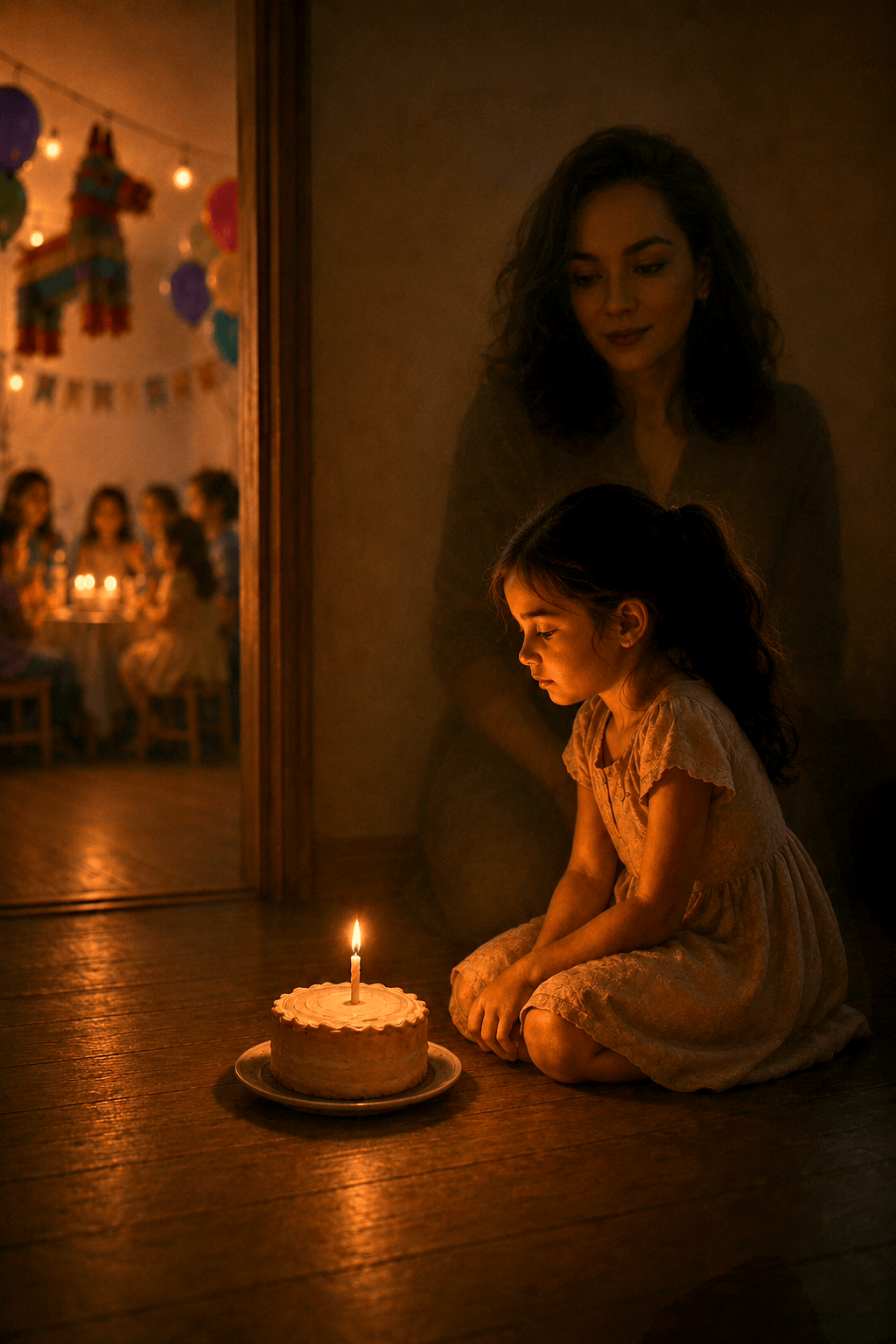

I don’t remember my first birthday cake. Nor my second, or my third. I don’t remember a table laid out for me, a piñata hanging in a garden somewhere, the noise of children waiting for it to break so they could scramble for the sweets. I don’t remember a candle burning in front of my face, or anyone telling me to close my eyes and make a wish.
Perhaps that is why, for a long time, I thought birthdays were something that happened to other people. I discovered they were real when I was eight or nine. Around then, my nieces and nephews began to be born, and I saw how, once a year, the world would stop for a little while around one person. There was cake. There were presents. There were preparations.
Someone remembered which character the child liked, what they wanted to eat, what might make them happy. There was a date marked on the calendar that said, without needing words: I’m so glad you were born.
I watched and learnt.
I don’t remember thinking at the time that any of it was unfair. Children have a strange ability to accept the rules of the household as though they were the rules of the universe. If something never happens, you do not immediately ask why. First, you learn that this is simply how things are. I don’t know what it was like for my siblings either, because I came along unexpectedly, many years later.
Then I turned fifteen. In Mexico, a girl knows that fifteen can be a threshold. I had seen the dresses, the parties, families making plans for months. And I was excited. I don’t know exactly how much I dreamed about that party, but I do remember waiting for something to happen.
Nothing did.
I think that was when I began to understand something it would take me many years to dare to say out loud: for some reason, my parents had decided that those things were not for me. Birthdays existed. Cakes existed. Celebrations existed… They simply were not for me.
Then I grew up.
And when I finally had my own money, I did something I understand better now: I began celebrating everyone.
I celebrated my nieces and nephews, and later my great-nieces and great-nephews. I threw parties for them from their first birthdays onwards, year after year. I thought about themes, bought decorations, found everything that was needed, chose presents. I designed their cakes especially for them, with the characters that filled their imaginations at the time.
I enjoyed doing it. That is true as well. I do not want to turn all the love I gave into an unpaid bill, because there was happiness in giving it.
But there was something else too: perhaps, without knowing it, that little girl who had never blown out a candle was building birthdays everywhere.
I celebrated my mother. I celebrated some of my siblings. I bought cakes, flowers, presents chosen with the person receiving them especially in mind. I became fluent in the language of celebrating someone.
It was just that no one seemed to speak that language with me.
Every year my birthday came around, and some part of me waited. I was not asking for a grand party. Sometimes a cake would have been enough. Some flowers. A small present that said: I thought of you before this day arrived.
Some years, I ended up buying my own cake.
When I turned thirty, I expected something special. Thirty seemed like a number big enough for someone to stop and take notice.
Nothing happened.
At thirty-three, I celebrated my last birthday in Mexico. I still remember waiting for my mother to turn up with a cake.
She didn’t.
When I finally said something to her, her answer was simple:
‘It didn’t occur to me.’
There are things people say and probably forget five minutes later, yet those same words go on living for years inside the person who heard them.
It didn’t occur to me.
I had remembered so many times.
Always.
I had thought about everyone else’s cakes, their presents, their flowers, the things that might make them feel special. How could it be that mine never occurred to anyone?
Then I left Mexico.
Distance provided the perfect excuse for many things: I was far away. And yet I carried on sending things for every birthday, every Christmas. But in the other direction, towards me, presents were difficult. Parcels cost money. Everyone had their own lives to get on with.
Not a single present ever arrived from home.
At first, my partner celebrated my birthdays. And there was something about those early years that might have seemed excessive to someone else: every celebration repaired a tiny piece of something very old and very broken.
It was not just a cake. It had never been just a cake.
It was someone saying: I know today is your day.
It was someone who had thought ahead.
It was physical proof that I had occupied a small space in someone else’s mind.
For a few years, I felt that little girl finally had birthdays.
Then that ended too.
And there were birthdays I spent alone. No present. No embrace. No phone calls. No voice nearby. Some years, not even a call from my mother.
And I kept wondering why something that seemed so small hurt so much.
In therapy, I was asked the same question many times:
‘Have you told them this hurts you?’
Yes.
I have.
Many times.
I have told my mother in particular. I have asked her why there is never any gesture towards me. I have explained that I do not understand why I could spend weeks thinking about someone else’s present, their flowers, their cake, while no one seemed to think of me in the same way.
I did not always get an answer.
Or the answers were that I was exaggerating, that it was not that important, that I was making too much of something small.
As always.
But to me, it was never small.
Because I was not crying over a cake.
I was crying over all the cakes, over all the candles I never blew out. Over the fifteenth-birthday party I waited for and deserved. Over my thirtieth birthday. My thirty-third. Every birthday when I thought: maybe this year they will.
All those years I waited for someone to do spontaneously what I had already explained that I needed.
For a long time, I thought my sadness came from what I did not receive. Now I think a much more painful part of it came from the waiting.
I waited.
I waited for something.
Probably to feel loved.
That was the real ritual of my birthdays: waiting.
Waiting for a phone call. Waiting for a parcel. Waiting for flowers. Waiting for someone to have prepared something in secret. Waiting, just once, for someone to think of me with the same anticipation with which I had thought of others so many times.
And every year, when it did not happen, for a moment I became that broken little girl again, watching other people’s birthdays and learning that the celebration existed, but it was not for her.
This year, my birthday is approaching again.
A great deal has happened. Some people have drifted away, and from others I have chosen to distance myself. Some disappointments have repeated themselves so often that eventually they stopped surprising me.
And something strange has happened: for the first time in a very long time, I am not waiting.
I am not waiting for a parcel to arrive from Mexico, or for someone to buy me flowers. I am not waiting for my mother to remember to call. I know she will not. I am not waiting for a cake to appear that might somehow make up for all the cakes that were missing.
That still hurts.
It would be a lie to say otherwise.
Wounds do not simply disappear because you finally understand where they came from.
But beneath the pain, something else has appeared: peace.
The peace of not watching the door.
The peace of not checking my phone all day.
The peace of not constructing in my head the scene someone else ought to perform in order to prove that they love me.
Perhaps for many years I thought healing would mean that, at last, someone would celebrate me in the way I had always wanted to be celebrated.
Now I think healing may be something else: no longer handing other people the responsibility of proving to me, once a year, that my birth deserved to be celebrated.
That little girl is still inside me.
The girl without birthdays.
The girl who watched everyone else’s cakes.
The girl who waited for her fifteenth.
The girl who turned thirty and carried on waiting.
The girl who, at thirty-three, still thought perhaps her mother might appear with a cake.
The girl who bought flowers, presents, decorations and cakes for everyone because she understood perfectly the value of making someone feel special.
For years, I felt such sadness for her… and I did not know how to mend her.
Today, I feel that I want to go to her, sit beside her and perhaps say:
I don’t know why they didn’t celebrate you.
I don’t know why, so many times, they didn’t think of you.
I cannot change any of those birthdays.
But I am not going to leave you waiting any more.
I am here now.
This year, I still do not know what I will do on my birthday.
Perhaps I will buy a cake. Perhaps I won’t. Perhaps I will light a candle. Perhaps I will buy myself flowers.
But if I do, it will not be the sad cake a woman buys herself because nobody else remembered.
It will be mine.
It will not be there to replace what I did not receive, or to pretend that it did not hurt. Nor will it be there to convince myself that I do not need anyone.
It will be there to celebrate something it took me many years to understand:
that I, too, was invited to my own life.
Perhaps I was never a girl without birthdays.
Perhaps I was a girl whose birthday other people did not know how to celebrate.
And now that I am an adult, I can finally take her by the hand, place a candle in front of her and say:
‘Make a wish.’
This time, you do not have to wait for someone else to light the candle.


Deja una respuesta