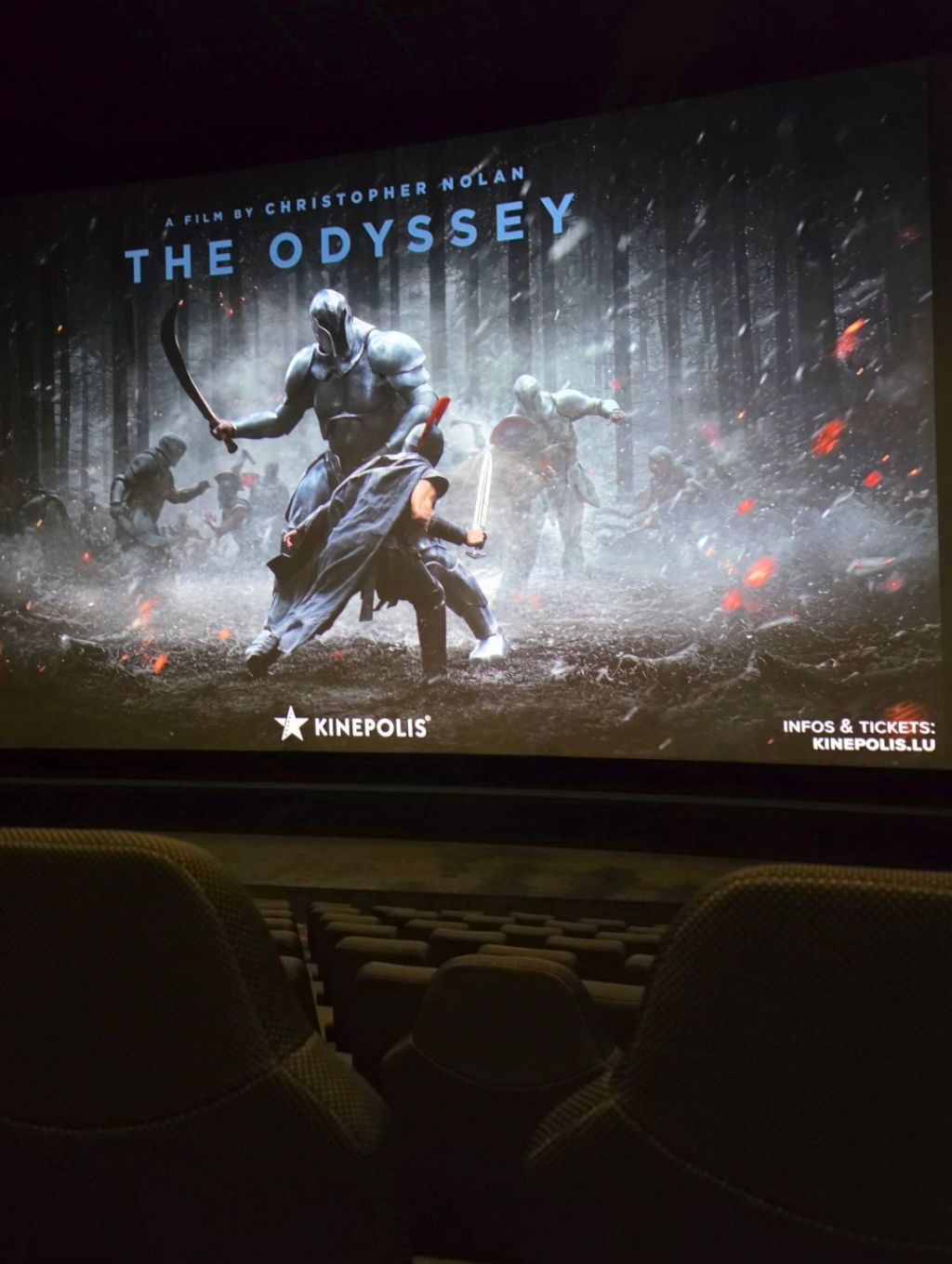
I have just seen The Odyssey, Christopher Nolan’s film, and I left the cinema thinking that, behind the monsters, the gods, the storms and the battles, this story is still speaking about something profoundly human.
We can see it as a great adventure: Odysseus’s return to Ithaca after the Trojan War, a journey that should have been relatively brief but ends up lasting ten years. Yet we can also read it as an inner journey. Odysseus does not merely cross the sea: he crosses fear, desire, vanity, loss, death, temptation and oblivion.
In that sense, The Odyssey is one of the foundational narratives of the hero’s journey. It does not merely tell us how someone manages to return home, but how he must transform himself in order to be capable of inhabiting it once again.
Ithaca is not merely an island. It is home, identity, lost order and the possibility of gathering together the parts of oneself after passing through chaos.
Unlike many heroic narratives, The Odyssey does not begin with an innocent young man leaving home to discover the world. Odysseus has already lived through his great adventure. He has spent twenty years away from Ithaca: ten fighting in the Trojan War and another ten trying to return. He has contributed to the Greek victory and achieved glory.
His problem is no longer how to become a hero, but how to stop being nothing more than a warrior.
Troy represents action, competition, violence and public honour. Ithaca represents intimacy, family, the continuity of life and legitimate rule. Odysseus’s true challenge is not to win another war, but to abandon the logic of war and recover his humanity.
The call to adventure also appears in reverse. Odysseus is not called to leave home, but to return to it. Yet that return cannot be direct, because the man who left for Troy is no longer the same man who is trying to come back.
Between Odysseus and Ithaca there is not merely a geographical distance. There is a psychological distance.
The sea is the story’s great symbolic space. It has no stability, it changes constantly and it can never be completely mastered. From an archetypal perspective, it represents the unconscious: that inner territory in which our repressed desires, our fears, our impulses, our monsters and also our protective forces emerge. On dry land, Odysseus can find his bearings. At sea, his strategies cease to be enough. He can solve specific situations through intelligence, but he cannot control the entire ocean. That is why Poseidon, god of the sea and earthquakes, represents a deep force that resists the hero’s will. He is that which cannot be subjected to calculation.
At first, Odysseus believes that his intelligence is sufficient to govern the world. Poseidon reminds him that there are forces greater than his will. Each storm destroys his illusion of control and forces him to develop something he still lacks: humility.
The journey does not require him to abandon his intelligence. It requires him to recognise its limits.
Odysseus is not a hero like Achilles. His chief quality is not physical strength, but the ability to adapt. He knows how to lie, improvise, negotiate, disguise himself and tell stories. He can conceal his name, assume new identities and quickly understand his opponents’ weaknesses. For that reason, he embodies two great archetypes.
On the one hand, he is the hero who faces trials and fights to restore order. On the other, he is the trickster, the figure who survives through ingenuity, deception and games with language.
Which of the two would you be? Or could it be that true balance consists in accepting that both coexist within you?
This combination is his greatest virtue, but it also contains his shadow. Anyone capable of adopting many identities runs the risk of losing his own. The great storyteller may become trapped in his fictions. The strategist may become a manipulator. Part of Odysseus’s learning consists in discovering when he must use cunning and when he must renounce it.
The Cyclops Polyphemus is one of the most powerful symbols in the story. He is enormous, brutal, solitary and has only one eye. That single eye can be interpreted as a one-sided consciousness. Polyphemus sees, but only from his own perspective. He does not recognise the other, does not respect the laws of hospitality and lives enclosed within his own needs.
He is the image of a primitive ego: a force that knows only its own appetite.
Odysseus manages to defeat him by saying that his name is “Nobody”. When the Cyclops calls for help and shouts that Nobody is attacking him, the others believe that there is no danger.
To escape the monstrous ego, the hero must temporarily renounce his identity. He must become nobody. Yet once he is safe, Odysseus makes a decisive mistake. He cannot resist revealing his true name. He needs Polyphemus to know who has defeated him.
There the shadow of Odysseus appears: his vanity.
He has been capable of erasing his name in order to survive, but he still needs recognition. His pride brings about Poseidon’s curse and prolongs the journey. His pride. His pride.
The episode suggests that it is not enough to defeat the monster outside us. It is also necessary to recognise the part of the monster that lives within.
Circe turns Odysseus’s men into animals. Yet she does not appear to introduce anything entirely new into them. Rather, she reveals what was already latent. The men lose their human form because they become ruled by appetite. Circe represents fascination, pleasure and the possibility of returning to a purely instinctive existence.
But her role does not end there.
At first she appears as a threat, and later she becomes a guide. Once Odysseus succeeds in establishing a conscious relationship with her, Circe ceases to be a destructive sorceress and begins to guide him.
From a psychological perspective, she can be understood as a figure of the anima: an inner feminine image capable of disorientating the hero, but also of leading him towards a deeper consciousness. Is it worth it?
Circe’s transformation shows that some psychic forces first appear as threats because they have not yet been recognised. Once integrated, they can become sources of wisdom.
The journey to the world of the dead is the initiatory centre of The Odyssey.
In many heroic narratives, there is a descent into a cave, an abyss, a prison, the belly of a monster or a kingdom of shadows. It is the moment when the hero loses his certainties and comes into contact with mortality.
Odysseus speaks with Tiresias, with his mother and with the heroes of old. There he discovers that glory cannot conquer death.
His encounter with Achilles is especially important. Achilles had chosen a short and glorious life over a long and anonymous one. Yet from the world of the dead, he admits that he would prefer to be alive, even in humble circumstances.
This scene calls into question the heroic ideal of The Iliad. Martial glory ceases to appear as the highest value. The Odyssey proposes another ethic: to live, to return, to care for one’s home, to recover one’s bonds and to allow life to continue.
After looking death directly in the face, Ithaca no longer means the same thing. Returning home ceases to be an inglorious retreat and becomes a radical choice in favour of existence.
The Sirens do not merely offer pleasure. They offer knowledge. They promise to reveal everything that has happened and to sing the complete truth of the world.
Odysseus wants to hear them. That is why he asks his companions to tie him to the mast while they block their ears and continue rowing.
The scene reveals the ambiguous relationship we have with knowledge. Consciousness desires to know everything, yet there are truths, obsessions and ideas capable of paralysing us. Whoever listens to the Sirens abandons the journey. He stops acting, building and returning. He remains entranced. The mast represents an axis of identity. Odysseus can approach this dangerous experience because he remains tied to something firm.
Psychologically, we can explore disturbing desires, thoughts and truths so long as we preserve an inner structure that allows us to return. Without it, fascination can absorb us.
It is also important that Odysseus does not face this trial alone. He listens, but his companions row. One part of consciousness may approach the mystery while other functions must keep everyday life in motion.
Only in that way does one remain sane.
Scylla and Charybdis represent two forms of destruction. Moving completely away from one forces Odysseus closer to the other. This trial destroys the fantasy that intelligence will always find a perfect solution. Nevertheless, a decision must be made, however imperfect it may be. Odysseus must choose, knowing that he cannot save everyone. He has to accept a limited loss in order to avoid a greater catastrophe.
From an archetypal perspective, this episode marks the transition from a youthful intelligence, convinced that every problem can be solved, to a tragic wisdom capable of accepting that some conflicts have no clean resolution. Maturity does not consist in always avoiding suffering. It also consists in accepting responsibility for making decisions within imperfect circumstances.
Odysseus’s companions receive a clear prohibition: they must not touch the sacred cattle of Helios. Driven by hunger, however, they slaughter the animals.
Hunger is understandable, but it does not justify everything.
The episode represents the violation of a sacred boundary. It reminds me of Eden and its prohibitions. The companions consume something that does not belong to them and destroy the covenant that sustained their journey. In psychological terms, they embody impulses that demand immediate satisfaction and refuse to accept limits. When a person sacrifices all their principles in the face of urgency, they eventually destroy the very structure that supports them. As a consequence, the ship is wrecked and Odysseus is left completely alone.
I told you: Odysseus’s journey is everyone’s journey.
By losing his entire crew, he also loses the less disciplined and integrated parts of himself. From that moment on, the journey becomes even more inward.
Calypso offers Odysseus protection, pleasure and even immortality. She offers him the possibility of living outside time.
Yet he chooses to return to Ithaca.
This choice is one of the most profound statements in the story. Odysseus renounces immortal perfection in order to recover a human life, limited and concrete. Do you see? Imperfection has its own honour. The hero does not have to be perfect. In this case, he chooses to be human.
Calypso’s island appears to be a paradise, but it is also a prison. Nothing there truly changes. Existence can repeat itself indefinitely because there is no history, ageing or responsibility. In other words, Calypso represents your comfort zone.
Ithaca, by contrast, contains pain, conflict, ageing and death. But it also contains bonds, memory and belonging.
The hero chooses a meaningful mortality over an empty eternity. And what do you choose: your comfort or the intensity of life?
A finite life with roots and responsibilities is worth more than a perfection without history.
After being shipwrecked, Odysseus arrives naked and exhausted in the land of the Phaeacians. He has lost his ships, his companions, his wealth and every outward sign of his rank. There is something birth-like in his arrival. He emerges from the sea without social identity, reduced to his most elemental human condition.
Nausicaa represents hospitality and the possibility of re-entering the civilised world. Thanks to her and the Phaeacians, Odysseus recovers clothing, food, dignity and, finally, a ship.
Before becoming a king again, he must learn to be a guest. This reminds us that identity is not merely something we possess inwardly. It also depends on the recognition of others.
Odysseus recovers his place in the world by telling his story. When he recounts his adventures, he transforms the chaos he has lived through into comprehensible experience. Telling what happened is also a way of integrating it.
When Odysseus finally reaches Ithaca, Athena does not allow him to enter as a victorious king. She transforms him into a beggar.
The disguise performs an initiatory function. Odysseus must return without the outward signs of his power in order to discover what has truly happened in his kingdom. Do you care enough about the kingdom to return with the humility of a beggar?
The beggar is the king’s shadow. He represents vulnerability, anonymity and exclusion. To recover his place, Odysseus must first experience that which lies at the opposite extreme of his public identity.
Before, he gave orders; now, he must observe. Before, he was admired; now, he must endure mockery. Before, he needed to speak his name; now, he knows how to conceal it.
The contrast with the episode of Polyphemus is clear. Before the Cyclops, Odysseus could not resist revealing who he was. In Ithaca, after all his trials, he now knows how to remain silent. That capacity to wait reveals his true transformation.
During Odysseus’s absence, the suitors have settled in his house, consuming his wealth and pressuring Penelope to choose a new husband.
On the political level, they represent disorder, usurpation and the loss of legitimate authority. On the psychological level, they can be understood as partial forces that occupy the centre when guiding consciousness is absent.
The suitors consume, but they do not produce. They inhabit the house, but they do not care for it. They wish to possess the kingdom without accepting the responsibility of ruling it.
They are appetites that aspire to become kings.
When the true centre is absent for too long, other forces attempt to take its place: vanity, resentment, ambition, fear or immediate desire.
Odysseus’s return represents the restoration of order. The violence of the slaughter may trouble us from a contemporary perspective, but symbolically it expresses the expulsion of those usurping forces.
Penelope is not merely the wife who waits. She is the inner equivalent of Ithaca.
While Odysseus travels through an unstable world, she keeps the space of the home open. She weaves during the day and unravels her work at night in order to delay marrying one of the suitors. Her weaving represents fate, memory and the construction of meaning. Penelope suspends time until the story can be completed. Penelope, of course.
She also possesses an intelligence similar to Odysseus’s. They are equals and mirrors at the same time. They are flames… She does not immediately believe the man who claims to be her husband. She subjects him to a test involving the secret of their marriage bed.
Odysseus has survived because he knows how to distrust appearances. Penelope does too. She is a worthy wife of Odysseus. But now Odysseus must prove that he is a worthy husband of Penelope.
For that reason, their union is not based solely on romantic love. It is the mutual recognition of two intelligences capable of waiting, concealing, observing and understanding.
The deepest final symbol is the bed of Odysseus and Penelope. Odysseus built it around the living trunk of an olive tree, so that it cannot be moved without being destroyed. That bed represents the immovable centre of identity.
Odysseus has spent years at sea, where everything changes and shifts. He has slept on ships, beaches, in palaces and on islands. Yet at the heart of his home, something remains rooted.
The olive tree unites nature and culture: it is a living tree transformed into part of a human construction. In the same way, the marriage of Odysseus and Penelope unites desire, history, memory and commitment. When Penelope suggests that the bed might be moved, Odysseus reacts immediately because he knows that it is impossible. That secret knowledge proves his identity. Penelope does not recognise him through his appearance or his achievements. She recognises him because they both share knowledge of a root. Ithaca is that which cannot be moved because it forms part of the deepest structure of the self.
Athena is Odysseus’s great ally. She represents strategic intelligence, prudence, measure and the ability to act at the right moment.
She does not remove the trials, but she helps the hero to understand and overcome them.
She can be interpreted as an external representation of Odysseus’s inner wisdom: an intelligence that is no longer merely at the service of pride, but of the restoration of order. Her presence also reminds us that no heroic journey is entirely individual. The hero must act, but he also needs help, inspiration, grace, destiny or guidance.
We do not always save ourselves alone.
The Odyssey does not tell only the story of Odysseus’s return. It also tells the story of Telemachus’s growth. At the beginning, Telemachus lives in the shadow of an absent father. He does not fully know who he is because he does not know whether Odysseus is alive or dead.
His search for news of his father functions as a process of individuation. He must abandon passivity, speak before the assembly, travel, form relationships with other kings and begin to construct his own identity.
Odysseus travels in order to become a father again. Telemachus travels in order to become an adult son.
When they finally meet, they do not simply recover the relationship they had before. They build a new relationship between two men capable of recognising one another and acting together. The son needs the father in order to understand part of his origin, but the father also needs the son. Without Telemachus, Odysseus’s return would be incomplete, because there would be no future to return to.
At the beginning of the journey, Odysseus trusts too greatly in his own ingenuity and needs his victories to be recognised. By the end, he has learnt to hide, wait, endure and act at the right moment.
His transformation can be summarised as the passage from fame to belonging; from display to silence; from control to the acceptance of limits; from strategy to wisdom; from public identity to intimate connection; and from warrior to husband, father and king.
He does not return less heroic. He returns with a different understanding of heroism. At the beginning, being a hero means conquering. At the end, it means preserving.
From a psychological perspective, each island can represent a state of consciousness and each creature an inner force.
Polyphemus is the devouring ego that recognises only its own desire.
Circe is the regression into instinct, but also an energy that can be transformed into guidance.
The Sirens represent a fascination capable of bringing life to a standstill.
Scylla and Charybdis are the dilemmas that admit no perfect solution.
The cattle of the Sun represent the limits that cannot be broken without consequences.
Calypso is the temptation to abandon time, responsibility and history.
The suitors are the impulses that occupy the centre when true consciousness is absent.
Athena is guiding intelligence.
Penelope is fidelity to the deepest core.
Telemachus is the future that needs to be recognised.
Ithaca is the integrated self.
The journey does not necessarily consist in destroying all these forces. It consists in learning how to relate to them. Some must be defeated; others listened to; some must be abandoned, while others need to be integrated.
Odysseus’s return does not restore the past exactly as it was. After twenty years of absence, he cannot recover the life that existed before Troy.
He has changed. Penelope has changed. Telemachus has grown. Ithaca, too, has suffered the consequences of time. What Odysseus recovers is not an untouched past, but the possibility of inhabiting his own existence once again.
For that reason, Ithaca is less a reward than a reconciliation: with mortality, with time, with our bonds and with our own identity.
All of us abandon an original home at some point: childhood, innocence, a relationship, a community or an earlier version of ourselves. We pass through experiences that change us and, at times, fragment us.
The true question is not whether we can become who we once were again.
The question is whether we can return transformed without losing that which was essential to who we were. I believe we can. We do not want to be who we were before we were fragmented. It is neither possible nor desirable, because then all the suffering, adventures and challenges would have been in vain.
Perhaps that is why The Odyssey continues to move us after so many centuries. Because the complete hero is not the one who remains invulnerable or defeats all his enemies. It is the one who passes through chaos, recognises his own shadow and succeeds in reconnecting with life.
In the end, the most difficult journey is not the one that takes us far from home. It is the one that allows us to return to ourselves.
And who knows, perhaps this text, too, admits more than one reading.
In The Odyssey, identity is never revealed through grand speeches. It is revealed through signs that only two people understand: a name, a bow, a bed.


Deja una respuesta