
🇪🇸 Versión en español abajo⬇️
Today I want to interpret the suit of Pentacles in the tarot as though it were a story. Not merely as separate meanings, but as a complete path.
This tale is both particular and universal: the story of someone who once held a truth in the mind, but must now ask whether that truth can take shape in reality.
Because the Swords spoke of the mind, of words, of decisions and of wounds. But the Pentacles speak of something else: of what is built, of what is cared for, of what is lost, of what has value, of what remains.
The Swords cut.
The Pentacles asked:
“Now what are you going to do with that truth?”
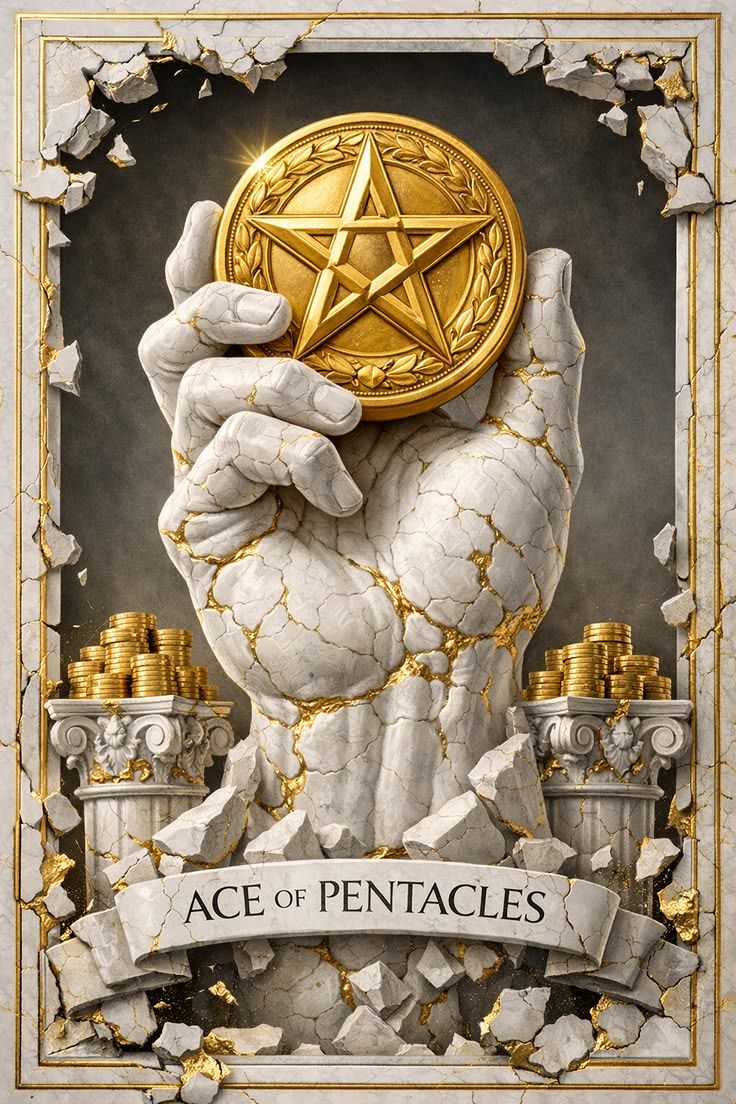
First came the Ace of Pentacles.
A seed in the palm of the hand.
A concrete possibility. Something small, but real. After so much hurt, so many unspoken words, so many thoughts going round and round, an opportunity appeared: not an empty promise, not a fantasy, but the real possibility of beginning something different.
He felt it as a question:
“If you truly know what you want, what are you willing to care for?”
Because the Ace of Pentacles does not speak only of desire. It speaks of potential. Of an open door. Of something that can grow, but will not grow on its own.
Then came the Two of Pentacles.
And with it, the back and forth.
He tried to balance what he felt with what he could sustain. His heart was looking in one direction, but his life, his fears, his responsibilities and his habits were pulling him in another. It was not the blindfold of the Two of Swords, but the constant movement of someone trying not to let anything fall.
He wanted to move forward, but he also wanted to remain in control.
He wanted to come closer, but also to protect his stability.
He wanted to take the seed, but feared he would not know what to do with it.
The Two of Pentacles showed him that a truth is not enough if one’s whole life does not learn how to make room for it.
Then came the Three of Pentacles.
And there he understood that building is not done alone.
After so many swords between the King and the Queen, it was not enough to be right, nor to have clarity, nor to feel deeply. If something was to be raised again, it would have to be done through cooperation, humility and real work.
The Three of Pentacles spoke of dialogue, of agreements, of recognising the other person’s place. Perhaps he had to stop acting as though he could solve everything from inside his own mind. Perhaps she needed to see actions, not only words. Perhaps both of them had to learn to build a structure where before there had only been defence.
Because love, when it wants to remain, also needs architecture.
With the Four of Pentacles, he closed himself off.
Not for lack of feeling, but for fear of losing more.
He guarded his heart like someone holding a coin against their chest. He clung to his pride, to his safety, to his reasons, to his silences. After having felt that everything could break, he wanted to control the little that was left.
But the Four of Pentacles showed him an uncomfortable truth: sometimes we believe we are protecting ourselves when, in truth, we are shutting ourselves in.
Clinging is not always caring.
Silence is not always maturity.
Holding on too tightly can also stop something from breathing.
Then came the Five of Pentacles.
And there appeared the feeling of loss, of misery.
Cold. Distance. Outside. As though between the King and the Queen there were an illuminated doorway, but neither knew how to enter. He may have felt excluded from what once gave him warmth. She may have felt alone even while close by. He felt she had left him trembling in the cold. She still believed she would never be enough for him. Both may have walked with visible and invisible wounds, convinced the other no longer looked at them in the same way.
The Five of Pentacles did not speak only of material lack. It spoke of emotional lack. Of feeling poor in certainties, poor in presence, poor in comfort.
After so many swords, the Pentacles showed the real cost of distance: it did not only hurt in the mind. It was also felt in the body, in the routine, in the days, in the absence. Spiritual poverty.
Then appeared the Six of Pentacles.
And with it, the question of balance.
Who gave more?
Who waited more?
Who held more?
Who felt indebted?
Who felt they were asking too much?
The Six of Pentacles laid reciprocity on the table as a necessary truth. Because where one gives from ego and the other receives from a wound, love becomes unequal. And where one always waits and the other always decides when to appear, the scales end up tipping.
He understood that he could not come closer merely to soothe his guilt. He could not offer crumbs and call them an offering. He could not expect the Queen to receive just anything simply because it came from him.
The Six of Pentacles taught him that love also needs justice.
With the Seven of Pentacles came the waiting.
A waiting heavy with questions.
He looked at what had been sown. He looked at what had been lived. He looked at everything that had grown and everything that had withered. He wondered whether it was still worth tending that soil, whether there were still roots beneath the silence, whether anything could bear fruit again after so much winter.
The Seven of Pentacles did not give him an immediate answer. It asked him for patience. It asked him for honesty. It asked him to look without anxiety.
Because not everything that takes time is dead.
But not everything that is waited for is destined to bloom.
Then came the Eight of Pentacles.
And there he understood that wanting was not enough, nor was waiting. There had to be work.
Work on himself. On his way of speaking. On his way of staying silent. On his way of coming closer without invading, of asking forgiveness without justifying himself, of holding a truth without turning it into pressure. He had to learn the craft of mature love.
The Eight of Pentacles did not promise quick results. It showed him a table, tools, repetition, discipline. Every small act mattered. Every coherent gesture. Every word spoken with care. Every silence chosen not to punish, but to avoid hurting.
After the Swords, the Pentacles told him:
“Now prove through actions what you claim to have understood.”
Then appeared the Nine of Pentacles.
And there the Queen became inevitable.
She was in her own garden.
Whole. Serene. Dignified. Everything had hurt her, but she had learnt to sustain herself. She no longer waited from a place of lack. She no longer needed to chase an explanation in order to know how much she was worth. She had cultivated her own space, her beauty, her peace, her independence.
The Nine of Pentacles did not show her as cold. It showed her as abundant.
And he had to see her that way: not as someone he had to convince, recover or defeat, but as someone who already belonged to herself. He saw her bloom without asking permission, without begging for presence, without breaking under his absence. And in that image there was admiration, but also a pang of loss.
If he wanted to come closer, he would have to do so with respect. Not to fill a void. Not to disturb her garden. Not to ask her to lower her boundaries. But to meet a woman who had learnt to bloom even after the wounds.
And he too had to ask himself whether he was whole.
Whether he had cultivated his own life.
Whether he recognised his own worth without needing someone else to come and confirm it.
And finally came the Ten of Pentacles.
The vision of something that can endure. Not only emotion. Not only desire. Not only a pending conversation. The Ten of Pentacles spoke of legacy, of home, of stability, of a construction that does not depend on the impulse of a single day, but on a choice sustained over time.
He saw what could have been. And perhaps he also saw what could still be.
But the Ten of Pentacles is not reached through promises. It is reached through maturity, presence, responsibility, through actions repeated until they become trust.
Because a truth may be born in the Ace of Swords, but it only becomes life when it finds earth in the Ten of Pentacles.
Then appeared the Page of Pentacles.
A new part of him awoke.
It was no longer only the curiosity of the Page of Swords, wondering what had happened. Now it was a humbler disposition: to learn how to care for something real.
The Page of Pentacles looked at the seed with attention. He did not run. He did not proclaim. He did not demand. He observed.
“What must I learn?
What must I change?
What can I truly offer?
What does this story need so it does not repeat itself?
What does she need in order to trust?”
The Page of Pentacles brought a simple intention: to begin again from the small, from the honest, from the concrete.
Then came the Knight of Pentacles.
And with him, constancy.
It was not the swift impulse of the Knight of Swords, who wanted to say everything at once and cut through the distance with a single phrase. This Knight moved slowly. But he moved.
Step by step.
Action by action.
Day by day.
The Knight of Pentacles did not conquer through intensity, but through presence. He did not promise the heavens if he could not care for the earth. He did not say “I understand” only to repeat the same thing afterwards. His love was not haste: it was permanence.
He had to learn that, sometimes, repair does not arrive as a dramatic declaration, but as a new behaviour sustained over time. However, there is the risk that his impulse may be too slow, almost immovable.
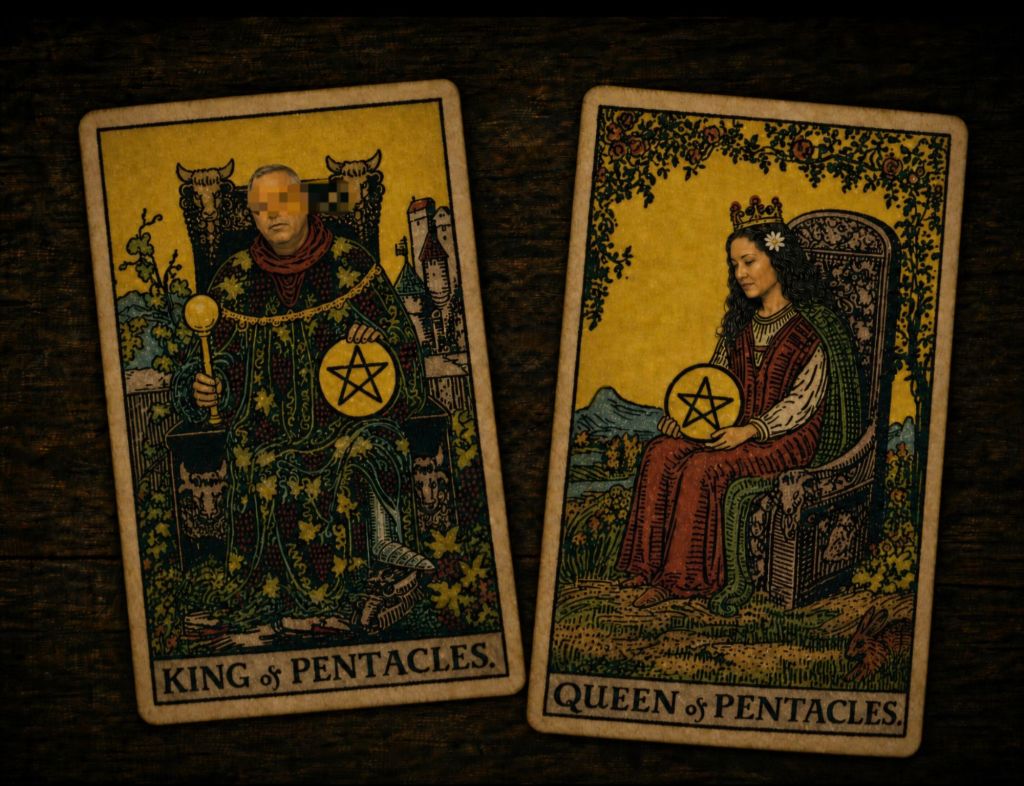
Then appeared the Queen of Pentacles.
She was there: warm, fertile, wise, protective of her world.
But before seeing her as Queen, he also had to look at the shadow of that world. Because the Pentacles, when they harden, can become a wall.
She could be seen as a difficult woman, demanding, too comfortable in her own garden. Someone who no longer opens the door easily. Someone who measures, observes, waits for proof. Someone who does not give her tenderness to just any hand. And someone who, despite knowing her own worth, at times still thinks she will never be good enough for the King.
Now she was not only the Queen of Swords, clear and firm, asking for truth, respect and maturity. She was also the Queen of Pentacles: a woman who knows how to care, but also knows the value of her care. Her tenderness was not weakness. Her patience was not permission to be hurt. Her capacity to love did not mean she would accept just anything.
The Queen of Pentacles showed him that love also needs body, home, calm, safety. That a brilliant truth is not enough if afterwards there are no hands capable of holding it.
She did not ask for riches.
She asked for presence.
She asked for coherence.
She asked for a place where what was said could feel safe.
And at the end appeared the King of Pentacles.
But before becoming that King, he had to recognise how he could be seen in his shadow:
Stubborn.
Closed.
Clinging to his way of doing things.
A man who perhaps confused stability with control. Who could protect his world so much that he ended up seeming inaccessible. Who could speak of reality when, deep down, he was afraid to take a risk. Who could hide his heart behind the practical, the correct, the convenient, the safe.
Perhaps the Queen saw him that way: firm, yes, but also immovable. Capable of sustaining many things, except that which required vulnerability. Capable of working, building, enduring, but slow to open his hand when he had to give something of himself.
In his shadow, the King of Pentacles could seem materialistic not only because he valued the tangible, but because he needed proof, guarantees, solid ground before daring to feel out loud.
And yet, in his light, the King of Pentacles knows how to stand by what he says. He is the man who does not appear only when emotion overwhelms him. The man who does not confuse desire with commitment. The man who understands that to love is also to care for the earth where love grows.
The King of Pentacles does not promise from urgency. He builds from stability. He does not offer words to impress, but actions to prove. He does not take the seed only to let it die. He plants it, waters it, protects it, waits for it.
And so, after travelling through the whole suit of Pentacles, he understood something:
It was not enough to know what he wanted.
It was not enough to suffer for it.
It was not enough to have the truth in front of him.
He had to give it form.
He had to care for it.
He had to deserve the trust of that which he claimed to love.
Between the King and the Queen there were too many swords. That is true.
But the Pentacles brought another possibility: that after truth could come construction. That after the wound could come care. That after silence could come actions. That after fear could come a real presence.
Because the Pentacles do not only weigh heavily.
They also sustain.
And there is the Ace of Pentacles, King. 🪙
The seed before you.
Plant it. 🌱
Lo que cuentan los Oros
Hoy quiero interpretar el palo de Oros del tarot como si fuera una historia. No solo como significados separados, sino como un camino completo.
Este relato es una historia particular y, al mismo tiempo, universal: la historia de alguien que ya tuvo una verdad en la mente, pero ahora debe preguntarse si esa verdad puede tomar forma en la realidad.
Porque las Espadas hablaron de la mente, de las palabras, de las decisiones y de las heridas. Pero los Oros hablan de otra cosa: de lo que se construye, de lo que se cuida, de lo que se pierde, de lo que vale, de lo que permanece.
Las Espadas cortaron.
Los Oros preguntaron:
“¿Y ahora qué vas a hacer con esa verdad?”
Primero apareció el As de Oros.
Una semilla en la palma de la mano.
Una posibilidad concreta. Algo pequeño, pero real. Después de tanta herida, de tanta palabra no dicha, de tanto pensamiento dando vueltas, apareció una oportunidad: no una promesa vacía, no una fantasía, sino la posibilidad real de empezar algo distinto.
Él lo sintió como una pregunta:
“Si de verdad sabes lo que quieres, ¿qué estás dispuesto a cuidar?”
Porque el As de Oros no habla solo de deseo. Habla de potencial. De una puerta abierta. De algo que puede crecer, pero que no crecerá solo.
Después llegó el Dos de Oros.
Y con él, el vaivén.
Él intentó equilibrar lo que sentía con lo que podía sostener. Su corazón miraba hacia una dirección, pero su vida, sus miedos, sus responsabilidades y sus hábitos tiraban hacia otra. No era la venda del Dos de Espadas, sino el movimiento constante de alguien que trata de no dejar caer nada.
Quería avanzar, pero también quería mantener el control.
Quería acercarse, pero también proteger su estabilidad.
Quería tomar la semilla, pero temía no saber qué hacer con ella.
El Dos de Oros le mostró que una verdad no basta si la vida entera no aprende a acomodarse a ella.
Entonces vino el Tres de Oros.
Y ahí entendió que construir no se hace en soledad.
Después de tantas espadas entre el Rey y la Reina, no bastaba con tener razón, ni con tener claridad, ni con sentir profundamente. Si algo iba a levantarse de nuevo, tendría que hacerse con cooperación, humildad y trabajo real.
El Tres de Oros habló de diálogo, de acuerdos, de reconocer el lugar del otro. Tal vez él debía dejar de actuar como si pudiera resolverlo todo desde su propia mente. Tal vez ella necesitaba ver hechos, no solo palabras. Tal vez ambos tenían que aprender a construir una estructura donde antes solo había defensa.
Porque el amor, cuando quiere permanecer, también necesita arquitectura.
Con el Cuatro de Oros, él se cerró.
No por falta de sentimientos, sino por miedo a perder más.
Guardó su corazón como quien guarda una moneda contra el pecho. Se aferró a su orgullo, a su seguridad, a sus razones, a sus silencios. Después de haber sentido que todo podía romperse, quiso controlar lo poco que quedaba.
Pero el Cuatro de Oros le mostró una verdad incómoda: a veces creemos que nos estamos protegiendo cuando, en realidad, nos estamos encerrando.
Aferrarse no siempre es cuidar.
Callar no siempre es madurez.
Guardar demasiado también puede impedir que algo respire.
Entonces llegó el Cinco de Oros.
Y ahí apareció la sensación de pérdida, de miseria.
Frío. Distancia. Afuera. Como si entre el Rey y la Reina hubiera una puerta iluminada, pero ninguno supiera cómo entrar. Él pudo sentirse excluido de lo que antes le daba calor. Ella pudo sentirse sola incluso estando cerca. Él sintió que ella lo había dejado temblando en el frío. Ella aún creía que nunca sería suficiente para él. Ambos pudieron caminar con heridas visibles e invisibles, convencidos de que el otro ya no los miraba igual.
El Cinco de Oros no habló solo de carencia material. Habló de carencia emocional. De sentirse pobre de certezas, pobre de presencia, pobre de consuelo.
Después de tantas espadas, los Oros mostraron el costo real de la distancia: no solo dolía en la mente. También se sentía en el cuerpo, en la rutina, en los días, en la ausencia. Pobreza espiritual.
Luego apareció el Seis de Oros.
Y con él, la pregunta por el equilibrio.
¿Quién dio más?
¿Quién esperó más?
¿Quién sostuvo más?
¿Quién se sintió en deuda?
¿Quién sintió que pedía demasiado?
El Seis de Oros puso sobre la mesa la reciprocidad como una verdad necesaria. Porque donde uno da desde el ego y el otro recibe desde la herida, el amor se vuelve desigual. Y donde uno siempre espera y el otro siempre decide cuándo aparecer, la balanza termina inclinándose.
Él comprendió que no podía acercarse solo para calmar su culpa. No podía dar migajas y llamarlas ofrenda. No podía esperar que la Reina recibiera cualquier cosa solo porque venía de él.
El Seis de Oros le enseñó que el amor también necesita justicia.
Con el Siete de Oros, llegó la espera.
Una espera cargada de preguntas.
Él miró lo sembrado. Miró lo vivido. Miró todo lo que había crecido y todo lo que se había marchitado. Se preguntó si todavía valía la pena cuidar esa tierra, si aún había raíces debajo del silencio, si algo podía volver a dar fruto después de tanto invierno.
El Siete de Oros no le dio una respuesta inmediata. Le pidió paciencia. Le pidió honestidad. Le pidió mirar sin ansiedad.
Porque no todo lo que tarda está muerto.
Pero no todo lo que se espera está destinado a florecer.
Entonces llegó el Ocho de Oros.
Y ahí entendió que no bastaba con querer, ni con esperar. Había que trabajar.
Trabajar en sí mismo. En su manera de hablar. En su manera de callar. En su forma de acercarse sin invadir, de pedir perdón sin justificarse, de sostener una verdad sin convertirla en presión. Había que aprender el oficio del amor maduro.
El Ocho de Oros no prometió resultados rápidos. Le mostró una mesa, herramientas, repetición, disciplina. Cada acto pequeño importaba. Cada gesto coherente. Cada palabra dicha con cuidado. Cada silencio elegido no para castigar, sino para no herir.
Después de las Espadas, los Oros le dijeron:
“Ahora demuestra con hechos lo que dices haber comprendido”.
Después apareció el Nueve de Oros.
Y ahí la Reina se volvió inevitable.
Ella estaba en su propio jardín.
Entera. Serena. Digna. Le había dolido todo, pero había aprendido a sostenerse. Ya no esperaba desde la carencia. Ya no necesitaba perseguir una explicación para saber cuánto valía. Había cultivado su propio espacio, su belleza, su paz, su independencia.
El Nueve de Oros no la mostró fría. La mostró abundante.
Y él tuvo que verla así: no como alguien a quien debía convencer, recuperar o vencer, sino como alguien que ya se pertenecía. La vio florecer sin pedir permiso, sin rogar presencia, sin romperse ante su ausencia. Y en esa imagen hubo admiración, pero también una punzada de pérdida.
Si quería acercarse, tendría que hacerlo con respeto. No para llenar un vacío. No para desordenar su jardín. No para pedirle que bajara sus límites. Sino para encontrarse con una mujer que había aprendido a florecer incluso después de las heridas.
Y él también tuvo que preguntarse si estaba entero.
Si había cultivado su propia vida.
Si reconocía su valor sin necesitar que alguien viniera a confirmarlo.
Y finalmente llegó el Diez de Oros.
La visión de algo que puede permanecer. No solo emoción. No solo deseo. No solo una conversación pendiente. El Diez de Oros habló de legado, de hogar, de estabilidad, de una construcción que no depende del impulso de un día, sino de una elección sostenida en el tiempo.
Él vio lo que pudo haber sido. Y tal vez también vio lo que aún podía ser.
Pero el Diez de Oros no se alcanza con promesas. Se alcanza con madurez, con presencia, con responsabilidad, con actos repetidos hasta volverse confianza.
Porque una verdad puede nacer en el As de Espadas, pero solo se vuelve vida cuando encuentra tierra en el Diez de Oros.
Entonces apareció la Sota de Oros.
Una parte nueva de él despertó.
Ya no era solo la curiosidad de la Sota de Espadas, preguntándose qué había pasado. Ahora era una disposición más humilde: aprender cómo cuidar algo real.
La Sota de Oros miró la semilla con atención. No corrió. No proclamó. No exigió. Observó.
“¿Qué debo aprender?
¿Qué debo cambiar?
¿Qué puedo ofrecer de verdad?
¿Qué necesita esta historia para no repetirse?
¿Qué necesita ella para confiar?”
La Sota de Oros trajo una intención sencilla: empezar de nuevo desde lo pequeño, desde lo honesto, desde lo concreto.
Luego llegó el Caballero de Oros.
Y con él, la constancia.
No era el impulso veloz del Caballero de Espadas, que quería decirlo todo de golpe y cortar la distancia con una sola frase. Este Caballero avanzaba despacio. Pero avanzaba.
Paso a paso.
Hecho tras hecho.
Día tras día.
El Caballero de Oros no conquistaba con intensidad sino con presencia. No prometía el cielo si no podía cuidar la tierra. No decía “lo entendí” para luego repetir lo mismo. Su amor no era prisa: era permanencia.
Él tuvo que aprender que, a veces, la reparación no llega como una declaración dramática, sino como una conducta nueva sostenida en el tiempo. Sin embargo, existe el riesgo de que su impulso sea demasiado lento, casi inamovible.
Después apareció la Reina de Oros.
Ella estaba ahí: cálida, fértil, sabia, protectora de su mundo.
Pero antes de verla como Reina, él tuvo que mirar también la sombra de ese mundo. Porque los Oros, cuando se endurecen, pueden volverse muro.
Ella podía ser vista como una mujer difícil, exigente, demasiado cómoda en su propio jardín. Alguien que ya no abre la puerta con facilidad. Alguien que mide, observa, espera pruebas. Alguien que no entrega su ternura a cualquier mano. Y alguien que, a pesar de conocer su propio valor, por momentos aún piensa que nunca será suficientemente buena para el Rey.
Ahora, no era solo la Reina de Espadas, clara y firme, pidiendo verdad, respeto y madurez. También era la Reina de Oros: una mujer que sabe cuidar, pero que también sabe cuánto vale su cuidado. Su ternura no era debilidad. Su paciencia no era permiso para ser herida. Su capacidad de amar no significaba que aceptaría cualquier cosa.
La Reina de Oros le mostró que el amor también necesita cuerpo, hogar, calma, seguridad. Que no basta con una verdad brillante si después no hay manos capaces de sostenerla.
Ella no pedía riquezas.
Pedía presencia.
Pedía coherencia.
Pedía un lugar donde lo que se dijera pudiera sentirse seguro.
Y al final apareció el Rey de Oros.
Pero antes de convertirse en ese Rey, él tuvo que reconocer cómo podía ser visto en su sombra:
Terco.
Cerrado.
Aferrado a su manera de hacer las cosas.
Un hombre que quizá confundía estabilidad con control. Que podía proteger tanto su mundo que terminaba pareciendo inaccesible. Que podía hablar de realidad cuando, en el fondo, tenía miedo de arriesgarse. Que podía esconder el corazón detrás de lo práctico, de lo correcto, de lo conveniente, de lo seguro.
Tal vez la Reina lo veía así: firme, sí, pero también inmóvil. Capaz de sostener muchas cosas, menos aquello que exigía vulnerabilidad. Capaz de trabajar, construir, resistir, pero lento para abrir la mano cuando tenía que entregar algo de sí.
En su sombra, el Rey de Oros podía parecer materialista no solo por valorar lo tangible, sino porque necesitaba pruebas, garantías, suelo firme antes de atreverse a sentir en voz alta.
Sin embargo, en su luz, el Rey de Oros sabe sostener lo que dice. Es el hombre que no aparece solo cuando la emoción lo desborda. El hombre que no confunde deseo con compromiso. El hombre que entiende que amar también es cuidar la tierra donde el amor crece.
El Rey de Oros no promete desde la urgencia. Construye desde la estabilidad. No ofrece palabras para impresionar, sino actos para demostrar. No toma la semilla para dejarla morir. La planta, la riega, la protege, la espera.
Y así, después de atravesar todo el palo de Oros, él comprendió algo:
No bastaba con saber qué quería.
No bastaba con sufrir por ello.
No bastaba con tener la verdad frente a él.
Tenía que darle forma.
Tenía que cuidarla.
Tenía que merecer la confianza de aquello que decía amar.
Entre el Rey y la Reina hubo demasiadas espadas. Es verdad.
Pero los Oros trajeron otra posibilidad: que después de la verdad viniera la construcción. Que después de la herida viniera el cuidado. Que después del silencio vinieran actos. Que después del miedo viniera una presencia real.
Porque los Oros no solo pesan.
También sostienen.
Y ahí está el As de Oros, Rey. 🪙
La semilla frente a ti.
Plántala. 🌱


Deja una respuesta