
🇪🇸 Versión en español abajo ⬇️
The Swords speak of the mind, of words, of decisions, and of the wounds left by truths when they are not spoken in time, or when they are spoken from pain.
Today, I want to interpret the suit of Swords in the tarot as though it were a story. Not only as separate meanings, but as a complete journey. A particular story and, at the same time, a universal one: the story of someone who knows what he wants, but carries the weight of everything that has hurt.
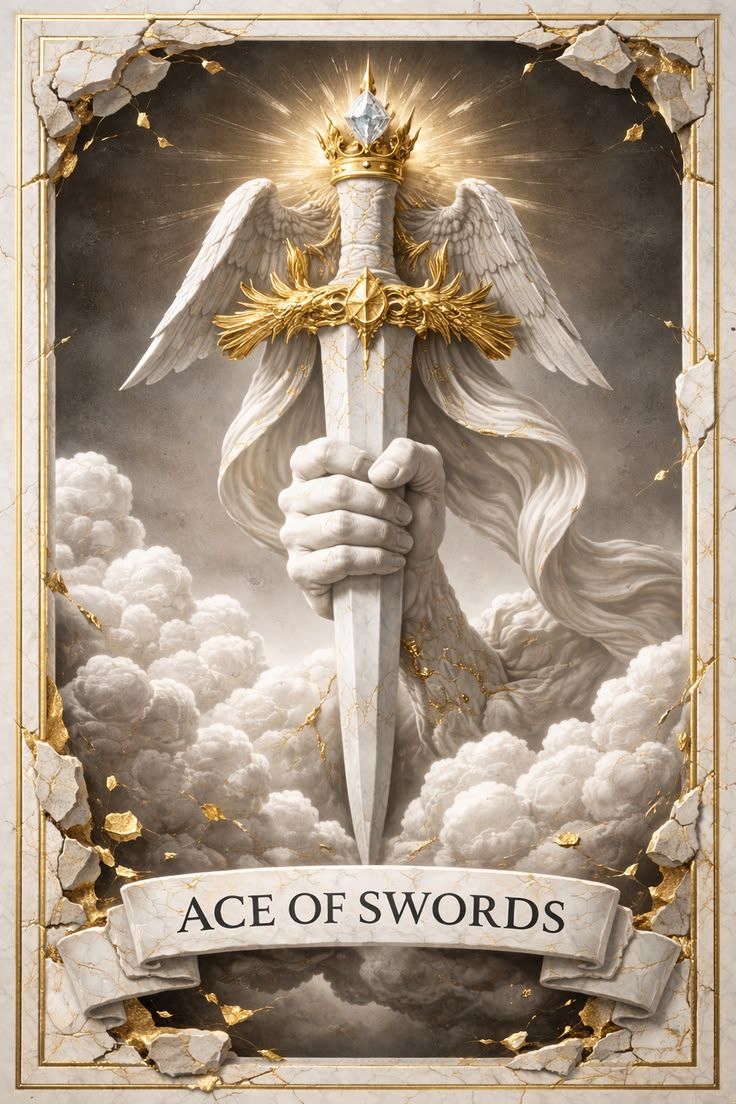
First appeared the Ace of Swords.
It was like a truth piercing the sky.
He knows it. He sees it clearly. He knows what he wants, he knows whom he wants, he knows where his mind and his heart are pointing, even if he tries to disguise it as logic. There is a sharp certainty within him: a truth he can no longer keep denying.
Then came the Two of Swords.
That truth left him still, blocked, with a blindfold over his eyes that he refused to remove. Not because he did not know what to choose, but because choosing hurt. He remained silent, his eyes closed before what was evident, trying to balance two forces: what he felt and what he feared. His mind asked him for calm, but his soul had already made a decision.
Then came the Three of Swords.
A broken heart. And there he understood that truth can also wound. What had happened between the King and the Queen had left a deep mark. There were words that cut, silences that weighed heavily, pride, distance, disappointment. It was not only sadness: it was the feeling that something beautiful had been pierced by too many reasons, too many wounds, too many swords.
With the Four of Swords, he withdrew.
Extreme exhaustion. Time and distance so as not to feel everything all at once. He needed to lie down within his own silence, close his eyes, stop fighting memories, thoughts, and possibilities. He felt crushed by everything that had happened, as though each sword had fallen upon his chest, one by one, until it left him without the strength to explain anything.
But rest did not erase the conflict. The Five of Swords arrived.
There appeared the battles no one won. The arguments in which being right cost more than having peace. Perhaps the King wanted to uphold his authority. Perhaps the Queen defended her dignity. Perhaps both of them spoke and acted from the wound, not from love. He looked at the field after the battle and understood that some victories leave a bitter taste.
Then appeared the Six of Swords.
He moved away. Not necessarily because he wanted to leave for ever, but because he needed to cross towards a less painful place. He carried the swords with him, the memories, the phrases, the doubts, but also the hope of reaching a calmer shore. Without forgetting. Out of sheer survival.
With the Seven of Swords, the most difficult part began.
There were things left unsaid. Strategies, evasions, emotional secrets. Perhaps he pretended to be fine. Perhaps she did too. Perhaps they both protected themselves so much from appearing vulnerable that they ended up seeming cold, calculating, distant. He knew what he wanted, but he did not always know how to say it without exposing himself.
Then came the Eight of Swords.
And he felt trapped. Not because there was no way out, but because there were too many thoughts. Every possibility was a rope. Every fear, a blindfold. He wanted to move, to come closer, to decide, to speak, but something inside him said: “You cannot. Not now. Not after all this.”
He was surrounded by swords, but many of them were made of memory, guilt, and fear. Not all of them were real.
Then came the Nine of Swords.
The nights grew heavier. He thought too much. He relived conversations. He imagined endings. He wondered whether he had failed, whether she had failed, whether they had both broken themselves by defending themselves. Although he knew what he wanted, the weight of what had happened kept him awake.
It was not indecision: it was anguish.
It was wanting to move forwards with the heart, while having a mind full of wounds.
And finally, the Ten of Swords fell.
The lowest point. The moment when he could no longer hold the pain, nor the pride, nor the inner battle. He felt defeated by everything that had happened between the King and the Queen. As though love, reason, pride, and sadness had all ended up driven into his back.
But in that fall there was a silent truth: the worst had already passed. After the ten, there is nothing left but to rise.
Then appeared the Page of Swords.
A young part of him awoke. He wanted to observe, understand, ask. He began to look at the story with different eyes. No longer only from pain, but from curiosity:
“What really happened?
What did I not say?
What did I refuse to see?
What truth is still alive beneath so much defence?
And her?”
The Page brought the desire to communicate, although still with caution.
Then came the Knight of Swords.
And with him, the impulse. The desire to go straight in, to say everything, to cut through the distance, to face the matter without beating about the bush. But there also appeared the risk of acting from haste, from anger, or from anxiety.
He had to learn that it is not enough to know what he wants. He must also know how to come closer without turning his truth into another sword.
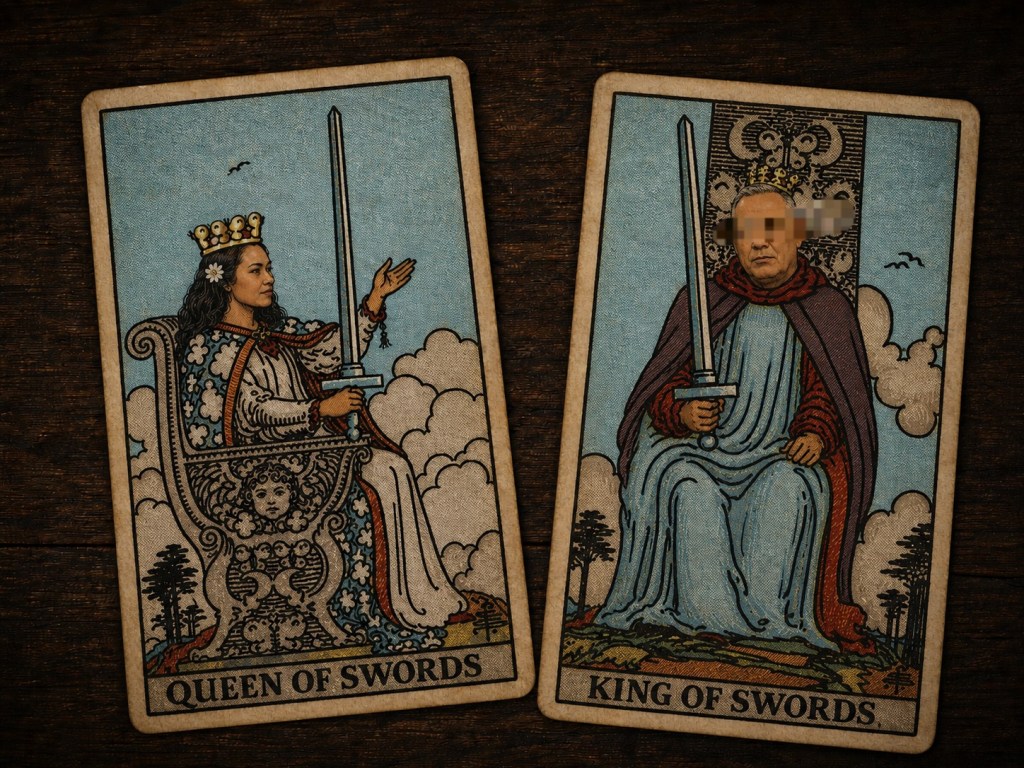
Then appeared the Queen of Swords.
She was there: clear, firm, intelligent, wounded, but whole. She was not a woman easy to deceive or to understand. She had learnt to protect herself, to set boundaries, to look straight ahead. Perhaps she seemed cold, but not because she did not feel; rather, because she had felt too much.
The Queen did not ask for pretty words. She asked for truth, respect, and maturity.
And at the end appeared the King of Swords.
He had to become that King. Not only the man who knows what he wants, but the man capable of holding his truth with responsibility.
The King of Swords does not beg from chaos, nor attack from pride. He speaks clearly, with dignity. He decides consciously. He acknowledges what happened. He does not use the sword to wound, but to separate truth from fear.
And so, after passing through the entire suit of Swords, he understood something:
He was not crushed because he did not know what he wanted.
He was overcome because he did know, but the path towards it was full of wounds, silences, defences, and memories.
Between the King and the Queen there had been too many swords.
But there is also a possibility: that both of them stop using them as weapons and begin to use them as truth.
Because the Swords do not only cut.
They also liberate.
And there is the Ace of Swords, King.
The truth before you.
Take it.
Lo que cuentan las Espadas
Las Espadas hablan de la mente, de las palabras, de las decisiones y de las heridas que dejan las verdades cuando no se dicen a tiempo, o cuando se dicen desde el dolor.
Hoy quiero interpretar el palo de Espadas del tarot como si fuera una historia. No solo como significados separados, sino como un camino completo. Una historia particular y, al mismo tiempo, universal: la historia de alguien que sabe lo que quiere, pero carga con el peso de todo lo que ha dolido.
Primero apareció el As de Espadas.
Fue como una verdad atravesando el cielo.
Él lo sabe. Lo ve con claridad. Sabe lo que quiere, sabe a quién quiere, sabe hacia dónde apuntan su mente y su corazón, aunque intente disfrazarlo de lógica. Hay una certeza afilada dentro de él: una verdad que ya no puede seguir negándose.
Después llegó el Dos de Espadas.
Esa verdad lo dejó quieto, bloqueado, con una venda en los ojos que se niega a quitar. No porque no supiera qué elegir, sino porque elegir dolía. Se quedó en silencio, con los ojos cerrados ante lo evidente, tratando de equilibrar dos fuerzas: lo que sentía y lo que temía. Su mente le pedía calma, pero su alma ya había tomado una decisión.
Entonces vino el Tres de Espadas.
Y ahí entendió que la verdad también puede herir. Lo ocurrido entre el Rey y la Reina había dejado una marca profunda. Hubo palabras que cortaron, silencios que pesaron, orgullo, distancia, decepción. No era solamente tristeza: era la sensación de que algo hermoso había sido atravesado por demasiadas razones, demasiadas heridas, demasiadas espadas.
Con el Cuatro de Espadas, él se retiró.
Cansancio extremo. Tiempo y distancia para no sentirlo todo de golpe. Necesitaba acostarse dentro de su propio silencio, cerrar los ojos, dejar de pelear con recuerdos, pensamientos y posibilidades. Se sintió aplastado por todo lo que había pasado, como si cada espada hubiera caído sobre su pecho, una por una, hasta dejarlo sin fuerza para explicar nada.
Pero el descanso no borró el conflicto. Llegó el Cinco de Espadas.
Ahí aparecieron las batallas que nadie ganó. Las discusiones donde tener la razón costó más que tener paz. Tal vez el Rey quiso sostener su autoridad. Tal vez la Reina defendió su dignidad. Tal vez ambos hablaron y actuaron desde la herida, no desde el amor. Él miró el campo después de la batalla y comprendió que algunas victorias dejan un sabor amargo.
Luego apareció el Seis de Espadas.
Él se alejó. No necesariamente porque quisiera irse para siempre, sino porque necesitaba cruzar hacia un lugar menos doloroso. Llevaba consigo las espadas, los recuerdos, las frases, las dudas, pero también la esperanza de llegar a una orilla más tranquila. Sin olvido. Por pura supervivencia.
Con el Siete de Espadas, empezó la parte más difícil.
Hubo cosas no dichas. Estrategias, evasiones, secretos emocionales. Quizás él fingió estar bien. Quizás ella también. Quizás ambos se cuidaron tanto de no mostrarse vulnerables que terminaron pareciendo fríos, calculadores, lejanos. Él sabía lo que quería, pero no siempre sabía cómo decirlo sin exponerse.
Entonces llegó el Ocho de Espadas.
Y se sintió atrapado. No por falta de salida, sino por exceso de pensamientos. Cada posibilidad era una cuerda. Cada miedo, una venda. Quería moverse, acercarse, decidir, hablar, pero algo dentro de él le decía: “No puedes. No ahora. No después de todo esto.”
Estaba rodeado de espadas, pero muchas estaban hechas de memoria, culpa y temor. No todas eran reales.
Después vino el Nueve de Espadas.
Las noches se volvieron más pesadas. Pensó demasiado. Revivió conversaciones. Imaginó finales. Se preguntó si había fallado, si ella había fallado, si ambos se habían roto por defenderse. Aunque sabía lo que quería, el peso de lo ocurrido lo desvelaba.
No era indecisión: era angustia.
Era querer avanzar con el corazón, pero tener la mente llena de heridas.
Y finalmente cayó el Diez de Espadas.
El punto más bajo. El momento en que ya no pudo sostener más el dolor, ni el orgullo, ni la batalla interna. Se sintió derrotado por todo lo que había sucedido entre el Rey y la Reina. Como si el amor, la razón, el orgullo y la tristeza hubieran terminado clavándose en su espalda.
Pero en esa caída había una verdad silenciosa: lo peor ya había pasado. Después del diez, no queda otra cosa más que levantarse.
Entonces apareció la Sota de Espadas.
Una parte joven de él despertó. Quiso observar, entender, preguntar. Empezó a mirar la historia con otros ojos. Ya no solo desde el dolor, sino desde la curiosidad:
“¿Qué pasó realmente?
¿Qué no dije?
¿Qué no quise ver?
¿Qué verdad sigue viva debajo de tanta defensa?
¿Y ella?”
La Sota trajo el deseo de comunicarse, aunque todavía con cautela.
Luego llegó el Caballero de Espadas.
Y con él, el impulso. Las ganas de ir directo, de decirlo todo, de cortar la distancia, de enfrentar el asunto sin rodeos. Pero también apareció el riesgo de actuar desde la prisa, desde la rabia o desde la ansiedad.
Él debía aprender que no basta con saber lo que quiere. También debe saber cómo acercarse sin convertir su verdad en otra espada.
Después apareció la Reina de Espadas.
Ella estaba ahí: clara, firme, inteligente, herida, pero entera. No era una mujer fácil de engañar ni de entender. Había aprendido a protegerse, a poner límites, a mirar de frente. Tal vez parecía fría, pero no porque no sintiera, sino porque había sentido demasiado.
La Reina no pedía palabras bonitas. Pedía verdad, respeto y madurez.
Y al final apareció el Rey de Espadas.
Él tuvo que convertirse en ese Rey. No solo en el hombre que sabe lo que quiere, sino en el hombre capaz de sostener su verdad con responsabilidad.
El Rey de Espadas no ruega desde el caos ni ataca desde el orgullo. Habla claro, con dignidad. Decide con conciencia. Reconoce lo ocurrido. No usa la espada para herir, sino para separar la verdad del miedo.
Y así, después de atravesar todo el palo de Espadas, él comprendió algo:
No estaba aplastado porque no supiera qué quería.
Estaba abatido porque sí lo sabía, pero el camino hacia eso estaba lleno de heridas, silencios, defensas y recuerdos.
Entre el Rey y la Reina hubo demasiadas espadas.
Pero también existe una posibilidad: que ambos dejen de usarlas como armas y empiecen a usarlas como verdad.
Porque las Espadas no solo cortan.
También liberan.
Y ahí está el As de Espadas, Rey.
La verdad frente a ti.
Tómala.


Deja un comentario