
🇬🇧 English version below ⬇️
La lechuza volvió a gritar anoche. No sé qué hora era. Cuando me incorporé, el reloj marcaba las tres y diecisiete, pero llevaba tanto tiempo despierta que la madrugada había perdido sus límites. Últimamente, no duermo bien… Sentía una presión debajo del esternón, como si alguien hubiera introducido una mano entre mis costillas y estuviera cerrándola lentamente. El corazón golpeaba demasiado deprisa. Tenía frío en los dedos, calor en la nuca y esa certeza irracional, absoluta, de que algo terrible estaba a punto de suceder. Nada sucedía. Eso era lo peor.
No había nadie detrás de la puerta. Ninguna noticia esperando en el teléfono. Últimamente, desde el primer momento en que abro los ojos, por la mañana, temo que algo ocurrirá, que el timbre va a sonar, que alguien tocará la puerta. Tengo miedo. Sin embargo, anoche, no había ningún peligro que pudiera señalar con el dedo. Solo mi cuerpo, convencido de que estaba muriendo, mientras el resto del mundo dormía con una indiferencia ofensiva.
Pero entonces algo en realidad pasó: la escuché. Un chillido largo, áspero, como si alguien arrastrara una hoja de metal por el interior de un hueso. Reconocí aquella “voz”. La había escuchado antes.
La primera vez era una niña. A veces, los terrores llegan antes que las palabras y se instalan en el cuerpo como animales que encuentran una madriguera. Corría por un pasillo interminable. Las puertas cambiaban de lugar. Detrás de mí venía algo enorme, blanco, con unas alas que parecían hechas de la misma sustancia que las pesadillas. No necesitaba verlo para saber que estaba allí. Escuchaba sus garras arañando la madera, su respiración suntuosa, grave, aquel grito que atravesaba las paredes y continuaba sonando incluso después de despertar. Yo solo me escondía. Siempre me escondía. Luego despertaba, pero no del todo. Durante años creí que la lechuza quería devorarme, destrozarme.
En México había escuchado que las lechuzas podían ser brujas, mujeres que abandonaban su cuerpo durante la noche para convertirse en aves. Nunca supe qué me aterrorizaba más: que aquella criatura fuera una bruja o que, debajo de sus plumas, hubiera alguien demasiado parecido a mí. ¿Y si había algo malo conmigo y por eso me perseguía?
El miedo aprendió a hablar antes que la propia niña. En ciertas infancias una puede acostumbrarse tanto a la vigilancia, al juicio, a la humillación, que termina construyendo un perseguidor dentro de su cabeza. Un animal que nunca duerme, porque alguien tiene que anticipar el próximo golpe. La lechuza gritaba cuando yo no podía hacerlo. Y ese grito me helaba. Apenas podía soportarlo.
Gritaba por las palabras que yo tragaba, por las lágrimas que escondía, por aquella necesidad vergonzosa de ser querida. Gritaba cuando me llamaban extraña, cuando me sentía de sobra, cuando comprendía que podía desaparecer de una habitación sin que nadie notara mi ausencia. Estas palabras son de la adulta, pero la niña no lo sabía. Ella solo tenía miedo de sus ojos.
Volvió a gritar cuando crucé el océano.
No la escuché entre las turbinas del avión ni sobre las aguas negras del Atlántico. La escuché mucho después, en una habitación extranjera, cuando descubrí que había aprendido a decir tantas cosas en otras lenguas y, sin embargo, no encontraba ninguna palabra capaz de explicar lo que me estaba ocurriendo. Había dejado atrás un país, una casa, una versión de mí misma. Creía que la distancia bastaría para desprenderme de todo aquello que me había herido. Qué ingenuidad. La memoria se instala en los pliegues de la ropa, en el olor de ciertos alimentos, en una palabra pronunciada con el acento de la infancia. Puede esperar durante meses, inmóvil, y después abre las alas en mitad de una conversación cualquiera.
La lechuza gritó cuando comprendí que podía ser extranjera incluso dentro de mí. Cuando mi acento parecía tener más importancia que mis conocimientos y cuando tuve que aprender a defender mi inteligencia en una lengua que todavía no me permitía defender mi dolor.
Gritó por la mujer que había tenido el valor de marcharse y por la niña que seguía esperando, al otro lado del océano, que alguien la llamara para volver a casa.
Hubo una época en la que dejó de gritar. O eso creí. Fue cuando llegó la depresión. No recuerdo exactamente cuándo comenzó. No hubo un acontecimiento definitivo, una fecha que pudiera escribir en un calendario. La vida siguió ocurriendo con su obscena normalidad: los correos electrónicos, las compras, las conversaciones, las facturas, las mañanas que llegaban sin haber sido invitadas.
Yo también seguía ocurriendo. Me levantaba. Trabajaba. Respondía. Sonreía cuando correspondía. Había perfeccionado el arte de parecer una persona que estaba bien. Pero algo se había apagado. No era solamente tristeza. La tristeza todavía conserva cierta relación con el mundo: llora por alguien, extraña algo, desea que una circunstancia cambie. Aquello era diferente. Era una habitación sin ventanas donde incluso el sufrimiento parecía demasiado cansado para manifestarse. Los libros permanecían cerrados. La música había perdido sus colores. El hambre llegaba tarde o no llegaba. Había días en los que bañarme parecía una tarea desproporcionada, como si el agua tuviera el peso de todas las cosas que no conseguía hacer.
Y lo más terrible era la culpa. ¿Con qué derecho me sentía así? Tenía una vida. Había sobrevivido. Había conseguido cosas que alguna vez me parecieron imposibles. Debería estar agradecida. Debería. Esa palabra era otra forma de violencia.
Una noche miré por la ventana y vi una silueta blanca sobre la rama de un árbol. No se movía. No gritaba. Comprendí que ella, la lechuza, también conocía aquella forma de oscuridad. Su grito había perdido la fuerza para salir.
Después vino el amor. O algo que se le parecía tanto que tardé demasiado en distinguirlo. No hablaré de su nombre. Los nombres son pequeñas prisiones donde encerramos a personas que continúan viviendo mucho después de haberse marchado de nuestra historia. Recuerdo, en cambio, la espera.
El teléfono sobre la mesa. La pantalla iluminándose por cualquier motivo menos por el que yo deseaba. Las conversaciones que repasaba buscando una señal, una explicación, una prueba de que no había imaginado todo. Aunque quizás sí lo hice. No existen pruebas de que en realidad algo ocurrió, salvo un grito blanco que nadie pudo escuchar.
Recuerdo la humillación íntima de esperar una palabra. Y recuerdo algo peor: descubrir que aquel silencio me dolía de una manera demasiado aguda. No fue solo la ausencia de alguien a quien amaba. Era la niña invisible despertando dentro de la mujer adulta. Era el miedo a no ser suficiente, a resultar prescindible, a que el amor siempre terminara encontrando una razón para marcharse.
La lechuza gritó aquella noche con una violencia que no le conocía. ¿Por qué yo no? ¿Por qué me duele tanto algo que nunca existió? Sentía entonces que la lechuza me destrozaba con sus garras desde adentro, obligándome a gritar su nombre, a escupir cada trozo de esperanza, de anhelo. Pero ya he dicho, no hablaré de su nombre.
Ella golpeó las alas contra los cristales de mi memoria. Derribó las explicaciones que había construido para protegerlo, para protegerme. Me obligó a mirar la parte más vergonzosa de mi deseo: aquella que confundía ser elegida con tener valor. Quise arrancarme el corazón para dejar de sentirlo golpeando contra una puerta que nadie iba a abrir. Pero el corazón no obedece a la razón. Excava donde ya hubo una herida y llama destino a lo que reconoce. ¿Cómo pudo alguien que solo jugaba romperme de esa manera?
La lechuza siguió gritando. No por él. A veces sí. Pero también por mí. Tenía vergüenza y rabia de haber amado, de haber creído.
También gritó cuando regresé a la casa de mi infancia.
Hay lugares que conservan nuestra edad aunque hayamos envejecido. Basta cruzar una puerta para volver a tener ocho años, para sentir que una mirada puede reducirnos a nada, para descubrir que el cuerpo recuerda jerarquías que la conciencia creía haber superado. Había vuelto buscando respuestas. Encontré silencios, mentiras y máscaras.
Volví creyendo que ciertas verdades, una vez pronunciadas, podrían reparar algo, pero descubrí que no todas las personas desean la verdad. Algunas necesitan que la historia permanezca intacta porque han construido su inocencia sobre ella.
La lechuza gritó cuando comprendí que el amor familiar también podía exigir una forma de desaparición. Cuando descubrí que ser necesaria no significaba ser amada. Cuando tuve que elegir entre seguir sosteniendo aquello que me destruía o aceptar que algunas pertenencias se pagan con la propia identidad. Aquella vez su grito no sonó como el miedo. Sonó como una estructura partiéndose desde dentro. Vi caer las paredes. Las obligaciones. Las lealtades. La imagen de una familia que había defendido durante años porque necesitaba creer en ella. Y entre los escombros encontré una pluma. No supe si había caído de sus alas o de las mías. La guardé, sin saber para qué.
La lechuza volvió cuando la muerte empezó a rondar mis pensamientos. No traía guadaña ni la solemnidad que le atribuyen los libros. Llegó en forma de preguntas. De cuerpos frágiles. De ausencias. De la conciencia insoportable de que todo aquello que amamos puede desaparecer sin previo aviso. Y, esta vez, no estaba dispuesta a irse sin que la escuchara.
Hubo noches en las que pensaba en las personas que ya no estaban. Otras, en las que seguían vivas pero habían dejado de existir para mí. Aprendí que hay duelos que nadie reconoce porque no tienen cadáver. Quizás por eso a una le cuesta más trabajo recuperarse de ellos. Porque aunque nadie quiere legitimarlos, sus entrañas saben que, en algún momento, fue real.
Se puede llorar a una madre que todavía respira. A un amor que nunca terminó de comenzar. A una infancia que existió, pero no como una necesitaba. A la mujer que una habría podido ser si hubiera conocido antes ciertas verdades.
La lechuza gritaba sobre esas tumbas invisibles.
Y yo, que durante tantos años había temido que anunciara la muerte, empecé a sospechar que quizá anunciaba otra cosa. El final de una forma de vivir.
Esta noche ha vuelto. Son las cuatro y veintiséis. La ansiedad continúa instalada en mi pecho. He intentado respirar despacio, contar los objetos de la habitación, beber agua, convencer a mi cuerpo de que no hay ningún depredador escondido detrás de los muebles. Pero el miedo no escucha argumentos.
El miedo es antiguo, tiene raíces que atraviesan décadas. A veces se disfraza de presentimiento, otras de culpa, otras de una urgencia inexplicable por resolver algo que ni siquiera sé nombrar.
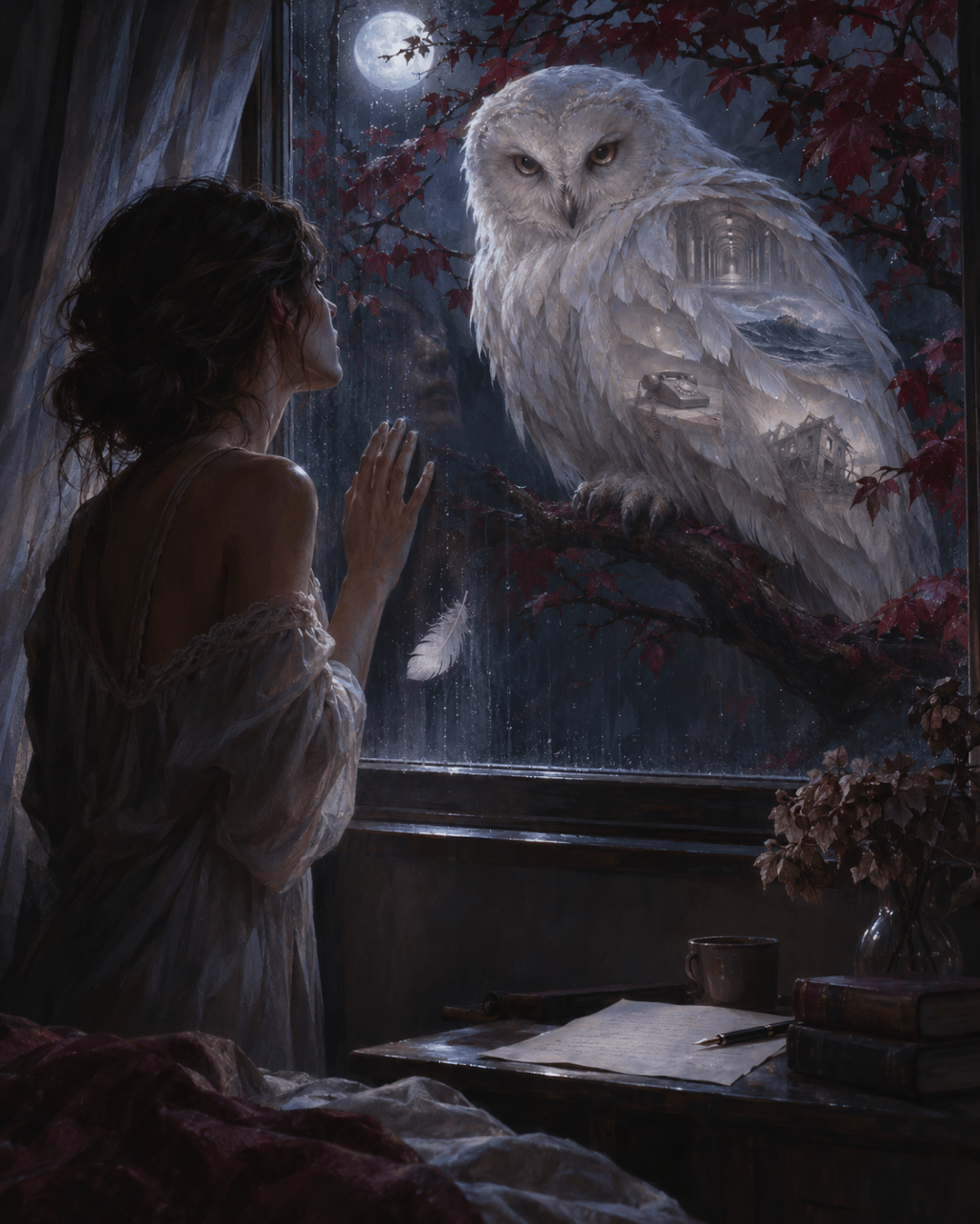
Me levanto. Camino hasta la ventana. Normalmente puedo ver el parque desde mi ventana, y así el paso de las estaciones y la lenta transformación de las hojas. Pero ahora, afuera, la noche tiene esa quietud sospechosa de las cosas que parecen esperar un acontecimiento. El árbol rojo oscuro frente a la casa apenas se mueve. El tiempo parece haberse detenido en algún momento de la noche.
Y la veo. Está posada entre las ramas, inmensa, blanca, con los ojos abiertos. Es la misma de mis pesadillas. La misma que me persiguió por corredores interminables. La que observó mis exilios, mis amores, mis derrotas. La que permaneció inmóvil cuando la depresión me arrebató incluso el deseo de escucharla. ¿Cómo es posible que esté aquí ahora?
Durante años he pensado que aparecía cada vez que algo terrible estaba a punto de suceder. Ahora me pregunto si no habrá sido al revés. Si no habrá gritado cada vez que algo terrible ya estaba sucediendo dentro de mí y yo todavía no encontraba palabras para reconocerlo. La miro.
Ella no aparta los ojos. Nunca lo hace.
—¿Qué quieres de mí? —pregunto.
No responde. Nunca ha respondido como responden los seres humanos.
Extiende las alas.
Mi corazón sigue latiendo. Lo sé porque lo escucho. Estoy a salvo, me digo. Estoy en casa, y ella está afuera. Aunque quisiera, no podría entrar.
Y por un instante veo algo: en cada pluma hay una escena de mi vida. Una niña escondida detrás de una puerta. Una mujer mirando el océano. Una cama donde alguien permanece inmóvil mientras el mundo continúa girando. Un teléfono que no suena. Una casa derrumbándose. Un corazón que sigue latiendo a pesar de todo. Un ave bajo los escombros… No ha venido a mostrarme el futuro; ha venido a devolverme mis gritos. Todos.
La lechuza abre el pico. Espero el grito. Pero esta vez no lo escucho afuera. Entro en pánico. No quiero. No entiendo nada. Siento su voz subir desde el fondo del estómago, atravesar el pecho, rozar las cicatrices que creía cerradas. Es una vibración anterior a los idiomas, anterior incluso a la vergüenza.
La lechuza… mi voz.
Me apoyo contra el cristal. Sigo teniendo miedo. El corazón todavía corre demasiado deprisa. La madrugada no se ha vuelto más amable y mañana tendré que enfrentarme a las mismas incertidumbres que me han mantenido despierta. Ninguna revelación me ha curado. La lechuza tampoco ha venido a prometerlo. Nunca lo hace. Permanece sobre la rama mientras busco una hoja de papel. Escribo una frase. Después otra.
No sé si estoy contando una historia, confesando algo o intentando encontrar una forma de atravesar la noche.
Afuera, el ave cierra lentamente los ojos. Por primera vez comprendo que no necesito hacerla callar. Al contrario. Necesito escuchar qué está intentando decir. Sin embargo, no sé cuál de las dos ha pasado todos estos años encerrada.
Y cuando vuelvo a levantar la mirada, ya no está. Solo queda una pluma blanca adherida al cristal.
Y una pregunta que no me atrevo a responder:
¿Cuántas veces más tendrá que gritar la lechuza por mí?
The times the Owl cried 🦉
The owl cried out again last night. I don’t know what time it was. When I sat up, the clock read seventeen minutes past three, but I had been awake for so long that the early hours had lost their boundaries. I haven’t been sleeping well lately… There was a pressure beneath my breastbone, as though someone had slipped a hand between my ribs and was slowly closing it into a fist. My heart was pounding far too fast. My fingers were cold, the back of my neck was hot, and I had that irrational, absolute certainty that something terrible was about to happen. Nothing happened. That was the worst part.
There was no one behind the door. No news waiting on my phone. Lately, from the moment I open my eyes in the morning, I am afraid something will happen, that the doorbell will ring, that someone will knock. I am frightened. And yet, last night, there was no danger I could point to. Only my body, convinced it was dying, while the rest of the world slept with an offensive indifference.
But then something really did happen: I heard her. A long, harsh shriek, as though someone were dragging a sheet of metal through the inside of a bone. I recognised that ‘voice’. I had heard it before.
The first time, I was a child. Sometimes, terrors arrive before words and settle inside the body like animals finding a burrow. I was running down an endless corridor. The doors kept changing places. Behind me came something enormous and white, with wings that seemed to be made of the very substance of nightmares. I didn’t need to see it to know it was there. I could hear its talons scratching the wood, its deep, luxuriant breathing, that cry piercing the walls and continuing to echo even after I woke. All I did was hide. I always hid. Then I would wake, but never entirely. For years, I believed the owl wanted to devour me, to tear me apart.
In Mexico, I had heard that owls could be witches, women who left their bodies at night to transform themselves into birds. I never knew which frightened me more: that the creature might be a witch, or that beneath its feathers there might be someone far too much like me. What if there was something wrong with me, and that was why it was pursuing me?
Fear learnt to speak before the little girl herself did. In some childhoods, you grow so accustomed to being watched, judged and humiliated that you end up constructing a pursuer inside your own head. An animal that never sleeps, because someone has to anticipate the next blow. The owl cried out when I could not. And her cry chilled me to the bone. I could scarcely bear it.
She cried for the words I swallowed, for the tears I hid, for that shameful need to be loved. She cried when they called me strange, when I felt I was in the way, when I realised I could disappear from a room without anyone noticing I was gone. These are the words of the grown woman, but the little girl knew none of this. She was simply afraid of the owl’s eyes.
She cried out again when I crossed the ocean.
I didn’t hear her among the aircraft’s turbines or above the black waters of the Atlantic. I heard her much later, in a room in a foreign country, when I discovered that I had learnt to say so many things in other languages and yet could not find a single word capable of explaining what was happening to me. I had left behind a country, a home, a version of myself. I thought distance would be enough to free me from everything that had hurt me. How naïve. Memory settles into the folds of clothing, into the smell of certain foods, into a word spoken with the accent of childhood. It can lie waiting for months, motionless, before spreading its wings in the middle of an ordinary conversation.
The owl cried when I realised that I could be a foreigner even within myself. When my accent seemed to matter more than what I knew, and when I had to learn to defend my intelligence in a language that still did not allow me to defend my pain.
She cried for the woman who had found the courage to leave, and for the little girl who was still waiting, on the other side of the ocean, for someone to call her home.
There was a time when she stopped crying. Or so I believed. It was when depression arrived. I cannot remember exactly when it began. There was no defining event, no date I could write on a calendar. Life went on with its obscene normality: emails, shopping, conversations, bills, mornings arriving uninvited.
I, too, went on happening. I got up. I worked. I replied. I smiled when it was expected of me. I had perfected the art of appearing to be someone who was all right. But something had gone out. It wasn’t simply sadness. Sadness still retains some connection to the world: it weeps for someone, misses something, wishes a circumstance would change. This was different. It was a room without windows, where even suffering seemed too exhausted to make itself known. Books remained unopened. Music had lost its colours. Hunger arrived late, or not at all. There were days when taking a shower seemed an overwhelming task, as though the water carried the weight of everything I could not bring myself to do.
And the worst of it was the guilt. What right did I have to feel this way? I had a life. I had survived. I had achieved things that had once seemed impossible. I ought to be grateful. Ought to. Those words were another form of violence.
One night, I looked out of the window and saw a white silhouette perched on the branch of a tree. She did not move. She did not cry. I understood that she, the owl, knew that kind of darkness too. Her cry no longer had the strength to break free.
Then came love. Or something that resembled it so closely that it took me far too long to tell the difference. I will not speak his name. Names are small prisons in which we lock away people who go on living long after they have left our story. What I remember instead is the waiting.
The phone on the table. The screen lighting up for every reason except the one I longed for. The conversations I went over again and again, searching for a sign, an explanation, some proof that I had not imagined it all. Although perhaps I had. There is no proof that anything really happened, except for a white cry that no one could hear.
I remember the private humiliation of waiting for a word. And I remember something worse: discovering that his silence hurt me with an intensity I could scarcely understand. It was not merely the absence of someone I loved. It was the invisible little girl awakening inside the grown woman. It was the fear of not being enough, of being dispensable, of love always finding a reason to leave.
The owl cried that night with a violence I had never known in her. Why not me? Why does something that never existed hurt me so much? I felt the owl tearing me apart from within with her talons, forcing me to scream his name, to spit out every fragment of hope, of longing. But as I have already said, I will not speak his name.
She beat her wings against the panes of my memory. She demolished the explanations I had constructed to protect him, to protect myself. She forced me to confront the most shameful part of my desire: the part that confused being chosen with having worth. I wanted to tear out my heart so I would no longer have to feel it pounding against a door that no one was going to open. But the heart does not obey reason. It digs where a wound has already been and calls what it recognises destiny. How could someone who was merely playing break me like that?
The owl went on crying. Not for him. Sometimes, yes. But for me too. I felt ashamed and furious that I had loved, that I had believed.
She cried again when I returned to my childhood home.
There are places that preserve our age even as we grow older. All it takes is crossing a threshold to be eight years old again, to feel that a single look can reduce us to nothing, to discover that the body remembers hierarchies the conscious mind believed it had overcome. I had returned in search of answers. I found silences, lies and masks.
I went back believing that certain truths, once spoken aloud, might repair something, but I discovered that not everyone wants the truth. Some people need the story to remain intact because they have built their innocence upon it.
The owl cried when I understood that familial love could also demand a kind of disappearance. When I discovered that being needed did not mean being loved. When I had to choose between continuing to hold together what was destroying me and accepting that some forms of belonging are paid for with one’s own identity. That time, her cry did not sound like fear. It sounded like a structure breaking apart from within. I watched the walls fall. The obligations. The loyalties. The image of a family I had defended for years because I needed to believe in it. And among the rubble, I found a feather. I did not know whether it had fallen from her wings or mine. I kept it, without knowing why.
The owl returned when death began to haunt my thoughts. It came without a scythe or any of the solemnity the books attribute to it. It came in the form of questions. Of fragile bodies. Of absences. Of the unbearable awareness that everything we love can disappear without warning. And this time, the owl was not prepared to leave without making me listen.
There were nights when I thought of those who were no longer here. Others when I thought of those who were still alive but had ceased to exist for me. I learnt that there are forms of grief no one acknowledges because there is no corpse. Perhaps that is why they are so much harder to recover from. Because although no one wants to recognise them, something deep in our guts knows that, at some point, what we mourn was real.
You can grieve for a mother who is still breathing. For a love that never quite began. For a childhood that existed, but not in the way you needed it to. For the woman you might have become had you known certain truths sooner.
The owl cried over those invisible graves.
And I, who had spent so many years fearing that she heralded death, began to suspect that perhaps she was announcing something else. The end of a way of living.
Tonight, she has returned. It is twenty-six minutes past four. The anxiety is still lodged in my chest. I have tried breathing slowly, counting the objects in the room, drinking water, convincing my body that there is no predator hiding behind the furniture. But fear does not listen to reason.
The fear is ancient, its roots reaching back through decades. Sometimes it disguises itself as a premonition, sometimes as guilt, sometimes as an inexplicable urgency to resolve something I cannot even name.
I get up. I walk to the window. Usually, I can see the park from here, and with it the passing of the seasons and the slow transformation of the leaves. But now, outside, the night has the suspicious stillness of things that seem to be waiting for something to happen. The dark-red tree in front of the house barely moves. Time seems to have stopped at some point during the night.
And I see her. She is perched among the branches, enormous and white, her eyes wide open. She is the same owl from my nightmares. The same one that pursued me down endless corridors. The one that witnessed my exiles, my loves, my defeats. The one that remained motionless when depression robbed me even of the desire to hear her. How can she possibly be here now?
For years, I have believed she appeared whenever something terrible was about to happen. Now I wonder whether it might have been the other way round. Whether she cried out whenever something terrible was already happening inside me and I had not yet found the words to recognise it. I look at her.
She does not look away. She never does.
‘What do you want from me?’ I ask.
She does not answer. She has never answered the way human beings do.
She spreads her wings.
My heart is still beating. I know because I can hear it. I am safe, I tell myself. I am inside the house, and she is outside. Even if she wanted to, she could not get in.
And for an instant, I see something: in every feather there is a scene from my life. A little girl hiding behind a door. A woman gazing out across the ocean. A bed where someone lies motionless while the world goes on turning. A phone that does not ring. A house collapsing. A heart that keeps beating in spite of everything. A bird beneath the rubble… She has not come to show me the future; she has come to give me back my cries. Every last one.
The owl opens her beak. I wait for the cry. But this time, I do not hear it outside. Panic seizes me. I don’t want this. I don’t understand any of it. I feel her voice rising from the pit of my stomach, passing through my chest, brushing against scars I thought had healed. It is a vibration older than language, older even than shame.
The owl… my voice.
I lean against the glass. I am still afraid. My heart is still racing. The early hours have grown no kinder, and tomorrow I will have to face the same uncertainties that have kept me awake. No revelation has cured me. Nor has the owl come to promise that it would. She never does. She remains on the branch as I look for a sheet of paper. I write one sentence. Then another.
I do not know whether I am telling a story, confessing something or simply trying to find a way through the night.
Outside, the bird slowly closes her eyes. For the first time, I understand that I do not need to silence her. Quite the opposite. I need to listen to what she is trying to tell me. And yet, I do not know which of us has spent all these years locked away.
And when I look up again, she is gone. All that remains is a white feather clinging to the windowpane.
And a question I dare not answer:
How many more times will the owl have to cry out for me?


Deja una respuesta