
🇪🇸 Versión en español abajo ⬇️
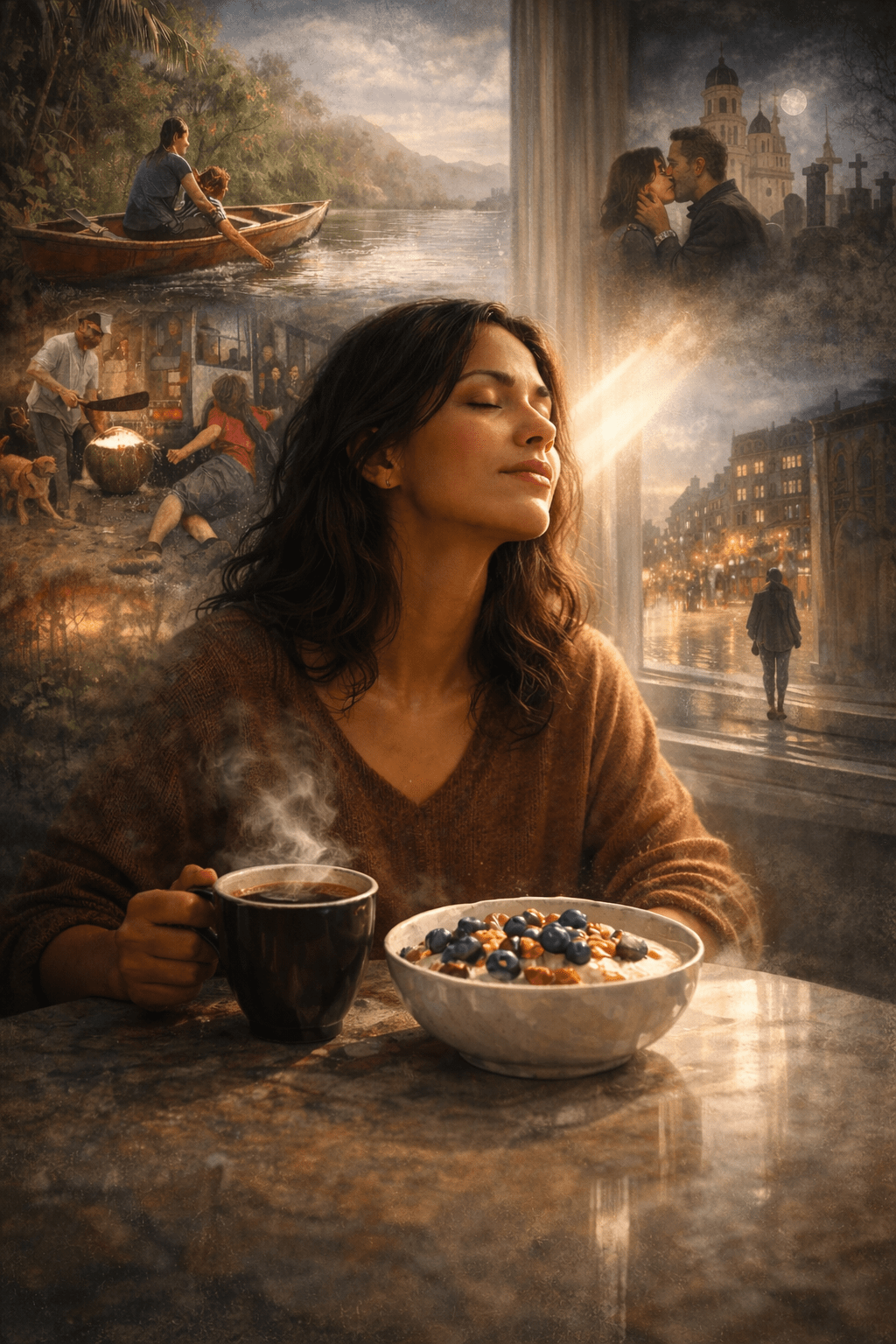
I eat the same breakfast every day: Greek yoghurt, blueberries, honey and cashews.
Black coffee, very black, very hot.
There is something reassuring about repetition, almost ascetic, as if the morning needed that exact order to exist without jolts. I open the fridge, take out the yoghurt, and feel the clean cold of the tub in my palm. I leave it on the counter while I make the coffee. I look out of the kitchen window: it is dark, foggy. Outside, everything is wet; it looks as though it has rained.
I always make the coffee the same way, in the mocca pot. I open the compartment and the smell of ground coffee rises at once: dark, dry, deep, like fine earth waking at the touch of air. I level it with the spoon, precise, almost ceremonial. I close the pot carefully, feeling the firm fit of the metal, that brief, firm seal that marks the true beginning of the morning. The water begins to heat. First, silence. Then a faint, inward murmur. Then the pressure gathering in a contained, intimate sound, like something preparing itself from within.
I like it that way. Black. Very hot. No sugar. No milk. No reprieve. Nothing to soften it. That is how life tastes too, in some months.
And yet sometimes—only sometimes—before closing it completely, I open the little jar of spices I keep at the back of the cupboard. Cloves. Cinnamon. The smell arrives at once: warm, enveloping, dense. That aroma does not belong to this city, nor to these cold walls, nor to this restrained climate. It does not belong to the fog. A pinch is enough for everything to change before the coffee even exists.
Today, there is cinnamon.
The first drip arrives like a minimal signal. Thick. Dark. Slow. The pot breathes in a steady rhythm and the aroma begins to fill the kitchen in layers: first bitter, then roasted, and then that warm note of spice mingling with the steam.
I watch the liquid rise. Black. Dense. Shining.
The final bubbling is low, a soft sound announcing the end of the wait. I pour the coffee and the steam rises straight to my face, intense, enveloping, with a heat that wakes my senses before the first sip.
I always drink it very hot. Almost too hot.
I return to the bowl.
The yoghurt falls with that thick sound that always forces me to slow down. Its white surface remains intact, smooth, silent. Then the blueberries. I let them fall one by one. They tap softly against the bottom: small dark moons on white. Their colour is deep, almost nocturnal, bright beneath the pale morning light. I look at them longer than necessary. The skin taut, firm, cold to the touch. Then the honey: a golden thread that slides down patiently and disappears without a sound. The cashews fall last, irregular, discreet, soft to the touch.
I sit in the same place as always. Though I could choose any other, I do not. I could change corners every day, and who would care, but I do not. The coffee steams to my right. The bowl in front of me.
I take the first sip of coffee. Bitter. Direct. Very hot.
The cinnamon appears afterwards, soft, persistent, like the soot on a ‘comal’ used to make tortillas in a hut at the corner of the yard.
Then I bring the spoon to my mouth. First the cold creaminess of the yoghurt. Then the faint sweetness of the honey. And finally, the blueberry.
It bursts.
It yields to me, and in that instant my memory drops to its knees. It is a soft, intimate surrender. The skin gives way and the inside releases a delicate acidity that spreads along the edges of the tongue with unexpected precision.
Today something is different.
Not in the kitchen.
Not in the routine.
Not in the identical breakfast of every day.
In the taste.
In that dark, acidic sphere that, for an instant, holds five hundred and four moons of memories.
I have read that sometimes a minimal sensation is enough to return the whole past to the body. Proust needed only a madeleine. It is not the food: it is the crack in habit. For me, a blueberry is enough.
Just one.
The taste does not stay in the mouth. It rises, unfolds, invades. And without warning, without transition, the scenes return like a sensory whirlwind the body recognises before the mind.
First, the garden.
Light filtering through large, damp leaves, green in too many shades to name. The air thick, warm, loaded with a vegetal sweetness that clings to the skin. The sun falls in fragments on the earth in shifting patches of light and shadow.
A girl of seven, perhaps eight, plays alone. Always alone. Her fingers run over the broad leaves of the trees, feeling their living texture, cool, slightly rough. Some are warm from the sun; others cold from the shade. She tilts them to see how the light changes as it passes through them, as if the world could bend with a minimal gesture. It smells of guavas and ripe mangoes. Around her there is abundance: green everywhere, invisible insects buzzing, dark earth, fertile, damp.
The tropical garden of Mexico’s Pacific coast throbs with a silent intensity. Everything grows. Everything expands. Everything seems full. And yet the girl plays alone. She speaks softly to herself. She looks towards the house without going in. She prolongs the game with the leaves longer than necessary. She does not know how to name loneliness. She feels it. It is a light, constant presence, like a shadow moving with the light.
The sour taste persists. She no longer knows whether it is blueberries or the tamarinds from the yard of childhood.
And the movement changes.
The sway of a canoe on the river. The smell of salt and warm dampness. The sound of the oar entering and leaving the water in a slow, hollow, hypnotic rhythm. She is sitting opposite her father. Her small hands grip the edge of the wood, warm from the sun, feeling its roughness. Each sway makes the body tense slightly. She is afraid. A quiet, contained fear, lodged in rigid shoulders, measured breathing, in a gaze fixed on the water for too long.
And yet there is something else.
Pride.
Silent pride at being there. At having been taken. At sharing that moment with someone whose attention had always seemed a territory to be conquered. She raises her eyes towards him discreetly. He rows, concentrated, near and far at the same time. She wants to say something. She says nothing.
She settles for balance, for not falling, for being part of that shared instant while the salty smell enters with every breath.
The whirlwind quickens.
The noise.
Metallic.
Abrupt.
Petrol.
Heat.
Asphalt.
Blood.
She is fourteen and the bus is still moving. The door open. The jerk.
Vertigo suspended. And then, the impact.
Hands first. Knees after.
Skin scraping against the rough, hot pavement. Blood mixed with small stones that hurt less than the laughter. The bus keeps moving. Behind her, the laughter: shrill, mocking, persistent. Young voices layered over one another while the heartbeat fills the ears from within.
She remains on the ground a moment longer than necessary. Not because of the pain: because of the disbelief. The heat of the asphalt comes through her clothes. Dust clings to her palms. In her mouth there is a dry, sour, persistent taste.
This time it is not the blueberries.
Then, the rhythmic blow.
The sound of her father’s machete, again, cutting coconuts. Once, twice. Precise. Dry. The warm air steeped in salt and damp earth. The barking of the huge dogs breaks in from the background: deep, insistent, territorial.
The girl watches from a few steps back. Never too close. Fear vibrates low in her stomach. Shoulders tense. Hands searching for something to hold. The machete strikes. The dogs bark. For a moment, the two sounds blur together.
Then the coconut opens.
They hand her one. Cold. Too cold for the heat around her. The wet surface slips between her fingers.
She drinks.
The coconut water enters clear, sweet, ice-cold. The cold crosses her mouth, runs down her throat, spreads through her chest with a comforting slowness. The barking continues. The machete strikes again. But the cold remains.
And for an instant, fear becomes habitable.
There is a dizziness, a swirl of years, and around it the bustle of classes in other languages filters through the corridors: overlapping voices, hard consonants, brief laughter, chairs scraping, pages turning. A constant, functional noise that allows no complete silence.
I press my back against the wall. Cold. Smooth. Impersonal.
My heart beats a little faster than necessary. I do not know whether for the right reasons.
Then another heat. Internal. Electric. Adulthood. A cemetery in the background.
The white headstones, motionless. The air cool, mineral. A soft, inevitable kiss. The contact is warm, sweet, human. A fine surge of adrenaline rises through my chest.
I open my eyes for a second. I speak in Spanish. I should not.
The headstones are still there. Life happens in front of the stillness of time.
A faint, persistent sweetness remains in my mouth, and I leave on the train with a stupid smile on my lips and the feeling of falling into an irredeemable abyss.
The bustle returns. The cold too. The heart beats with too much awareness.
And then, the night. That night.
A European city built among ruins, lying in cold lights across the wet pavement. I walk quickly, desperate to get back somewhere. But home is no longer a concrete place, but a sensation. The air comes in cold, dry, without salt, without tropical humidity. Lit windows. Warm lives inside. And the silent certainty of being far away.
The world falls apart at that moment. Geographically. Linguistically. Emotionally.
My chest is heavy.
A broken heart, not as metaphor, but as a physical sensation.
The spoon is still in my hand. The coffee is still steaming. Black. Very hot. With cinnamon. The bustle continues. The walls are still cold. Nothing outside has changed.
I look towards the window.
The city remains grey, disciplined in its scant light. For months, the sun has been almost a theory. I have always hidden from light out of habit, out of an old bodily discomfort.
But today, a ray enters.
Fine. Discreet. Almost timid.
It slides over the table, the bowl, the coffee steam, until it comes to rest on my face.
I do not move away.
I do not lower my gaze.
I close my eyes.
I know you are there.
The warmth is slight, mild, contained. It does not overwhelm. It barely brushes the skin. The body does not tense. It breathes.
And in my mouth, something still lingers. Not the exact taste, but its trace.
Many months have passed and I still feel the sweetness of the blueberries, crossed by a light, persistent acidity that does not disappear even when the bowl is empty, even as the morning advances, even as life continues with its everyday order.
I understand then that it was not only habit. It was a bodily ritual. A silent way of containing the world.
The cold of the yoghurt.
The bitterness of freshly made coffee in the mocca pot.
The cinnamon that carries my country back to me.
The slight sweetness.
The persistent acidity.
Everything the body had been storing without language: the lush and lonely garden, the river and fearful pride, the asphalt and the laughter, the barking and the ice-cold coconut, the sweet kiss in front of death, the cold walls, the foreign night, the urgency to return. Where to?
Everything compressed. Latent. Waiting for a minimal crack in routine.
I open my eyes.
The light is still on my face. I do not hide from it. I receive it as one receives a familiar taste that no longer hurts, even if it remains.
And I understand, at last, why it was not the coffee, nor the honey, nor the cinnamon that opened memory.
It was the blueberry.
Small. Dark. Sweet and slightly sour. Like memory itself. Like the life that clings to the body.
Since then, even in this city where the sun hardly ever appears, there are mornings when I close my eyes, let the light touch my face, and feel that the taste of blueberries does not live on the tongue, but in everything the body has survived without knowing it was remembering.

El sabor de los arándanos 🫐
Desayuno lo mismo todos los días: yogur griego, arándanos, miel y anacardos.
Café negro, muy negro, muy caliente.
La repetición tiene algo tranquilizador, casi disciplinario, como si la mañana necesitara ese orden exacto para existir sin sobresaltos. Abro la nevera, saco el yogur y siento el frío limpio del envase en la palma. Lo dejo sobre la encimera mientras preparo el café. Miro por la ventana de la cocina: está oscuro, con niebla. Afuera todo está mojado; parece que ha llovido.
El café lo preparo siempre igual, en la cafetera. Abro el compartimento y el olor del café molido asciende de inmediato: oscuro, seco, profundo, como una tierra fina que despierta al contacto con el aire. Lo nivelo con la cuchara, precisa, casi ceremoniosa. Cierro la cafetera con cuidado, sintiendo el ajuste firme del metal, ese encaje breve que marca el inicio real de la mañana. El agua empieza a calentarse. Primero, el silencio. Luego, un murmullo leve, interno. Después, la presión acumulándose en un sonido contenido, íntimo, como algo que se prepara desde dentro.
Me gusta así. Negro. Muy caliente. Sin azúcar. Sin leche. Sin tregua. Sin nada que lo suavice. Así sabe la vida también, algunos meses.
Aunque a veces —solo a veces—, antes de cerrarla del todo, abro el pequeño frasco de especias que guardo al fondo del armario. Clavos. Canela. El olor llega de inmediato: cálido, envolvente, denso. Ese aroma no pertenece a esta ciudad, ni a estos muros fríos, ni a este clima contenido. No pertenece a la niebla. Basta una pizca para que todo cambie antes incluso de que el café exista.
Hoy hay canela.
El primer goteo llega como una señal mínima. Espeso. Oscuro. Lento. La cafetera respira con un ritmo constante y el aroma empieza a llenar la cocina por capas: primero amargo, luego tostado, y después esa nota cálida de la especia mezclándose con el vapor.
Observo el líquido ascender. Negro. Denso. Brillante.
El burbujeo final es bajo, un sonido suave que anuncia el fin de la espera. Sirvo el café y el vapor sube directo al rostro, intenso, envolvente, con una temperatura que despierta mis sentidos antes del primer sorbo.
Siempre lo bebo muy caliente. Casi demasiado.
Vuelvo al cuenco.
El yogur cae con ese sonido espeso que siempre me obliga a bajar la velocidad. Su superficie blanca queda intacta, lisa, silenciosa. Luego los arándanos. Los dejo caer uno a uno. Golpean suavemente el fondo: pequeñas lunas oscuras sobre el blanco. Su color es profundo, casi nocturno, brillante bajo la luz pálida de la mañana. Los observo más de lo necesario. La piel tersa, firme, fría al tacto. Después la miel: un hilo dorado que se desliza con paciencia y desaparece sin ruido. Los anacardos caen al final, irregulares, discretos, suaves al contacto.
Me siento en el mismo sitio de siempre. Aunque podría elegir cualquier otro, no lo hago. Podría cambiar de rincón cada día, y a quién le importaría, pero no lo hago. El café humea a mi derecha. El cuenco frente a mí.
Tomo el primer sorbo de café. Amargo. Directo. Muy caliente.
La canela aparece después, suave, persistente, como el tizne en un comal para hacer tortillas en una choza en la esquina del patio.
Luego llevo la cuchara a la boca. Primero la cremosidad fría del yogur. Después la dulzura tenue de la miel. Y finalmente, el arándano.
Se rompe.
Se rinde ante mí, y en ese instante mi memoria cae de rodillas. Es una rendición suave, íntima. La piel cede y el interior libera una acidez delicada que se expande por los bordes de la lengua con una precisión inesperada.
Hoy algo es distinto.
No en la cocina.
No en la rutina.
No en el desayuno idéntico de todos los días.
En el sabor.
En esa esfera ácida y oscura que, por un instante, contiene quinientas cuatro lunas de recuerdos.
He leído que a veces basta una sensación mínima para devolver el pasado entero al cuerpo. A Proust le bastó una magdalena. No es el alimento: es la grieta en la costumbre. A mí me basta un arándano.
Uno solo.
El sabor no se queda en la boca. Asciende, se despliega, invade. Y sin aviso, sin transición, las escenas regresan como un torbellino sensorial que el cuerpo reconoce antes que la mente.
Primero, el jardín.
Luz filtrándose entre hojas grandes, húmedas, verdes en demasiados tonos para nombrarlos. El aire espeso, tibio, cargado de un olor vegetal y dulce que se adhiere a la piel. El sol cae fragmentado sobre la tierra en manchas móviles de luz y sombra.
Una niña de siete, quizá ocho años, juega sola. Siempre sola. Sus dedos recorren las hojas anchas de los árboles, sintiendo la textura viva, fresca, ligeramente rugosa. Algunas están calientes por el sol; otras, frías por la sombra. Las inclina para ver cómo cambia la luz al atravesarlas, como si el mundo pudiera doblarse con un gesto mínimo. Huele a guayabas y mangos maduros. A su alrededor hay abundancia: verde por todas partes, insectos invisibles zumbando, tierra oscura, fértil, húmeda.
El jardín tropical del Pacífico mexicano late con una intensidad silenciosa. Todo crece. Todo se expande. Todo parece lleno. Y, sin embargo, la niña juega sola. Habla en voz baja consigo misma. Mira hacia la casa sin entrar. Prolonga el juego con las hojas más de lo necesario. No sabe nombrar la soledad. La siente. Es una presencia leve, constante, como una sombra que se mueve con la luz.
El sabor ácido persiste. Ya no sabe si son los arándanos o los tamarindos del patio de la infancia.
Y el movimiento cambia.
El vaivén de una canoa sobre el río. El olor a sal y humedad tibia. El sonido del remo entrando y saliendo del agua con un ritmo pausado, hueco, hipnótico. Está sentada frente a su padre. Sus manos pequeñas se aferran al borde de la madera caliente por el sol, sintiendo la rugosidad. Cada balanceo hace que el cuerpo se tense apenas. Tiene miedo. Un miedo quieto, contenido, instalado en los hombros rígidos, en la respiración medida, en la mirada fija sobre el agua demasiado tiempo.
Y, sin embargo, hay algo más.
Orgullo.
Orgullo silencioso de estar allí. De haber sido llevada. De compartir ese momento con alguien cuya atención siempre parecía un territorio por conquistar. Levanta la mirada hacia él con discreción. Él rema, concentrado, cercano y lejano al mismo tiempo. Quiere decir algo. No dice nada.
Se conforma con el equilibrio, con no caerse, con ser parte de ese instante compartido mientras el olor salino entra con cada respiración.
El torbellino se acelera.
El ruido.
Metálico.
Brusco.
Gasolina.
Calor.
Asfalto.
Sangre.
Tiene catorce años y el autobús aún está en movimiento. La puerta abierta. El tirón.
El vértigo suspendido. Y después, el impacto.
Las manos primero. Las rodillas después.
La piel raspando contra el pavimento áspero y caliente. La sangre mezclada con pequeñas piedras que lastiman menos que las risas. El autobús sigue avanzando. Detrás, las carcajadas: agudas, burlescas, persistentes. Voces jóvenes superpuestas mientras el latido llena los oídos desde dentro.
Permanece en el suelo un instante más de lo necesario. No por el dolor: por la incredulidad. El calor del asfalto atraviesa la ropa. El polvo se pega a las palmas. En la boca queda un sabor seco, ácido, persistente.
Esta vez no son los arándanos.
Luego, el golpe rítmico.
El sonido del machete de su padre, otra vez, cortando cocos. Una, dos veces. Preciso. Seco. El aire cálido impregnado de sal y tierra húmeda. Los ladridos de los perros enormes irrumpen al fondo: graves, insistentes, territoriales.
La niña observa desde unos pasos atrás. Nunca demasiado cerca. El miedo vibra bajo en el estómago. Los hombros tensos. Las manos buscando algo que sostener. El machete golpea. Los perros ladran. Por un momento, ambos sonidos se confunden.
Luego el coco se abre.
Le entregan uno. Frío. Demasiado frío para el calor que lo rodea. La superficie húmeda resbala entre sus dedos.
Bebe.
El agua de coco entra clara, dulce, helada. El frío atraviesa la boca, baja por la garganta, se expande por el pecho con una lentitud reconfortante. Los ladridos siguen. El machete golpea otra vez. Pero el frío permanece.
Y por un instante, el miedo se vuelve habitable.
Hay un mareo, un remolino de años, y alrededor el bullicio de las clases en otros idiomas se filtra por los pasillos: voces superpuestas, consonantes duras, risas breves, sillas arrastrándose, páginas pasando. Un ruido constante, funcional, que no permite silencio completo.
Apoyo la espalda en el muro. Frío. Liso. Impersonal.
El corazón late un poco más rápido de lo necesario. No sé si por las razones correctas.
Después, otro calor. Interno. Eléctrico. Edad adulta. Un cementerio al fondo.
Las lápidas blancas, inmóviles. El aire fresco, mineral. Un beso suave, inevitable. El contacto es cálido, dulce, humano. Una adrenalina fina sube por el pecho.
Abro los ojos un segundo. Hablo en español. No debería.
Las lápidas siguen allí. La vida ocurre frente a la quietud del tiempo.
En la boca queda una dulzura tenue, persistente, y me voy en el tren con una estúpida sonrisa en los labios y la sensación de estar cayendo en un abismo irremediablemente.
El bullicio regresa. El frío también. El corazón late con demasiada conciencia.
Y luego, la noche. Esa noche.
Una ciudad europea levantada entre ruinas, tendida en luces frías sobre el pavimento húmedo. Camino rápido, desesperada por regresar a algún lado. Pero casa ya no es un lugar concreto, sino una sensación. El aire entra frío, seco, sin sal, sin humedad tropical. Ventanas iluminadas. Vidas cálidas dentro. Y la certeza silenciosa de estar lejos.
El mundo se cae en ese momento. Geográfica. Lingüística. Emocionalmente.
El pecho pesa.
Un corazón roto, no como metáfora, sino como sensación física.
La cuchara sigue en mi mano. El café aún humea. Negro. Muy caliente. Con canela. El bullicio continúa. Los muros siguen fríos. Nada afuera ha cambiado.
Miro hacia la ventana.
La ciudad permanece gris, disciplinada en su luz escasa. Durante meses, el sol ha sido casi una teoría. Siempre me he ocultado de la luz por hábito, por una incomodidad antigua, corporal.
Pero hoy, un rayo entra.
Fino. Discreto. Casi tímido.
Se desliza sobre la mesa, el cuenco, el vapor del café, hasta detenerse en mi rostro.
No me aparto.
No bajo la mirada.
Cierro los ojos.
Sé que estás ahí.
El calor es leve, tibio, contenido. No abruma. Apenas roza la piel. El cuerpo no se tensa. Respira.
Y en la boca, aún persiste algo. No el sabor exacto, sino su huella.
Han pasado muchos meses y sigo sintiendo la dulzura de los arándanos, atravesada por una acidez ligera, persistente, que no desaparece aunque el cuenco esté vacío, aunque la mañana avance, aunque la vida continúe con su orden cotidiano.
Comprendo entonces que no era solo costumbre. Era un ritual corporal. Una forma silenciosa de contener el mundo.
El frío del yogur.
El amargor del café recién hecho en la cafetera.
La canela que recuerda a mi país.
La dulzura leve.
La acidez persistente.
Todo lo que el cuerpo fue guardando sin lenguaje: el jardín exuberante y solitario, el río y el orgullo temeroso, el asfalto y las risas, los ladridos y el coco helado, el beso dulce frente a la muerte, los muros fríos, la noche extranjera, la urgencia de volver. ¿A dónde?
Todo comprimido. Latente. Esperando una grieta mínima en la rutina.
Abro los ojos.
La luz sigue sobre mi rostro. No me oculto. La recibo como se recibe un sabor familiar que ya no hiere, aunque permanezca.
Y entiendo, por fin, por qué no fue el café, ni la miel, ni la canela lo que abrió la memoria.
Fue el arándano.
Pequeño. Oscuro. Dulce y ligeramente ácido. Como la memoria misma. Como la vida que se queda adherida al cuerpo.
Desde entonces, incluso en esta ciudad donde el sol casi nunca aparece, hay mañanas en las que cierro los ojos, dejo que la luz toque mi cara, y siento que el sabor de los arándanos no vive en la lengua, sino en todo lo que el cuerpo ha sobrevivido sin saber que lo estaba recordando.
 Trilingual Blog
Deja un comentario