
English version below

Siete años viviendo en el centro de Europa y Amalia nunca había concretado esta visita. No fue sino hasta la primavera de 2025 cuando estaba de pie frente al estanque de Monet en Giverny. El jardín parecía disolverse en una sinfonía húmeda de luz y silencio. Las glicinas colgaban como lágrimas lilas, balanceándose en el aire tibio, tan cerca del agua que sus reflejos parecían tocar la superficie. Los sauces lloraban sobre el estanque con sus cabellos de mil matices, ondulantes, en duelo. Se asomaban al agua, pesados, casi humanos. En ese espejo quebrado de nenúfares y ramas, cuando Amalia cruzó el puente de madera pintado de verde, su garganta se cerró como una trampa. No podía respirar. El aire se volvió denso, una presión invisible en el pecho. Primero sintió el zumbido; luego, el calor que ascendía por su cuerpo. Las glicinas se desenfocaban, convirtiéndose en una mancha de pintura fresca y borrosa. Los sauces parecían inclinarse hacia ella… demasiado vivos, demasiado cerca.
A comienzos de los noventa, en Las Jarretaderas, el agua lo era todo: el río, la laguna, los canales y el mar que siempre se oía, aunque no se viera. El pueblo olía a humedad dulce y a sal vieja y las tardes tenían el color del óxido suave. Así era la vida en el Pacífico mexicano. Amalia tenía ocho años y era la menor de cinco hermanos. Nació cuando los demás ya se habían casado. Jugaba con sus sobrinos, aunque sentía que vivía entre generaciones que no le pertenecían. Aprendió a escuchar, a mirar desde la sombra de los aleros, a imaginar más de lo que hablaba.
Cada fin de semana, sus padres los llevaban al río Ameca. Era un ritual: el padre pescaba en su canoa, la madre encendía el anafre, las tortillas se calentaban envueltas en trapos y los niños corrían descalzos por la arena. Después de comer, como mandato, había que cruzar el río. Todos. Para Amalia, era un suplicio. Siempre caminaba más atrás. Siempre le costaba. Y a nadie parecía importarle. El río era familiar para todos, menos para ella.
Pero no era solo el río. Era lo que vivía debajo. Lo que se movía sin cuerpo, sin nombre. Ella lo sentía con una certeza que le hacía temblar los dedos: había algo que esperaba ser tocado. No eran peces. Era otra cosa: la fobia líquida a lo blando que flota, el terror del tacto vegetal sumergido, una aversión visceral a esas cosas largas, frías, que uno no ve, pero que rozan los tobillos. También le aterraban los perros de agua, aunque nunca los hubiera visto. Nadie sabía si eran reales o no, y eso era peor. Para ella, eran cuerpos cubiertos de un pelaje oscuro, largo, siempre mojado, que flotaba en el agua como una mancha estirada. Imaginaba su pelo flotando a la deriva, suave, tibio, como algas vivas. Sentía que podían tocarla o enredarse en sus piernas sin que nadie más lo notara. No le temía a los dientes; le aterraba el tacto: el pelo mojado deslizándose por su piel, pegándose a ella como una sombra.
Pero lo que más temía no eran los perros de agua. Había algo peor, más mustio, más lánguido, más anhelante y viscoso: las ramas sumergidas del sauce. Flanqueaban el Ameca con sus brazos rendidos, hundiéndose en el agua como si buscaran algo perdido. Habitaban en el umbral entre las arenas secas y el río. Sus hojas finas y largas tenían un color entre el jade y la ceniza, y en ciertas horas del día se volvían translúcidas, como piel mojada. Cuando la niña miraba su reflejo en el agua, no solo veía su cara: veía las ramas danzando debajo, con ese movimiento lento, arrastrado, como si tuvieran una vida secreta bajo la superficie.
Le parecían cabellos vivos, flotando a la espera de enredarse. Eso la aterraba. Sentía un cosquilleo en los brazos cuando los miraba, una electricidad vegetal en la lengua. Soñaba con ellos: ramas que le envolvían las piernas, trepaban por su cuello, se hundían en su boca como si quisieran beberla. Nadie la escuchaba. Nadie le creía. Al fin y al cabo, Amalia siempre había tenido demasiada imaginación, y esa era la consecuencia. A veces, sus sobrinos jugaban a asustarla, diciéndole que los perros de agua vivían justo ahí, bajo los sauces. Y aunque fingía no creerles, sabía que no era del todo mentira.
Una tarde cruzaron el río después de comer. El agua estaba más calma de lo habitual, más cálida, pero revuelta en el fondo. La familia iba delante, entre risas, con los pantalones remangados y el lodo subiéndoles por los tobillos. Amalia caminaba atrás, como siempre, con la mirada baja. Desde la orilla, las ramas de los sauces colgaban como brazos vencidos, y se mecían lentamente, arrastrando los dedos sobre la superficie.
Amalia dio un paso en falso y la arena la traicionó. Cayó justo en el umbral: donde la arena aún huele a manglar y el agua ya arrastra sombra. Cayó donde las ramas del sauce rozaban el río. No gritó. El agua se le metió por la nariz. Entonces lo sintió. No supo si era raíz, rama o animal. Solo que algo se movía bajo el agua. No era solo una rama: era una maraña vegetal, viva. Despierta. Se le pegó al cuello, al pecho, a la espalda. Otra se le enredó en la pierna. Y luego más. El sauce lloraba. No con agua; con ella. Estaba envuelta.
Fue como caer en un cuerpo: blanduzco, ondulante, agitado y rencoroso. Las ramas estaban ahí, flotando y enredándose como cabellos vivos, engulléndola. Ya no eran ramas. Eran tentáculos vegetales. Una trampa que no apretaba; solo envolvía, y lo hacía con dulzura.
Aún nadie escuchaba.
Quiso salir, pero el sauce —o lo que fuera— la sostuvo. El agua, que no era honda, se sentía profunda como un pozo. Todo sonaba lejano. No podía respirar. No podía moverse. El sauce la lloraba. Un llanto sin sonido, denso, pegajoso. Lo que tocaba su piel no era agua, ni planta, ni sombra: era el recuerdo hecho cuerpo. Un regreso al útero, al abrazo de la madre devoradora. Al enredo sin salida. ¿Cuántas almas de ancianas y brujas lloran a través del sauce?
Cuando por fin la levantaron, temblaba como un trapo escurrido. No dijo nada. Esa noche soñó con un sauce inclinado sobre ella, como una anciana ciega de brazos interminables y cabello líquido, murmurando sin boca desde el fondo del agua. Al despertar, le dolía todo el cuerpo, como si el río la hubiera abrazado con fuerza lenta, lo justo para no quebrarla.
Tangles
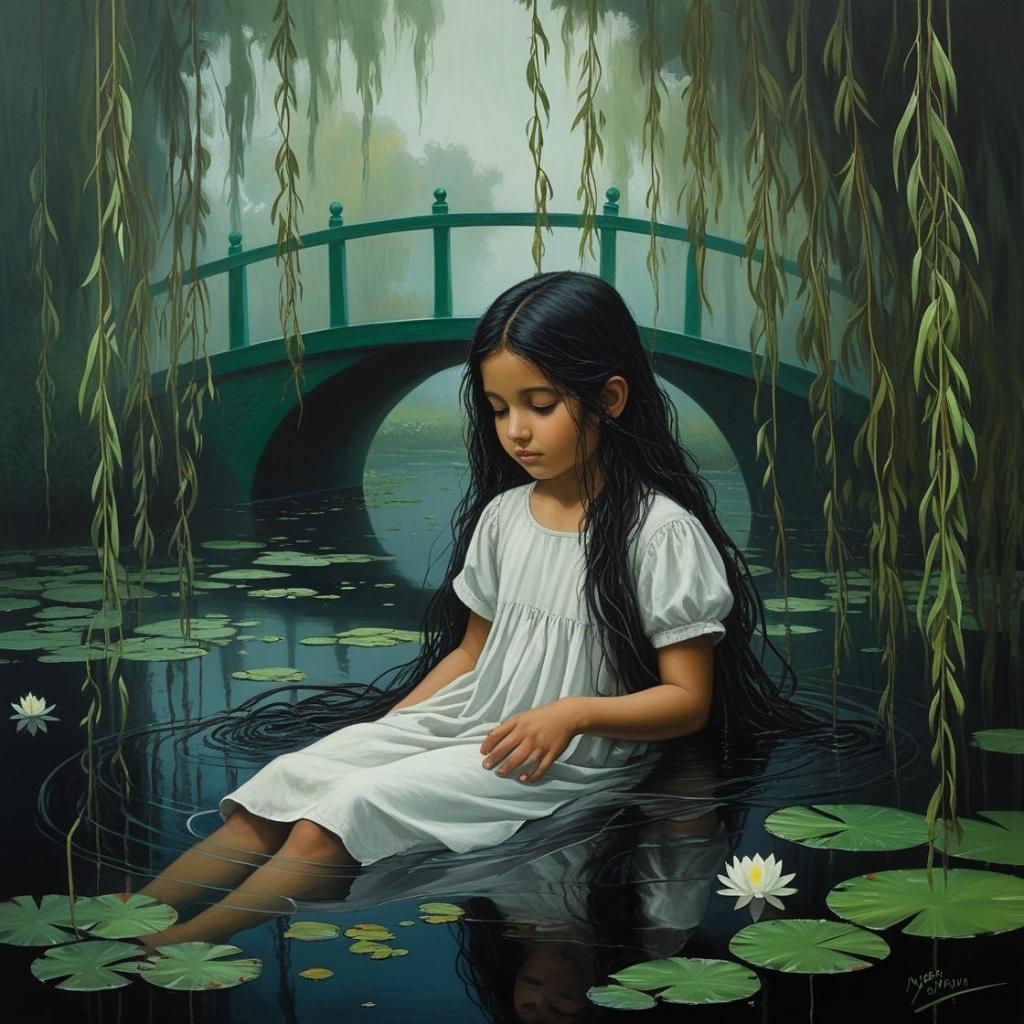
Seven years living in the heart of Europe, and Amalia had never managed to make this visit happen. It wasn’t until the spring of 2025 that she found herself standing before Monet’s pond in Giverny. The garden seemed to dissolve into a wet symphony of light and silence. The wisteria hung like lilac tears, swaying in the warm air, so close to the water that their reflections appeared to touch the surface. The weeping willows draped themselves over the pond, their hair of a thousand shades flowing, mourning. They leaned toward the water, heavy, almost human. In that fractured mirror of lily pads and branches, as Amalia crossed the green-painted wooden bridge her throat closed like a trap. She couldn’t breathe. The air thickened, an invisible pressure against her chest. First came the buzzing; then, the heat rising through her body. The wisteria blurred, becoming a smear of fresh, hazy paint. The willows seemed to lean closer to her… too alive, too near.
In the early nineties, in Las Jarretaderas, water was everything: the river, the lagoon, the canals, and the sea that could always be heard, even if not seen. The village smelled of sweet damp and aged salt, and the afternoons bore the colour of soft rust. That was life on the Mexican Pacific. Amalia was eight years old and the youngest of five siblings. She had been born when the others were already married. She played with her nieces and nephews, though she felt as though she lived among generations that did not belong to her. She learned to listen, to watch from the shade of the eaves, to imagine more than she spoke.
Every weekend, her parents took them to the Ameca River. It was a ritual: the father fished from his canoe, the mother lit the brazier, tortillas warmed inside cloths, and the children ran barefoot through the sand. After eating, as a rule, they had to cross the river. All of them. For Amalia, it was torture. She always walked at the back. Always struggled. And no one seemed to care. The river was familiar to everyone—except her.
But it wasn’t just the river. It was what lived beneath. What moved without body, without name. She felt it with a certainty that made her fingers tremble: something was waiting to be touched. Not fish. Something else: a liquid phobia of the soft things that float, the terror of contact with submerged vegetable matter, a visceral aversion to those long, cold things one cannot see, but that brush against one’s ankles. She was also terrified of water dogs, even though she’d never seen one. No one knew if they were real or not, which made it worse. To her, they were bodies covered in dark, long, ever-wet fur, floating in the water like a stretched stain. She imagined their fur drifting aimlessly, soft, warm, like living seaweed. She felt they might touch her or tangle around her legs without anyone else noticing. She didn’t fear their teeth; it was their touch that frightened her: the wet fur gliding over her skin, sticking to her like a shadow.
But what she feared most wasn’t the water dogs. There was something worse, more wilted, more languid, more yearning and viscous: the submerged willow branches. They flanked the Ameca with their surrendered arms, sinking into the water as if searching for something lost. They lived on the threshold between dry sand and river. Their thin, long leaves were the colour of jade and ash, and at certain times of day turned translucent, like wet skin. When the girl looked at her reflection in the water, she didn’t just see her face: she saw the branches dancing below, with that slow, dragging motion, as if they had a secret life beneath the surface.
They looked like living hair, floating and waiting to tangle. That terrified her. She felt a tingling in her arms when she looked at them, a vegetable electricity on her tongue. She dreamt of them: branches wrapping around her legs, climbing her neck, sinking into her mouth as if they wanted to drink her. No one listened. No one believed her. After all, Amalia had always had too much imagination, and that was the consequence. Sometimes, her nephews played at scaring her, telling her the water dogs lived right there, beneath the willows. And although she pretended not to believe them, she knew it wasn’t entirely a lie.
One afternoon, they crossed the river after lunch. The water was calmer than usual, warmer, but stirred up below. The family walked ahead, laughing, trouser legs rolled up, mud climbing their ankles. Amalia walked at the back, as always, eyes downcast. From the bank, the willow branches hung like defeated arms, slowly swaying, dragging their fingers across the surface.
Amalia took a wrong step and the sand betrayed her. She fell right on the threshold: where the sand still smells of mangrove and the water already drags shadow. She fell where the willow branches brushed the river. She didn’t scream. Water rushed up her nose. Then she felt it. She didn’t know if it was root, branch, or animal. Only that something moved beneath the water. It wasn’t just a branch: it was a living tangle of vegetation. Awake. It clung to her neck, her chest, her back. Another wrapped around her leg. And then more. The willow was weeping. Not with water; with her. She was enveloped.
It was like falling into a body: soft, undulating, restless and resentful. The branches were there, floating and tangling like living hair, swallowing her. They were no longer branches. They were tentacles of vegetation. A trap that didn’t tighten; it merely wrapped—and did so gently.
Still no one heard.
She tried to get out, but the willow—or whatever it was—held her. The water, though shallow, felt deep as a well. Everything sounded distant. She couldn’t breathe. She couldn’t move. The willow wept for her. A soundless cry, dense, sticky. What touched her skin was neither water, nor plant, nor shadow: it was memory given flesh. A return to the womb, to the embrace of the devouring mother. To the tangle with no escape. How many souls of old women and witches weep through the willow?
When they finally pulled her up, she trembled like a wrung-out rag. She said nothing. That night she dreamt of a willow bent over her, like a blind old woman with endless arms and liquid hair, murmuring without a mouth from the bottom of the water. When she awoke, her whole body ached, as if the river had embraced her with slow strength—just enough not to break her.
 Trilingual Blog
Deja un comentario