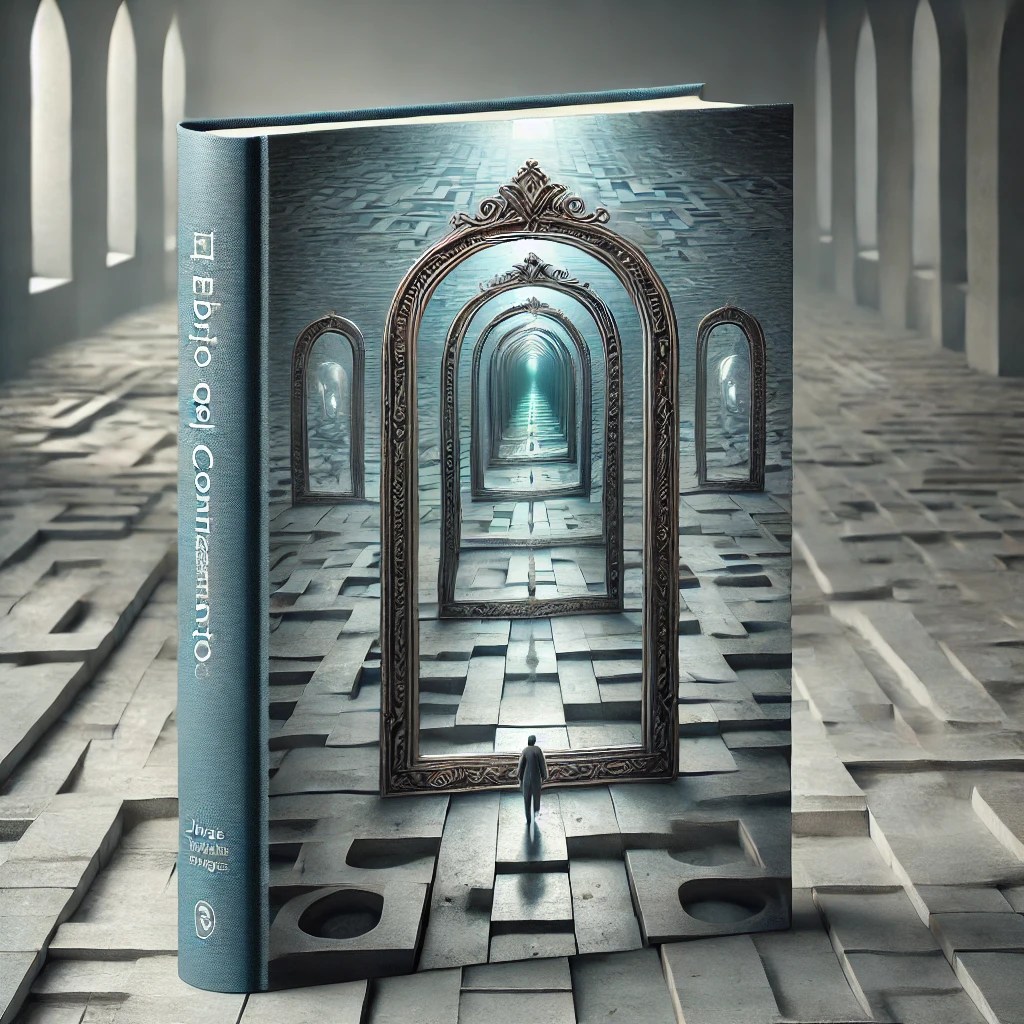

Review of a Fictional Book
Posthumously published in 2021, The Mirror of Confinement emerges as an extraordinary addition to the oeuvre of Argentine author Jorge Luis Borges. In an ironic twist, the master of metaphysical labyrinths and temporal paradoxes seems to have anticipated themes of isolation, depersonalisation, and loss of meaning that humanity experienced during the recent pandemic. This brief but intense collection of stories not only adds an enigmatic dimension to his work but, in many ways, feels as though it was written for the contemporary reader, trapped in a time eerily similar to the mental labyrinths Borges so often explored. It is speculated that this unpublished work was dictated to María Kodama, his last wife, who reportedly safeguarded the manuscript for decades.
The central story, titled “The Mirrors of Solitude,” narrates the tale of a man who, in the context of a confinement he cannot fully understand, begins to experience fragmentations of his own reality. Day after day, he discovers that his reflection in the mirror becomes a stranger—a figure that observes him without emotion and, over time, no longer even seems to recognise him. In his captivity, the protagonist—who might be a version of Borges himself—discovers a parallel universe: the mirror becomes a gateway to other versions of himself, in worlds where his life has taken different turns. Borges employs this device, reminiscent of his story The Aleph, to explore how confinement forces us to confront the infinite versions of who we are and who we might have been.
The Mirror of Confinement delves into a series of universes where the pandemic has been avoided or has never existed, creating a kind of Borgesian multiverse that blurs the line between reality and illusion. In one of the most memorable tales, “The Archive of the Confined,” Borges presents a library containing countless records of truncated lives, halted at some point in their development. Each record is marked by a particular detail: the last unsent letter, the word left unspoken, the love never confessed. In this archive, the “confined” are those who, deprived of freedom of movement, remain trapped in incomplete versions of themselves, condemned to wander among shelves where others like them repeat their own stories of loss and waiting.
A recurring theme in the book is humanity’s relationship with time, distorted by solitude and repetition. Borges asks here, through his characters, whether confinement is not in itself a metaphor for the human condition, compelled to inhabit a limited time and space while vaguely sensing the existence of other possibilities. The story “The Transparent Walls” addresses this idea by presenting a man who lives in an invisible cell, whose walls only he can perceive, as he watches others live in apparent freedom. With this tale, Borges elevates the experience of isolation to an almost Kafkaesque level of abstraction, where the limiting walls are both real and self-imposed.
The structure of the stories maintains Borges’s classic style: austere and dense prose, sentences laden with multiple meanings, and an elegance that paradoxically reads with the ease of the everyday. However, in this book, Borges seems to offer something unusually sombre. Unlike his earlier works, where mental games left a glimmer of fascination and surprise, here we find a more melancholic, almost resigned tone. The versions of reality he explores feel less like doors to intellectual curiosity and more like mirrors of our own limitations, reminding us that human freedom is always confined within its own visible or invisible boundaries.
The Mirror of Confinement does not abandon Borges’s characteristic irony. In one of the final stories, “The Confinement of Philosophers,” the author imagines a scenario in which the great thinkers of history are gathered in a single room to debate the meaning of confinement. He evokes figures such as Woodrow Wilson, Arthur Newsholme, Albert Einstein, and Rosa Luxemburg, participating in debates that resonate with our times. The arguments grow progressively more absurd and contradictory, until the discussion itself becomes a kind of vicious circle in which they are all trapped. This story, which could be interpreted as a parody of humanity’s tendency to rationalise the irrational, offers a subtle yet sharp critique: in times of crisis, logical thought becomes a labyrinth with no exit. In this final work, Borges acknowledges Michel Foucault by directly evoking what the French philosopher termed the “literature of confinement.” Inspired by this Foucauldian idea, Borges explores in his ultimate legacy how isolation reveals multiple inner realities and dimensions of identity trapped within mental and physical labyrinths.
Although it was conceived just before his death in 1986, Borges achieves a haunting resonance with recent reality in this book. At a time when physical confinement became a global reality, this collection seems to offer a metaphysical map of solitude and the psychological impact of the pandemic. In a kind of literary prophecy, Borges reminds us that isolation is not merely an imposed condition but an inherent aspect of human existence—a labyrinth within.
The Mirror of Confinement is an essential book for the present moment: a sharp meditation on collective loneliness and disorientation. Borges anticipates with remarkable clarity the crisis of confinement and the psychological impact of a time when reality fractures into contradictory versions. Ultimately, the work is a painful yet fascinating reflection of our era, confronting us with the fragility and mystery of our existence.
 Trilingual Blog
Deja un comentario